
Patron/Executive Editor
Dr. Muhammad Akram Shaikh
Director General, PASTIC
Managing Editors
Ms. Nageen Ainuddin
Mr. M. Aqil Khan
Editor
Dr. Saima Tanveer
Composer
Fasih ul Islam
&
Kashif Farooqui
T
ECHNOLOGY
R
OUNDUP
Technology Information Section (TIS)
Pakistan Scientific & Technological Information Centre
PASTIC
July-August, 2013
Vol. 5, No. 4
A NEWS BULLETIN FROM
Tech News Headlines
Tech & Trade Offers
Phone: 051-9248103-4, 9248111
Fax: 051-9248113
Email:editor@pastic.gov.pk
Web: www.pastic.gov.pk
PASTIC National Centre
Quaid-i-Azam University Campus
P.O. Box 1217, Islamabad
Editorial Board
l
Characteristics Assessment of Cooking Oil and Vanaspati Ghee
l Design of a Cost Efficient PV Parameter Monitoring System
Soft Drinks Linked to Behavioral Problems in Young Children
l Slow Earthquakes May Foretell Larger Events
l New Possibilities for Efficient Biofuel Production
l Computer Chip Based on Human Brain Developed
l
New Technology
in Sewing Machines
Golden Wheel
CSL-1810
Forthcoming Tech Events
l Technology for Flora Industry
l International Coal Conference
l International Conference on Information & Communication
Technologies
l International Conference on Agricultural, Biotechnology, Biological
and Biosystems Engineering
l International Conference on Bioinformatics, Computational
Biology and Biomedical Engineering
l International Conference on Mathematical,Computational and
Statistical Sciences,and Engineering
l Health Systems in Asia: Equality, Governance and Social Impact
Conference

Technology Roundup
Indigenous
Technology
Characteristics Assessment of Cooking Oil and Vanaspati Ghee
Vegetables oils are derived from plant sources like soybeans, palm, corn, melon, groundnut, sheabutter, cocnut,
etc. Some of these vegetable oils are used for domestic (edible) and industrial purpose (oleo chemicals). Many
oilseed crops are grown in Pakistan as a source of vegetable oil. These crops are ground in two categories viz.
conventional and non-conventional oilseed crops. Rapeseed-mustard, groundnut and sesame are conventional
crops and are being grown in the country for a long period. Sunflower, soybean and safflower are non-conventional
crops. There are also some oilseed crops, which are mainly used for industrial purposes, such as linseed and castor.
The quality of fats plays very important role in food processing technology. Oxidation of fat is the main reason of
deterioration in the quality of foods and can directly affect many quality characteristics such as flavour, colour,
texture, nutritive value, and safety of the food. The quality and dietary character of the edible oil have been a topic
of concern among food scientists, nutritionists and consumers. Lipids provide a concentrated source of energy and
essential fatty acids through dietary intake. They also serve as important constituents of cell walls and carrier of
fat-soluble vitamins. In addition, lipids provide flavour, texture and mouth feel to the food. Vegetable oils, made
up of lipids, are very common commodities in our daily life. A variety of fats and oils are widely available for
consumption in the form of cooking oil, health products and food ingredients, as well as for the manufacture of
cosmetics, soap and surfactants.
Vanaspati are manufactured by hydrogenation of vegetable oils, during which a reduction in the unsaturation of
oils and an increase in the isomerization at the double bonds take place. The trans isomers thus formed affect the
physical and chemical properties of the final products as they have higher melting points and greater stability.
Edible fats and oils represent one of the primary constituents in the formulation and manufacture of products by
the food industry. Extracted oils from wide range of different sources undergo supplemental transformations such
as fractionation, hydrogenation, and interesterification prior to utilization for the diet. During processing, a
variety of physico-chemical quality parameters of oil are monitored, including the determination of free fatty
acids, moisture, peroxide value, iodine value, and saponification number to name just a few. There is strong
evidence that rise in per capita income is related to an increase in cooking oil and vanaspati ghee consumption.
These products are essential food items for human utilization. In this scenario there is a need to periodically
monitor quality of cooking oils and vanaspati ghee sale at various stores and outlets in the country.
The research therefore, discusses the impact of processing and storage on quality of cooking oil and vanaspati ghee
as reflected by change in important physical and chemical parameters. Various physico-chemical characteristics
of commercial cooking oil and vanaspati ghee of different brands collected from local market have been analyzed.
All the characteristic parameters were analyzed using AOCS method, while fatty acids composition of samples
were determined using gas chromatography (GC) coupled with flame ionization detector (FID). Physico-chemical
characteristics of all cooking oils seem comparable with each other, however, vanaspati ghee samples showed
different physic-chemical characteristics due to presence of high amount of trans fat. Ther is direct relation
between physico-chemical characteristics such as moisture and impurities, iodine value, unsaponifiable matter,
saponification value, refractive index, density and colour.
Pak. J. sci. Ind. res. Ser. A: phys. Sci. 2013 56(1) 6-13 refs 28
Author: Aftab Ahmed Kndhro, Razia Sultna Saleem, Ambrat Lal and Arfa Ysmin (CRC-PCSIR Labortories
Complex, Shahrah-e-Dr. Salimuzzaman Sidiqqui, Karachi-75280, Pakistan.)
Courtesy:
2

Technology Roundup
3
Indigenous
Technology
Design of a Cost Efficient PV Parameter Monitoring System
Raising energy demands and climate changes are the main global issues. To overcome the energy limitations and
environmental pollution, the world is widely focusing on alternative and cleaner energy utilization. Minimum
environmental effects, a long life and abundance of availability make the PV more popular amongst clean energies.
However, there are few problems associated with PV technology which hinder its development, i.e., high cost and
low efficiency. Also, the optimum reliability is considered as an additional issue in this technology. Recent research
showed that by using a PV module in outdoor application in accordance with the manufacturer specification gave
errors and may cause a system failure later on. It is realized that the monitoring of PV parameters in realistic
condition is very essential for reliability, cost and performance improvements of a PV system. Also, the PV
parameters monitoring is essential for evaluation, implementation and in returns on investment analysis of PV
systems.
Presently, PV monitoring systems are complicated and expensive. The complexity in PV monitoring system is due
to the use of complicated control system, to extract the maximum power from a PV module for analysis whilst
designed a PV monitoring system by employing some expensive tools like a general purpose interface bus card
(GPIB) and precession measurement units (PMU).
Hence looking forward to the cost issues with PV implementation and the importance of PV parameters moitoring
in utilization and implementation of PV. This research designs a cost-effective PV parameters monitoring system
with a considerable range of accuracy. In order to evaluate the efficiency and performance of a PV module, the
monitoring of real and simulated maximum power points of a PV module, effective irradiance and area of a PV
module is required to be analysed. The designed system tracks the maximum power of PV module from real time
short circuit current and open circuit voltage of PV module under the computational maximum power tracking
technique. Instead of using expensive pyranometer and BPW photo diodes, the irradiance is sensed via designed
LDR sensor. The data logger is replaced with a database organised in PC whilst LABVIEW GUI is used for the data
processing and monitoring. The accuracy of the designed system is verified by simulating it in a well known PV
simulator PSIM and through real-time experimental results.
Photovoltaic (PV) parameters monitoring is very important for the implementation and optimum utilization of
solar energy as electricity source. Present PV monitoring systems are based on expensive tools and complicated
designs. This paper describes the design of a simple and cost-efficient PV monitoring system. The design system is
composed of hardware processed by a microntroller and a computer-based software designed in a user-friendly
graphical program LABVIEW. The designed system is observed in realistic conditions and is working well.
Courtesy:
Muhammad Ali, Mahmood Khan (GIK Institute of Engineering Sciences and Technology, Topi 23640, District
Swabi, K.P.K, Pakistan.), and Khasan Krimov (Physical Technical Institute of Academy of Sciences, Rudki Ave, 33,
Dushanbe, 734025, Tajististan.)
Science, Technology and Development, 2012 31(3): 244-250 refs 11

4
Technology Roundup
Soft Drinks Linked to Behavioral Problems in Young Children
More soft drinks are buyed per capita by the people in all most all countries.
These drinks are consumed by individuals of all ages, including very young
children. Although soft drink consumption is associated with aggression,
depression, and suicidal thoughts in adolescents, the relationship had not been
evaluated in younger children. A new study finds that aggression, attention
problems, and withdrawal behavior are also associated with soft drink
consumption in young children.
Shakira Suglia, ScD, and colleagues from Columbia University's Mailman
School of Public Health, University of Vermont, and Harvard School of Public
Health assessed approximately 3,000 (5-year) old children enrolled in the Fragile Families and Child Wellbeing Study, a
prospective birth cohort that follows mother-child pairs from 20 large U.S. cities. Mothers reported their child's soft drink
consumption and completed the Child Behavior Checklist based on their child's behavior during the previous two months.
The researchers found that 43% of the children consumed at least 1 serving of soft drinks per day, and 4% consumed 4 or
more.
Aggression, withdrawal, and attention problems were associated with soda consumption. Even after adjusting for
sociodemographic factors, maternal depression, intimate partner violence, and paternal incarceration, any soft drink
consumption was associated with increased aggressive behavior. Children who drank 4 or more soft drinks per day were
more than twice as likely to destroy things belonging to others, get into fights, and physically attack people. They also had
increased attention problems and withdrawal behavior compared with those who did not consume soft drinks.
The researchers found that the child's aggressive behavior score increased with every increase in soft drinks servings per
day." Although this study cannot identify the exact nature of the association between soft drink consumption and problem
behaviors, limiting or eliminating a child's soft drink consumption may reduce behavioral problems.
www.sciencedaily.com
Slow Earthquakes May Foretell Larger Events
Monitoring slow earthquakes may provide a basis for reliable prediction in
areas where slow quakes trigger normal earthquakes, according to Penn
State geoscientists.
We currently don't have any way to remotely monitor when land faults are
about to move. Marone and Bryan Kaproth-Gerecht, recent Ph.D. graduate,
looked at the mechanisms behind slow earthquakes and found that 60
seconds before slow stick slip began in their laboratory samples, a precursor
signal appeared. This has the potential to change the game for earthquake
monitoring and prediction, because if it is right and you can make the right
predictions, it could be big.
Normal stick slip earthquakes typically move at a rate of three to 33 feet per
second, but slow earthquakes, while they still stick and slip for movement,

5
Technology Roundup
move at rates of about 0.004 inches per second taking months or more to rupture. However, slow earthquakes often occur
near traditional earthquake zones and may precipitate potentially devastating earthquakes. Understanding the physics of
slow earthquakes and identifying possible precursory changes in fault zone properties are increasingly important goals.
Using serpentine, a common mineral often found in slow earthquake areas, scientists performed laboratory experiments
applying shear stress to rock samples so that the samples exhibited slow stick slip movement. The researchers repeated
experiments 50 or more times and found that, at least in the laboratory, slow fault zones undergo a transition from a state that
supports slow velocity below about 0.0004 inches per second to one that essentially stops movement above that speed. They
recognized that this is complicated and that velocity depends on the friction, although they don't know for sure what is
happening, but, from their lab experiments, they know that this phenomenon is occurring.
The researchers think that what makes this unusual pattern of movement is that friction contact strength goes down as
velocity goes up, but only for a small velocity range. Once the speed increases enough, the friction contact area becomes
saturated. It can't get any smaller and other physical properties take over, such as thermal effects. This mechanism limits the
speed of slow earthquakes. They also looked at the primary elastic waves and the secondary shear waves produced by their
experiments.
"Here we see elastic waves moving and we know what's going on with P and S waves and the acoustic speed," said
researchers. "This is important because this is what you can see in the field, what seismographs record." They notes that there
are not currently sufficient measuring devices adjacent to known fault lines to make any type of prediction from the precursor
signature of the movement of the elastic waves. It is, however, conceivable that with the proper instrumentation, a better
picture of what happens before a fault moves in slip stick motion is possible and perhaps could lead to some type of
prediction.
Www.news.psu.edu
New Possibilities for Efficient Biofuel Production
Limited availability of fossil fuels stimulates the search for different energy
resources. The use of biofuels is one of the alternatives. Sugars derived from
the grain of agricultural crops can be used to produce biofuel but these crops
occupy fertile soils needed for food and feed production.
Fast growing plants such as poplar, eucalyptus, or various grass residues such
as corn stover and sugarcane bagasse do not compete and can be a sustainable
source for biofuel. An international collaboration of plant scientists from
VIB and Ghent University (Belgium), the University of Dundee (UK), The
James Hutton Institute (UK) and the University of Wisconsin (USA)
identified a new gene in the biosynthetic pathway of lignin, a major
component of plant secondary cell walls that limits the conversion of
biomass to energy. This exciting, fundamental discovery provides an alternative pathway for altering lignin in plants and has
the potential to greatly increase the efficiency of energy crop conversion for biofuels.
A plant cell wall mainly consists of lignin and sugar molecules such as cellulose. Cellulose can be converted to glucose which
can then be used in a classical fermentation process to produce alcohol, similar to beer or wine making. Lignin is a kind of
cement that embeds the sugar molecules and thereby gives firmness to plants. Thanks to lignin, even very tall plants can
maintain their upright stature. Unfortunately, lignin severely reduces the accessibility of sugar molecules for biofuel

3
6
Technology Roundup
production. The lignin cement has to be removed via an energy-consuming and environmentally unfriendly process. Plants
with a lower amount of lignin or with lignin that is easier to break down can be a real benefit for biofuel and bioplastics
production.
For many years researchers have been studying the lignin biosynthetic pathway in plants. Increasing insight into this process
can lead to new strategies to improve the accessibility of the cellulose molecules. Using the model plant Arabidopsis thaliana,
Researchers through international research collaboration between VIB and Ghent University (Belgium), the University of
Dundee (UK), the James Hutton Institute (UK) and the University of Wisconsin (USA) has now identified a new enzyme in
the lignin biosynthetic pathway. This enzyme, caffeoyl shikimate esterase (CSE), fulfils a central role in lignin biosynthesis.
Knocking-out the CSE gene, resulted in 36% less lignin per gram of stem material. Additionally, the remaining lignin had an
altered structure. As a result, the direct conversion of cellulose to glucose from un-pretreated plant biomass increased four-
fold, from 18% in the control plants to 78% in the cse mutant plants.
These new insights, published this week online in Science Express, can now be used to screen natural populations of energy
crops such as poplar, eucalyptus, switchgrass or other grass species for a non-functional CSE gene. Alternatively, the
expression of CSE can be genetically engineered in energy crops. A reduced amount of lignin or an adapted lignin structure
can contribute to a more efficient conversion of biomass to energy.
www.vib.be/en
Computer Chip Based on Human Brain Developed
Www.aitopics.org
Today's computing chips are incredibly complex and contain billions of nano-
scale transistors, allowing for fast, high-performance computers, pocket-sized
smartphones that far outpace early desktop computers, and an explosion in
handheld tablets.
Despite their ability to perform thousands of tasks in the blink of an eye, none of
these devices even come close to rivaling the computing capabilities of the
human brain. At least not yet. But a Boise State University research team could
soon change that.
The team of expert researchers in machine learning (artificial intelligence) from Boise State University integrated circuit
design and memristor devices. They have taken on the challenge of developing a new kind of computing architecture that
works more like a brain than a traditional digital computer. By mimicking the brain's billions of interconnections and pattern
recognition capabilities, they may ultimately introduce a new paradigm in speed and power, and potentially enable systems
that include the ability to learn, adapt and respond to their environment.
The team's research builds on recent work from scientists who have derived mathematical algorithms to explain the
electrical interaction between brain synapses and neurons. By employing these models in combination with a new device
technology that exhibits similar electrical response to the neural synapses, they will design entirely new computing chips
that mimic how the brain processes information. Even better, these new chips will consume power at an order of magnitude
lower than current computing processors, despite the fact that they match existing chips in physical dimensions. This will
open the door for ultra low-power electronics intended for applications with scarce energy resources, such as in space,
environmental sensors or biomedical implants.

Technology Roundup
National Events
Technology for Flora Industry-Developing Flower Industry of Pakistan
International Coal Conference
International Conference on Information & Communication Technologies
International Events
International Conference on Agricultural, Biotechnology, Biological and
Biosystems Engineering
International Conference on Bioinformatics, Computational Biology and
Biomedical Engineering
International Conference on Mathematical,Computational and Statistical
Sciences,and Engineering
Health Systems in Asia: Equality, Governance and Social Impact Conference
3rd October, 2013
Haripur, Pakistan
7th - 9th November, 2013
Jampur, Pakistan
14-15 December, 2013
TBA, Karachi, Pakistan
22-23,October 2013
Dubai, United Arab Emirates
6th - 7th November, 2013
Paris, France
13 - 16 December, 2013
National University of Singapore, Singapore
www.irp.edu.pk
Www.muet.edu.pk
www.icict.iba.edu.pk
www.waset.org
Www.waset.org
www.waset.org
Www.healthsystemsasia.com
30-31 October, 2013
Hong Kong, China
7
Forthcoming Tech Events
Tech & Trade Offers
About PASTIC
PASTIC serves as a gateway for
Scientific & Technological
Information for R&D by
catering to the information
n e e d s o f r e s e a r c h e r s ,
entrepreneurs, industrialists,
educationists, policy makers
a n d p l a n n e r s t h r o u g h
anticipatory and responsive
information services.
T e c h n o l o g y I n f o r m a t i o n
Service Section of PASTIC
works exclusively for support
and promotion of technological
information on trade and
industry in the country.
“Technology Roundup” is a
news bulletin that provides
l a t e s t a n d i n n o v a t i v e
technology news, forthcoming
events, etc. It also promotes
products, technologies and
services globally in sectors
such as Agro-Industry, Bio-
Technology, Building Material,
B u s i n e s s , C h e m i c a l s ,
Electronics, Energy, Fisheries,
Food Processing, Machinery,
P a c k a g i n g , M i n i n g
Pharmaceuticals and Textiles.
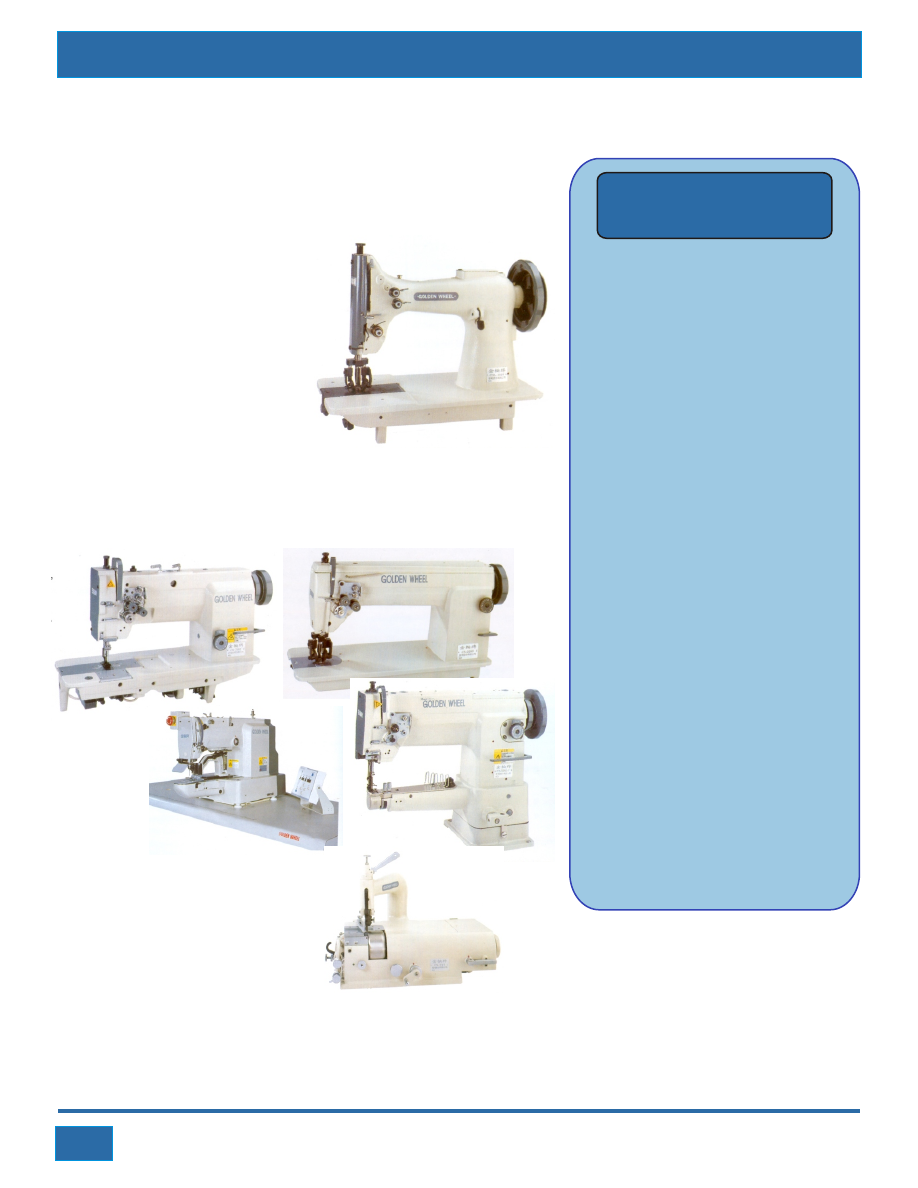
New Technology in Sewing Machine
Golden Wheel
CSL-1810
Features:
l
·Equipped with full range of parts
l
·Ornamental sewing (moccasin stitch)
for shoes, bags, leather goods, …..etc.
l
·According to the real demand of sewn
products:
l
It could apply roller foot or presser foot
for sewing
l
It could apply normal moccasin stitch or
cordinsert moccasin stitch
l
Needle gauge could apply 7.5mm or 6.35mm or 5.5mm for sewing
Wide of Other Machines are:
Company Contact
United Machinery
Naeem-ud-din (Managing Director)
Tel:092-21-34392781
E-mail: info@unitedmachinery.com
Address: S-3, Ground floor westland trade center K.C.H.S Shahra-e-Milat
Road, Karachi
Technology Roundup
Please give us your feedback and address queries to editor@pastic.gov.pk
8