
Patron/
Managing Editors
Editor
Composer
Executive Editor
Dr. Muhammad Akram Shaikh
Director General, PASTIC
Ms. Nageen Ainuddin
Mr. M. Aqil Khan
Dr. Saima Tanveer
Muhammad Kashif Farooqui
&
Fasih ul Islam
T
R
ECHNOLOGY
OUNDUP
Technology Information Section (TIS)
Pakistan Scientific & Technological Information Centre
PASTIC
November-December, 2012
Vol. 4 , No.6
A NEWS BULLETIN FROM
Tech News Headlines
Tech & Trade Offers
Phone: 051-9248103-4, 9248111
Fax:
051-9248113
Web: www.pastic.gov.pk
Email:editor@pastic.gov.pk
PASTIC National Centre
Quaid-i-Azam University Campus
P.O. Box 1217, Islamabad
Editorial Board
Development and Physico-Chemical Characterization of Apricot-
Datebars
Comparative Study on the Yield Performance of Sunflower Hybrids
underAgro-Ecological Conditions of D.I.Khan, Pakistan
Silicon-Based Light-Emitting Diodes (SILEDs) can Emit
Multicolour Light Without Heavy Metals
Writing Without Keyboard: Handwriting Recognition on the Wrist
New Way of Capturing Images Based on a Flat, Flexible,
Transparent, and Potentially Disposable Polymer Sheet
Xenon Flash for Photos in Dark from Smart Phones
Workshops on Exploratory Topics in Plasma Fusion Research (EPR)
2013
Worldwide Progress Towards Fusion Energy Symposium of AAAS
2013
Pacific Operational S & T Conference and Exhibition
40Th IOPAnnual Plasma Physics Spring Conference
Global Engineering Science and Technology Conference
New Ribbon Generators
RGN Series
Forthcoming Tech Events
Technology Roundup
2
Tech News
Technology Roundup

3
Technology Roundup
DEVELOPMENT and PHYSICO-CHEMICAL CHARACTERIZATION of APRICOT-DATE BARS
Pakistan is among top ten date (Phoenix dactylifera L.) producing countries. Dates are highly
nutritious and their importance for human health is mentioned in Holy Quran. One hundred
grams of date flesh contains 73.5g carbohydrates, 2.3g proteins, 1.5g and ash 0.2g fat. The dates
also contain vitamin A, C, B1, B2, folic acid, nicotinic acid, mineral elements and are considered
good source of energy mainly due to presence of high amount of readily digestible carbohydrates.
Mostly, fresh dates are used with little or no processing. However, several processed date products
are now available in markets including date paste, date syrup, date pickle & Jam etc.
Apricots are also abundantly produced in Northern Area of Pakistan and their production stood at
238 thousand tons in 2008. These can be used as fresh, dried or inprocessed form. These are good
source of carbohydrates and some important nutrients. One hundred grams of dried apricots
provide 62.64g carbohydrates, 30.89g moisture, 2.57g ash, 3.39g protein, 0.51g fat (18), 55mg
calcium, 2.66mg iron, 32mg magnesium, 71mg phosphorus, 10mg sodium and 1162mg potassium.
These also contain vitamin A, C, thiamin, riboflavin and niacin.
Considering the nutritional qualities of dates and apricot, apricot-date bars were developed at the
Institute of Food Science and Nutrition, University of Sargodha, Sargodha, Pakistan during the
year 2009-10. For this purpose date paste, dried apricot paste, skim milk powder, roasted gram
flour, peanuts and sodium chloride were used in different four propotions. The results indicated
that water activity, colour and texture of bars were affected significantly with the addition of dried
apricots. Moisture was also significantly affected which ranged from 17.14 to 19.21 percent and
71.49 to 72.81 percent whereas crude fat, crude protein, crude fibre, nitrogen free extract and ash
Tech News
Maximum proten percentage(26.76%) was observed in Hysunb-33 which statistically at par
with Dk4040 (25.95%.Minimum protein parentage(23.62%) was shown by Suncross-24 which
also at par with NK-212 (23.82%) and sunbred-265(23.73%)(Oral,E and K-Kara,189).
Sarhad J. Agric. Vol.28, No.2, 2012
Ejaz Ahmad Khan, and Ghazanfar Ullah Sadozai (Department of Agronomy)Faculty of
Agriculture, Gomal University, D.I. Khan Pakistan). Saeed Ahmed Qaisrani and Nazir Hussain
(Agricultural Research Institute, D.I. Khan Pakistan).
Courtesy:

4
Technology Roundup
Tech News
were not significantly affected with the addition of apricot paste. The quantities of sodium,
calcium, iron, manganese and zinc remained unchanged, whereas potassium increased
significantly in these treatments. In-vitro protein and starch digestibilities ranged from 85.90 to
86.88 percent and 0.238 to 0.244 mg/g, respectively. There was no change observed in the
quantities of free fatty acids. The total phenolic contents ranged from 225.20 to 263.84mg/100g.
Microbiological analysis revealed that these bars were in the safe limits in bacterial and mold loads
and might be stored for longer time. The studies further revealed that potential exists to produce
economical fruit bars with commercial value.
Courtesy:
Journal of Agricultural Research, 2012 50(3): 409-421 ref 37
Salim-ur-Rehman (National Institute of Food Science and Technology, University of Agriculture,
Faisalabad), Muhammad Nadeem (Institute of Food Science & Nutrition, University of Sargodha,
Sargodha, Pakistan), Muhammad Haseeb, Javaid Aziz Awan (National Institute of Food Science
and Technology, University of Agriculture, Faisalabad)

5
Technology Roundup
Writing Without Keyboard by Handwriting Recognition on the Wrist
Typing text messages on the mobile phone via the tiny soft keyboard is very
cumbersome. How about simply writing it into the air! This idea drove the
development of "airwriting" made by computer scientists of Karlsruhe Institute of
Technology (KIT), Canada. Sensors attached to a glove record hand movements, a
computer system captures relevant signals and translates them into text.
The airwriting glove is used to write letters into air, as if using an invisible board
or pad. For this purpose, acceleration sensors and gyroscopes are attached to the
thin glove. Contrary to systems based on cameras, these sensors are very small,
mobile, and robust. They record the movements of the hand and transmit them to a computer system via a wireless
connection. The computer system first checks whether the user is indeed writing. All movements that are not similar to
writing, such as cooking, doing laundry, waving to someone, are ignored. The system runs in the background without
interpreting every movement as computer input. The computer scientist thinks that the device is perfectly suited for
future mixed-reality applications. For instance, in glasses with integrated miniaturized screens, news may be displayed
Silicon-Based Light-Emitting Diodes (SILEDs) can Emit Multi Colour Light
Without Heavy Metals
Scientists of Karlsruhe Institute of Technology (KIT) and the University of
Toronto/Canada have now succeeded in manufacturing silicon-based light-
emitting diodes (SILEDs). They are free of heavy metals and can emit light in
various colors.
Silicon nanocrystals have a size of a few nanometers and possess a high
luminous potential. Silicon dominates in microelectronics and photovoltaics
industry, but has been considered unsuitable for light-emitting diodes for a
long time. However, this is not true for nanoscopic dimensions. Minute silicon
nanocrystals can produce light. These nanocrystals consist of a few hundred to thousand atoms and have a considerable
potential to act as highly efficient light emitters.
Scientists specifically adjust the color of the light emitted by the diodes by separating nanoparticles depending on their size.
Moreover, light-emitting diodes have a surprising long-term stability that has not been reached before. The increased service
life of the components in operation is due to the use of nanoparticles of one size only. This enhances the stability of the
sensi ti ve thin-fi lm components. Thus short circ ui ts due t o oversize d part ic le s are exclude d.
The development made by the researchers from Karlsruhe and Toronto is also characterized by an impressing homogeneity
of the luminous areas. The KIT researchers are among the few teams in the world that know how to manufacture such
devices. With the liquid-processed silicon LEDs that may potentially be produced on large areas as well as at low costs, the
nanoparticle community enters new territory, the associated potentials of which can hardly be estimated today.
The SILEDs also have the advantage that they do not contain any heavy metals. In contrast to cadmium selenide, cadmium
sulfide or lead sulfide used by other groups of researchers, the silicon used by this group for the light-emitting nanoparticles
is not toxic. Moreover, it is available at low costs and highly abundant on earth. Due to their many advantages, the SILEDs
will be developed further in cooperation with other partners.
www.esciencenews.com

36
Technology Roundup
to the user in the field of vision. When such a system is combined with the possibility to input commands and texts by
gestures, you do not even need a hand-held device.
During writing, the airwriting system decodes the letters by a pattern recognition method. Previous approaches mainly
focused on the recognition of single gestures assigned to certain commands. This approach goes far beyond. For every letter
of the alphabet, a statistical model of the characteristic signal pattern is stored. It also takes into account individual
differences in the writing style. The system can recognize complete sentences written in capital letters and presently has a
vocabulary of 8000 words. The system has an error rate of 11%. When it is adapted to the individual writing style of the user,
the error rate drops to 3%. Scientists are now working on further refining the method to filter out writing. Moreover, they
want to make the system smaller in order to increase wearing comfort and user acceptance.
This can be achieved with commercial components. An unobtrusive wrist band might be feasible, for example," says the
researchers. It is also planned to integrate the system in smart phones. In this case, neither the wrist band nor the tiny soft
keyboard would be required to write a text message.
www. I4u.com
New way of Capturing Immages Based on Flat, Flexible,Transparent, and
Potentially Disposables Polymer Sheet
Digital cameras, medical scanners, and other imaging technologies have
advanced considerably during the past decade. Continuing this pace of
innovation, an Austrian research team has developed an entirely new way of
capturing images based on a flat, flexible, transparent, and potentially disposable
polymer sheet.
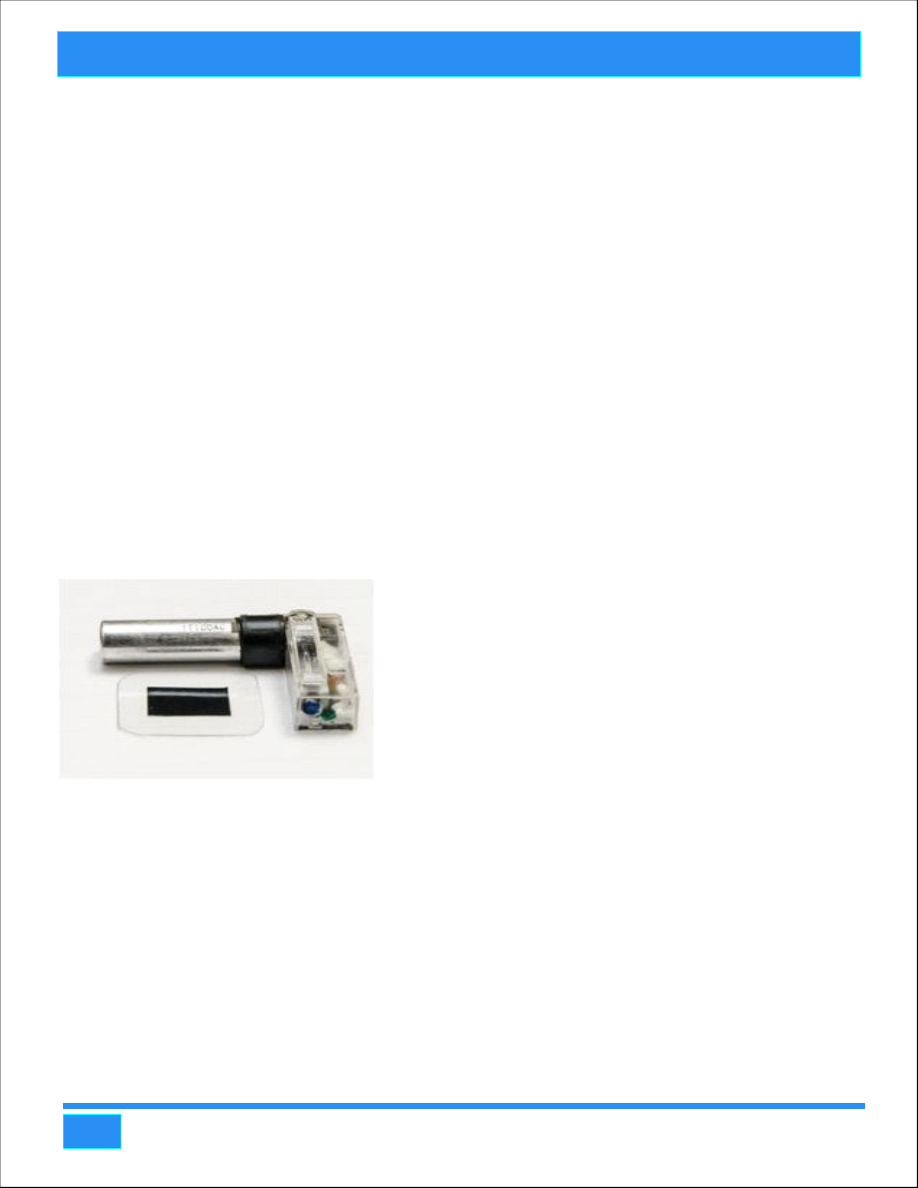
The new imager, which resembles a flexible plastic film, uses fluorescent
particles to capture incoming light and channel a portion of it to an array of
sensors framing the sheet. With no electronics or internal components, the
imager's elegant design makes it ideal for a new breed of imaging technologies, including user interface devices that can
respond not to a touch, but merely to a simple gesture.
It is the first image sensor that is fully transparent no integrated microstructures, such as circuits and is flexible and scalable
at the same time. The sensor is based on a polymer film known as a luminescent concentrator (LC), which is suffused with
tiny fluorescent particles that absorb a very specific wavelength (blue light for example) and then reemit it at a longer
wavelength (green light for example). Some of the remitted fluorescent light is scattered out of the imager, but a portion of it
travels throughout the interior of the film to the outer edges, where arrays of optical sensors (similar to 1-D pinhole cameras)
capture the light. A computer then combines the signals to create a gray-scale image. With fluorescence, a portion of the light
that is remitted actually stays inside the film.
For the luminescent concentrator to work as an imager, the researchers had to determine precisely where light was falling
across the entire surface of the film. This was the major technical challenge because the polymer sheet cannot be divided into
individual pixels like the CCD camera inside a smartphone. Instead, fluorescent light from all points across its surface
travels to all the edge sensors,calculating where each bit of light entered the imager .
The solution came from the phenomenon of light attenuation, or dimming, as it travels through the polymer. The longer it
travels, the dimmer it becomes. So by measuring the relative brightness of light reaching the sensor array, it was possible to
7
Technology Roundup
Powerful Xenon flash in Short Phones could help to get Photos in Dark
A Singapore invention looks set to equip mobile phones with a built-in,
small yet powerful Xenon flash, allowing consumers to take great photos
even in low-light conditions.
Scientists from Nanyang Technological University (NTU), Singapore
have made a revolutionary capacitor that overcomes the limitations of
current capacitors, which are needed to store enough energy to fire a
powerful flash like those found on digital cameras but are too big to fit in
slim mobile devices.
Made from polymers layered together, the new capacitor is at least four
times smaller than current electrolytic capacitors and is several times
faster than current ceramic-based capacitors. The multi-layered polymer capacitor is also able to deliver the same electricity
charge needed to power high-intensity xenon flash light matching those found in digital cameras.
Polymer capacitors such as the one developed by these researchers, generally possess a higher energy density than ceramic-
based multilayer capacitors. NTU's new material, a grafted co-polymer that stores charges similar to a multilayer ceramic
capacitor, can be operated at high voltages. Capacitors made using this grafted co-polymer are flexible and much smaller than
the conventional capacitors. In addition, the charge and discharge times of the capacitor are faster than other types of energy
storage devices making it suitable for flash applications.
Currently, the polymer Capacitor project is funded by Singapore's National Research Foundation (NRF) Proof-of-Concept
grant. The NTU-Xenon is expected to develop a working commercial prototype by September 2013. Through the
University's Nanyang Innovation and Enterprise Office, NTU and XT entered into a Collaboration Agreement to research
and develop a Multilayer Polymer Capacitor for xenon flash imaging applications. This project will yield a breakthrough
calculate where the light entered the film. This same principle has already been employed in an input device that tracks the
location of a single laser point on a screen.
The researchers were able to scale up this basic principle by measuring how much light arrives from every direction at each
position on the image sensor at the film's edge. They could then reconstruct the image by using a technique similar to X-ray
computed tomography, more commonly known as a CT scan.
Currently, the resolution from this image sensor is low (32x32 pixels with the first prototypes). The main reason for this is the
limited signal-to-noise ratio of the low-cost photodiodes being used. The researchers are planning better prototypes that cool
the photodiodes to achieve a higher signal-to-noise ratio.
The main application that researchers envision for this new technology is in touch-free, transparent user interfaces that could
seamlessly overlay a television or other display technology. This would give computer operators or video-game players full
gesture control without the need for cameras or other external motion-tracking devices. The polymer sheet could also be
wrapped around objects to provide them with sensor capabilities. Since the material is transparent, it's also possible to use
multiple layers that each fluorescence at different wavelengths to capture color images.
The researchers also are considering attaching their new sensor in front of a regular, high-resolution CCD sensor. This would
allow recording of two images at the same time at two different exposures. "Combining both would give us a high-resolution
image with less overexposed or underexposed regions if scenes with a high dynamic range or contrast are captured.
www.gizmag.com

solution for the digital imaging industry, which will be the world's smallest Xenon flash. Prof. Lee whose researchers had worked
on the invention for the past two and a half years, hopes that this collaboration is XT will accelerate the transfer of her innovation
from research lab to industry. She said that, “With XT's expertise in developing successful commercial prodects, thay is confident
that this collaboration will result in a descriptive innovation, not just in the area of flash technology, but also in the world
consumer electronics, as well computer and devices requires the use of capacitors in one way or another”.
Www.esciencenews.com
Technology Roundup
Workshop on Exploratory Topics in Plasma Fusion Research (EPR) 2013
www.iccworkshops.org
Worldwide Progress towards Fusion Energy Symposium of AAAS 2013
40Th IOP Annual Plasma Physics Spring Conference
www.iter.org
www.ndia.org
www.laserlab-europe.eu
Www.gistconfo.com
Global Engineering Science and Technology Conference
12-15 February 2013,
Fort worth Texas USA
16 February, 2013
Boston, Massachusetts, USA
Pacific Operational S & T Conference and Exhibition
5-8 March, 2013
Hilton, Hawaiian Village, USA
25-28 March, 2013
York, UK
1-2 April, 2013
Dubai, UAE
Forthcoming Tech Events
7
7
88
39
Technology Roundup
About PASTIC
PASTIC serves as a gateway for
Scientific & Technological
Information for R&D by
catering to the information
n e e d s o f r e s e a r c h e r s ,
entrepreneurs, industrialists,
educationists, policy makers
a n d p l a n n e r s t h r o u g h
anticipatory and responsive
information services.
T e c h n o l o g y I n f o r m a t i o n
Service Section of PASTIC
works exclusively for support
and promotion of technological
information on trade and
industry i n the countr y.
“Technology Roundup” is a
news bulletin that provides
l a t e s t a n d i n n o v a t i v e
technology news, forthcoming
events, etc. It also promotes
products,
services
globally in sectors
such as Agro-Industry,
Energy,
Food Processing, Machinery,
Pharmaceuticals and Textiles.
technologies and
Bio-
Technology, Building Material,
B u s i n e s s , C h e m i c a l s ,
Electronics,
Fisheries,
P a c k a g i n g ,
M i n i n g
Please give us your feedback and address queries to editor@pastic.gov.pk
Tech & Trade Offers
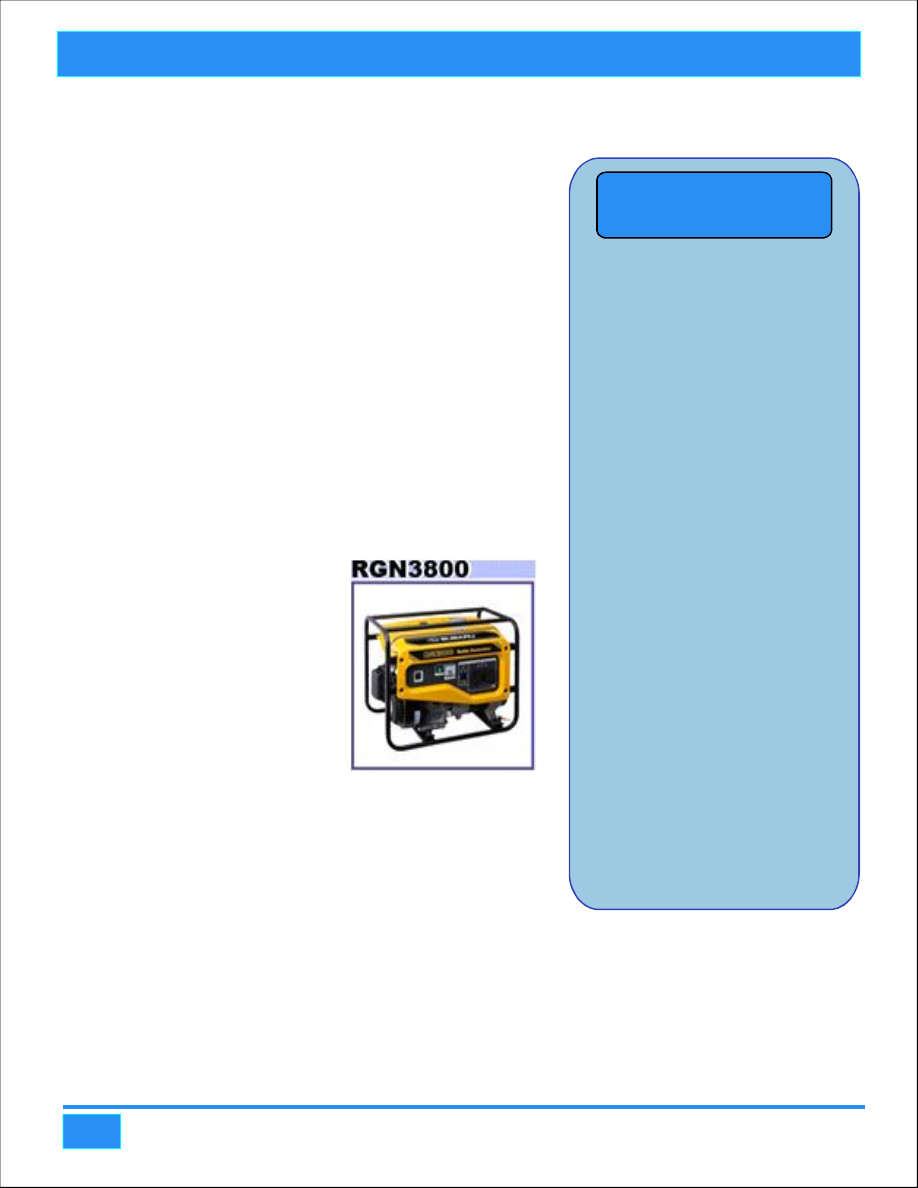
New Ribbon Generators RGN Series
New Robbin generator RGN series RGN3000 / RGN3800 / RGN5100
RGN7100 / RGN7800
There are many specifications in this generator which differ it with other
normal generators such as AC: 50Hz, 60Hz power factor: 1.0, DC out put (V-
A) 12 8.3, safety device type: fuse-less circuit breaker. Simply this is the
power source for super performance.
Company Name:
Contact Person:
Year of Establishment: 1970
Address Aiwan e Tijarat Road, Karachi.
Tel: 021-32420829
Fax: 021-32419350
Warranty:
AS MohammadAli & Sons
Qamar Abdullah
:
E-mail:
Web:
Subaru products
i)
RGN3000
Output: 2 KVA
ii)
RGN3800
Output: 2.4KVA
iii)
RGN5100
Output: 3.6 KVA
iv)
RGN7800E
Output: 5.5 KVA
New RGN series having 2 years manufacturer's
Dealers:
texport_80@hotmail.com
www.express-traders.com