
Patron/
Editors
Composer
Executive Editor
Dr. Khalil Ahmed Ibupoto
Director General, PASTIC
Ms. Nageen Ainuddin
Mr. M. Aqil Khan
Dr. Saima Tanveer
Ms. Saima Majeed
Ms. Shazia Parveen
T
R
ECHNOLOGY
OUNDUP
Technology Information Section (TIS)
Pakistan Scientific & Technological Information Centre
PASTIC
July-August, 2011
Vol. 3, No. 4
A NEWS BULLETIN FROM
Tech News Headlines
Forthcoming Tech Events
Tech & Trade Offers
Phone: 051-9248103-4, 9248111
Fax:
051-9248113
Web: www.pastic.gov.pk
Email:editor@pastic.gov.pk
PASTIC National Centre
Quaid-i-Azam University Campus
P.O. Box 1217, Islamabad
Editorial Board
l Pakistan: Perforated Hot Plate for baking Chapatti
l
l
l
l
l
l
Frog Skin to Treat Cancer
New Green Technology for Hydrogen Production
Novel Geothermal Technology Packs a One-Two Punch against
Climate Change
A Molecule that Switches On and Off
Biological Engineers Generate Natural Gas with Bacteria
Carbon Nanotubes can Store Solar Energy
l
l
l
l
l
l
10th International Conference on Sustainable Energy Technologies
2011 International Conference on Creativity and Innovation for
Sustainable Development
Zhejiang-Alberta Life Science Forum - Human Health Risk
Assessment, Food Safety, Environmental Contamination
ITCN Asia - International Information Technology and Telecom
Exhibition and Conference 2011
2011 International Conference on Advanced Materials Engineering
(ICAME 2011)
Green Conclave
Automatic Power Ups
MPEG4 Network Camera Ip3121

Technology Roundup
2
Tech News
Technology Roundup
Indigenous Technology
Pakistan: Perforated Hot Plate for baking Chapatti
A hot iron plate commonly known as Tawa is used to make chapatti (local bread) in nearly
every house of Indian subcontinent and the countries where the natives of these
countries have migrated: A chapatti, about eight inch diameter disc shaped bread, is an
essential part of the meal and one person eats about 3 to 4 in one meal. If the chapatti
making is made efficient then the housewife will stay less time in kitchen and gas or fuel
consumption in the oven will be low. Pakistani researchers from COMSATS Institute of
Information Technology have shown that a perforated hot plate bakes a chapatti in 45%
less time as compared to conventional plain hot plate and thereby both energy and time
economy is achieved. This perforated hot plate also acts as toaster and dispenses the
expensive electric toaster which is more prone to damage. Why it bakes quicker? It is
premised that when chapatti shaped dough is placed on conventional hot plate the
moisture of dough in contact with the hot plate converts to steam and steam pockets
emerge between dough and plate. The steam puts dents into the dough surface making it
uneven. Thus, heat transfer to dough is reduced by presence of steam and also the
contact area between dough and hot plate is reduced because of uneven surface of
dough. The trapped steam vents through perforations in the perforated hot plate getting
rid off the culprit of reduced heat transfer. From the point of view of overall energy saving
in gas based ovens, it is estimated that 0.025 m of gas per person per day will be saved
and this would result in substantial saving in domestic consumption of gas reserves. The
research result has been patented.
3
Source: VISB, 3rd March 2011
Frog Skin to Treat Cancer
Scientists at Queen's University, Belfast have discovered
proteins in frog skins which could be used to treat cancer,
diabetes, stroke and transplant patients by regulating the growth
of blood vessels. Professor Chris Shaw has identified two
proteins, or 'peptides', which can be used in a controlled and
targeted way to regulate 'angiogenesis' (the process by which
blood vessels grow in the body).
The proteins are found in secretions on the skins of the Waxy
Monkey Frog and the Giant Firebellied Toad. Scientists capture
the frogs and gently extract the secretions, before releasing them
back in to the wild. The frogs are not harmed in any way during

3
Technology Roundup
New Green Technology for Hydrogen Production
R
esearcher Mohamed Halabi of Eindhoven University of
Technology demonstrates a proof-of-concept for a new and
clean technology to produce high purity hydrogen from natural
gas. This allows hydrogen to be produced in an elegant
technique at much lower temperatures, and without releasing
carbon dioxide into the atmosphere.
Hydrogen is a valuable feedstock for the petrochemical industry
and it may play a big role in the energy supply of the future, as a
green, non-polluting, and efficient energy carrier. If it is burnt,
only water is formed. However, the conventional technology for hydrogen production from
natural gas ('steam reforming') is a highly energy intensive process, operated at high pressures
(up to 25 bar) and high temperature (850 degrees C), with multistage subsequent separation
and purification units. Moreover, huge amounts of CO have to be handled in post-processing
steps.
TU Eindhoven has now developed a new and improved technology called sorption enhanced
catalytic reforming of methane," using novel catalyst/sorbent materials. Halabi, working in
collaboration with the Energy Research Centre of the Netherlands (ECN), has demonstrated
the feasibility of producing hydrogen through such a process at much lower temperatures (400
to 500 degrees Celsius).
The process is performed in a packed bed reactor using a Rhodium-based catalyst and a
Hydrotalcite-based sorbent as a new system of materials. Hydrogen is produced on the active
catalyst and the cogenerated CO is effectively adsorbed on the sorbent, hence preventing any
2
2
this process.
Professor Shaw told that the proteins discovered have the ability to either stimulate or inhibit the
growth of blood vessels. By 'switching off' angiogenesis and inhibiting blood vessel growth, a
protein from the Waxy Monkey Frog has the potential to kill cancer tumours. Most cancer
tumours can only grow to a certain size before they need blood vessels to grow into the tumour
to supply it with vital oxygen and nutrients. Stopping the blood vessels from growing will make
the tumour less likely to spread and may eventually kill it. This has the potential to transform
cancer from a terminal illness into a chronic condition.
On the other hand, a protein from the Giant Firebellied Toad has been found to 'switch on'
angiogenesis and stimulate blood vessel growth. This has the potential to treat an array of
diseases and conditions that require blood vessels to repair quickly, such as wound healing,
organ transplants, diabetic ulcers, and damage caused by strokes or heart conditions.
The aim of the work at Queen's is to unlock the potential of the natural world because the natural
world holds the solutions to many of our problems. The need is to pose the right questions to find
them. The discovery holds the potential to develop new treatments for more than seventy major
diseases and conditions that affect more than one billion people worldwide.
http://www.alphagalileo.org

5
4
Technology Roundup
Novel Geothermal Technology Packs a One-Two Punch against
Climate Change
http://www.umn.edu/twincities/index.html
Researchers from Department of Earth Sciences, University of Minnesota have developed an
innovative approach to tapping heat beneath Earth's surface. The method is expected to not
only produce renewable electricity far more efficiently than conventional geothermal systems,
but also help reduce atmospheric carbon dioxide (CO2) dealing a one-two punch against
climate change.
Established methods for transforming Earth's heat into electricity involve extracting hot water
from rock formations several hundred feet from Earth's surface at the few natural hot spots
around the world, then using the hot water to turn power-producing turbines. The CPG system
uses high-pressure CO2 instead of water as the underground heat-carrying fluid.
CPG provides a number of advantages over other geothermal systems. First, CO2 travels more
easily than water through porous rock, so it can extract heat more readily. As a result, CPG can
be used in regions where conventional geothermal electricity production would not make
sense from a technical or economic standpoint.
This is probably viable in areas one could not even think about doing regular geothermal for
electricity production. In areas where one could, it is perhaps twice as efficient.
CPG also offers the benefit of preventing CO2 from reaching the atmosphere by sequestering it
deep underground, where it cannot contribute to climate change. In addition, because pure
CO2 is less likely than water to dissolve the material around it, CPG reduces the risk of a
geothermal system not being able to operate for long times due to "short-circuiting" or
plugging the flow of fluid through the hot rocks. Moreover, the technology could be used in
parallel to boost fossil fuel production by pushing natural gas or oil from partially depleted
reservoirs as CO2 is injected
CO emissions to the atmosphere.
Direct production of high purity hydrogen and fuel conversion greater than 99.5% is
experimentally achieved at low temperature range of (400 -- 500 ºC) and at a pressure of 4.5
bar with a low level of carbon oxides impurities: less than 100 ppm." The enormous reduction of
the reactor size, material loading, catalyst/sorbent ratio, and energy requirements are
beneficial key factors for the success of the concept over the conventional technologies. Small
size hydrogen generation plants for residential or industrial application operated at a relatively
low pressure, of less than 4.5 bar, seem to be feasible.
2
http://www.tue.nl
A Molecule that Switches On and Off
Researchers in France have developed a single molecule whose charge state and shape can be
changed at will. The advances, made at the CEMES, Centre for Materials Elaboration and
Structural Studies, (CNRS), may prove a key advantage in the race for miniaturization. In addition
to controlling its charge in a completely reversible way, the researchers have revealed a link
between the molecule's charge and its geometrical shape, effectively making it usable as a bit of
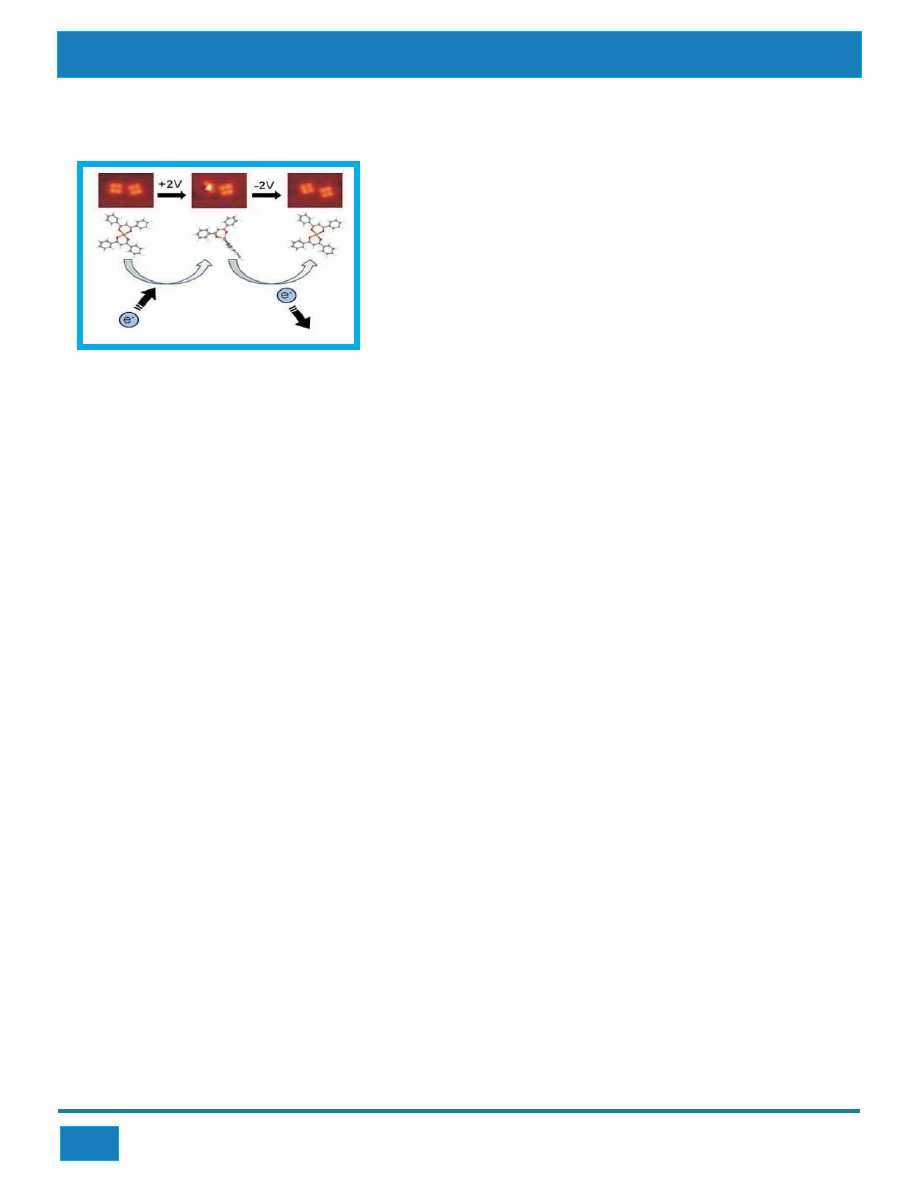
3
5
Technology Roundup
Biological Engineers Generate Natural Gas with Bacteria
Biological Engineer Ruihong Zhang and her students at UC Davis in California are turning
garbage into bio-gas that may provide the electricity in one’s home. Trash could soon be
powering our’s home A new kind of waste digester uses two different strains of bacteria in
different tanks. This would normally take place in the same environment, but microbiologists
have now separated it into two stages that increase natural-gas production. This process takes
the two bacteria and separates them into two separate environments.
In the process, food waste is collected from restaurants and institutions and then fed to
bacteria that thrive in low-oxygen environments. It is called anaerobic digestion, a naturally
information or an electromechanical system on a nanometric scale. This perfectly controllable
back-and-forth motion at the molecular level holds great
promise for the creation of ultra-dense digital memory or
nanomotors.
It is called a molecular switch: a molecule that can
interchangeably adopt state A or state B under the influence
of an external stimulus. In this specific experiment, the two
states correspond to different molecular geometries: the
composition remains the same but the shape changes. To
induce the change, an electron must be added to the
molecule, which constitutes the external stimulus. Adding an
electron also introduces an additional repelling force,
causing certain atoms to pull further away from each other and changing the molecule's shape from
a flat, square configuration to a more voluminous pyramidal configuration.
From a technical point of view, the operation is made possible by the use of a scanning tunneling
microscope (STM). The STM serves both as a camera to reveal the molecule's shape and as a tool for
injecting electrons: when the microscope's tip applies an electrical tension, the molecule gains an
electron and changes shape, becoming pyramidal. The process is completely reversible: when a
reverse voltage is applied, the molecule releases the electron and recovers a flat shape and neutral
charge. The CNRS researchers have measured the molecule's charge state in both configurations
using an atomic force microscope (AFM), thus establishing the close link between the molecule's
charge and its geometrical shape.
This switch opens the way to numerous applications, including the synthesis of elementary
memory units on a molecular scale. The molecule's capacity to hold a charge and release it on
demand could be used to encode binary information. In addition to applications in molecular
electronics, it would be possible to use the molecule's geometrical transformation to produce a
nanomachine.
http://www.cnrs
.fr

3
6
Technology Roundup
Carbon Nanotubes can Store Solar Energy
www.sciencedaily.com
A novel application of carbon nanotubes, developed by MIT
researchers, shows promise as an innovative approach to storing
solar energy for use whenever it is needed.
Storing the sun's heat in chemical form rather than converting it
to electricity or storing the heat itself in a heavily insulated
container has significant advantages, since in principle the
chemical material can be stored for long periods of time without
losing any of its stored energy.
Jeffrey Grossman and four co-authors figured out exactly how
fulvalene diruthenium is the best chemical for reversibly storing solar energy.
The new material found by Grossman and Kolpak is made using carbon nanotubes, tiny tubular
structures of pure carbon, in combination with a compound called azobenzene. The resulting
molecules, produced using nanoscale templates to shape and constrain their physical
structure, gain new properties that are not available in the separate materials.
Not only is this new chemical system less expensive than the earlier ruthenium-containing
compound, but it also is vastly more efficient at storing energy in a given amount of space about
10,000 times higher in volumetric energy density. By using nanofabrication methods, the
molecules interactions can be controlled increasing the amount of energy they can store and
the length of time for which they can store it and most importantly, both can be controlled
independently.
Thermo-chemical storage of solar energy uses a molecule whose structure changes when
exposed to sunlight, and can remain stable in that form indefinitely. Then, when nudged by a
stimulus a catalyst, a small temperature change, a flash of light it can quickly snap back to its
other form, releasing its stored energy in a burst of heat. Grossman describes it as creating a
rechargeable heat battery with a long shelf life, like a conventional battery
occurring process of decomposition. One type of bacteria turns carbohydrates into simple
sugars, amino acids and fatty acids. A second group of bacteria eats those compounds and turns
them into hydrogen gas, carbon dioxide, and acetic acid the primary component of vinegar.
Then a third group of bacteria takes those broken-down compounds and turns them into
methane and carbon dioxide. Between 60 and 80 percent becomes methane. The methane can
be used as fuel for an internal combustion engine that provides electricity.
Anaerobic digestion is not the same thing as human digestion, since the type of bacteria that
produce methane do not live in the human digestive tract. Industrial anaerobic digesters can
also harness this natural process to treat waste, provide heat, and increase nutrients in soil.
They are most commonly used for sewage treatment and for managing animal waste
The technology will turn three tons of food scraps into energy for 25 houses a day. But it is not
just for homes. The digester could be especially useful to fuel processing plants.
http://www.ieeeusa.org

37
Technology Roundup
Forthcoming Tech Events
10th International Conference on Sustainable Energy Technologies
2011 International Conference on Creativity and Innovation for
Sustainable Development
Zhejiang-Alberta Life Science Forum - Human Health Risk Assessment,
Food Safety, Environmental Contamination
ITCN Asia - International Information Technology
Telecom Exhibition
and Conference 2011
www.set2011.org
www3.iium.edu.my/irkhs/icci
http://zj-ablifesci.net/
www.itcnasia.com
&
2011 International Conference on Advanced Materials Engineering
(ICAME 2011)
Green Conclave
www.icame.org/cfp.htm
www.greenconclave.in
4-7 September, 2011
Istanbul, Turkey
12-14 September, 2011
Kuala Lumpur, Malaysia
19-21 September, 2011
Hangzhou, Zhejiang, China
20-22 September, 2011
Karachi,Pakistan
1-3 Octobe,r 2011
Cairo, Egypt
13-14 October, 2011
New Delhi, India

3
8
Technology Roundup
About PASTIC
PASTIC serves as a gateway for
Scientific & Technological
Information for R&D by
catering to the information
n e e d s o f r e s e a r c h e r s ,
entrepreneurs, industrialists,
educationists, policy makers
a n d p l a n n e r s t h r o u g h
anticipatory and responsive
information services.
T e c h n o l o g y I n f o r m a t i o n
Service Section of PASTIC
works exclusively for support
and promotion of technological
information on trade and
industry in the country.
“Technology Roundup” is a
news bulletin that provides
l a t e s t a n d i n n o v a t i v e
technology news, forthcoming
events, etc. It also promotes
products,
services
globally in sectors
such as Agro-Industry,
Energy,
Food Processing, Machinery,
Pharmaceuticals and Textiles.
technologies and
Bio-
Technology, Building Material,
B u s i n e s s , C h e m i c a l s ,
Electronics,
Fisheries,
P a c k a g i n g ,
M i n i n g
Please give us your feedback and address queries to editor@pastic.gov.pk
MPEG4 Network Camera Ip3121
www.newtech.pk
Origin: Pakistan
Address: 3rd floor, Moti Plaza, Murree Road,
Rawalpindi, Pakistan.
Phone: +92 333 5484626
Fax:
+92 51 5765110
Cell No: +92 333 5484626
Company Contact:
Automatic Power Ups
Origin: Pakistan
Company Contact
Name:Mr. Haseeb-Sajid [Entrepreneur]
Address: Phase-2(ext) D.H.A, Karachi, Pakistan
Phone: +92-322-2572227
Fax: +92-21-5394140
Cell No.: +92-322-2572227
ups@ simtek.com.pk
Tech & Trade Offers