
Patron/
Editors
Composer
Executive Editor
Dr. Manzoor Hussain Soomro
Director General, PASTIC
Ms. Nageen Ainuddin
Mr. M. Aqil Khan
Dr. Saima Tanveer
Ms. Saima Majeed
Ms. Shazia Parveen
T
R
ECHNOLOGY
OUNDUP
Technology Information Section (TIS)
Pakistan Scientific & Technological Information Centre
PASTIC
Jan-Feb, 2011
Vol. 3, No. 1
A NEWS BULLETIN FROM
Tech News Headlines
Forthcoming Tech Events
Tech & Trade Offers
Phone: 051-9248103-4, 9248111
Fax:
051-9248113
Web: www.pastic.gov.pk
Email:director@pastic.gov.pk
PASTIC National Centre
Quaid-i-Azam University Campus
P.O. Box 1217, Islamabad
Editorial Board
l
Indigenous Solar Still Technology for Potable Safe Water in Rural
Areas.
Nanoscale Iron for cleaning the Environment; Ultrafine Particles
destroy Toxic Compounds.
Optimizing large Wind Farms.
Cell Phone Sensors detect Radiation to Thwart Nuclear Terrorism.
Creating 'Living' Buildings.
Forensic Metal Fingerprinting: Simple, Handheld Device can
measure Corrosion on Machine Parts.
Satellite Data for monitoring Groundwater in Agricultural Regions.
l
l
l
l
l
l
l
l
l
l
2nd International Conference on Environmental Science and
Technology 2011
1st National Conference on Soft Computing and Information
Technology
Health Asia
l Symposia on Building Effective Coordination between R&D and
Industry
l 8 EngineeringAsia International Exhibition and Conference
th
ITIFAsia (International Trade & Industrial Machinery Show)
BIT`s 2nd Annual World Congress of Petromicrobiology 2011
l
Art Structure using Tension
Membranes
LVD Induction Lamp Technology

Technology Roundup
2
Tech News
Technology Roundup
Indigenous Technology
Solar Still Technology for Potable Safe Water in Rural Areas
Supply of fresh and clean drinking water is a basic need for all human beings. Many people throughout
the world do not have access to clean water and the problem of availability of adequate supplies of safe
drinking water is worsened with increase in human population.
The presence of high level of salts in water is a great threat to human life. About eighty percent of all
illnesses in the developing world results from waterborne diseases. Since majority of people live in rural
areas where the low population density and remote locations make it very difficult to install the
traditional clean water solutions. Due to high cost to treat contaminated water by the current
technological processes it is not considered suitable to utilize these technologies. The locally developed
solar still technology could provide one of the possible solutions to this problem. A research was
conducted to develop a cheaper solar still which could be easily fabricated with less technical expertise.
The effectiveness of sand bed as base energy absorbing surface to evaporate brackish water was studied
and its performance was compared with those obtained from conventional basin type solar still.
Scientists at Mechanical Engineering Department of Quaid-e-Awam University of Engineering, Science
& Technology, Shaheed Banazirabad, Nawabshah carried out a research to determine effectiveness of
common sand bed for desalination of brackish water. A locally manufactured basin type solar still having
equal angled double slope covers with an effective area of 1.5m using common sand as solar energy
absorber medium was used. Various samples of water with different degree of hardness were collected
from the different areas in the vicinity of QUEST (Quaid-e-Awam University of Engineering, Science &
Technology, Shaheed Banazirabad, Nawabshah). The system under study showed good performance in
terms of quality of water. It was observed that concentration of salts was reduced at remarkable level. The
chemical analysis of the desalinated water showed significant reduction in TDS and pH values. The
present set-up showed identical performance as compared to the conventional basin type solar still.
Sand bed system provides cheaper system for application in rural areas for getting potable water. Solar
still could be an attractive option to overcome potable water shortage problems in remote areas. An
optimum brine depth of 20mm was determined for maximum water production in the solar still.
Maintenance, energy costs, reliability, water quality are the advantages of solar distillation system. Hike
in energy prices and scarcity of fresh water seem bound to create early market for small manufactured
solar water distilling units. Although the input of one still is not sufficient for daily requirement of
average family comprising of four members, it could be enhanced by increasing surface area of the solar
still.
2
Courtesy:
Prof. Dr. Abdul Hameed Memon
Dean Faculty of Engineering
Quaid-e-Awan University of Engineering Sciences & Technology, Shaheed Banazirabad,
Nawabshah

3
Technology Roundup
Nanoscale Iron for cleaning the Environment; Ultrafine Particles destroy Toxic
Compounds
http://www.nsf.gov
Arlington, VA An ultrafine, nanoscale powder made from iron, is turning out to be a remarkably
effective tool for cleaning up contaminated soil and groundwater. Lehigh University environmental
engineer Wei-xian Zhang said that Iron's cleansing power stems from the simple fact that it rusts, or
oxidizes. Ordinarily, the only result is the familiar patina of brick-red iron oxide. But when metallic
iron oxidizes in the presence of contaminants such as trichloroethene, carbon tetrachloride, dioxins,
or PCBs, these organic molecules get caught up in the reactions and broken down into simple carbon
compounds that are far less toxic. Likewise with dangerous heavy metals such as lead, nickel, mercury,
or even uranium,: The oxidizing iron reduces these metals to an insoluble form that tends to stay
locked in the soil, rather than spreading through the food chain. Iron itself has no known toxic effect
just as well, considering the element is abundant in rocks, soil, water, and about everything else on the
planet. For all those reasons, many companies now use a relatively coarse form of metallic iron powder
to purify their industrial wastes before releasing them into the environment.
Zhang told that they are some 10 to 1000 times more reactive than conventional iron powders, because
their smaller size collectively gives them a much larger surface area, but they can be suspended in a
slurry and pumped straight into the heart of a contaminated site like an industrial-scale hypodermic
injection. Once there, the particles will flow along with the groundwater to work their
decontamination magic in place, a vastly cheaper proposition than digging out the soil and treating it
shovelful by shovelful, which is how the worst of the Superfund sites are typically handled today.
According to Zhang, nanoscale iron is similar biological treatments that use specialized bacteria to
metabolize the toxins. But unlike bacteria, the iron particles aren't affected by soil acidity,
temperature, or nutrient levels. Moreover, because the nanoparticles are between 1 and 100
nanometers in diameter, which is about ten to a thousand times smaller than most bacteria, the tiny
iron crystals can actually slip in between soil particles and avoid getting trapped.
Laboratory and field tests have confirmed that treatment with nanoscale iron particles can drastically
lower contaminant levels around the injection well within a day or two, and will eliminate all within a
few weeks reducing them so far as to meet federal groundwater quality standards. The tests also show
that the nanoscale iron will remain active in the soil for 6 to 8 weeks, or until what is left of it dissolves
in the groundwater. And after that, it will be essentially undetectable against the much higher
background of naturally occurring iron.
Optimizing large Wind Farms
Wind farms around the world are large and getting larger. Arranging thousands of
wind turbines across many miles of land requires new tools that can balance cost
and efficiency to provide the most energy for the buck. Charles Meneveau at Johns
Hopkins University, and his collaborator Johan Meyers from Leuven University in
Belgium, have developed a model to calculate the optimal spacing of turbines for
the very large wind farms of the future. The optimal spacing between individual
wind turbines is actually a little farther apart than what people use these days.
The blades of a turbine distort wind, creating eddies of turbulence that can affect other wind turbines

5
4
Technology Roundup
farther downwind. Most previous studies have used computer models to calculate the wake effect of
one individual turbine on another. Starting with large-scale computer simulations and small-scale
experiments in a wind tunnel, Meneveau's model considers the cumulative effects of hundreds or
thousands of turbines interacting with the atmosphere.
The energy a large wind farm can produce, depends less on horizontal winds and more on entraining
strong winds from higher in the atmosphere. A 100-meter turbine in a large wind farm must harness
energy drawn from the atmospheric boundary layer thousands of feet up.
In the right configuration, lots of turbines essentially change the roughness of the land much in the
same way that trees do and create turbulence. Turbulence, in this case, is not a bad thing. It mixes the
air and helps to pull down kinetic energy from above.
Using as example 5 megawatt-rated machines and some reasonable economic figures, Meneveau
calculates that the optimal spacing between turbines should be about 15 rotor diameters instead of the
currently prevalent figure of 7 rotor diameters.
http://www.aip.org/
Cell Phone Sensors detect Radiation to Thwart Nuclear Terrorism
Researchers at Purdue University are working with the state of
Indiana to develop a system that would use a network of cell
phones to detect and track radiation to help prevent terrorist
attacks with radiological "dirty bombs" and nuclear weapons.
Professor Ephraim Fischbach working with Jere Jenkins,
Director of Purdue's Radiation Laboratories told that such a
system could blanket the nation with millions of cell phones
equipped with radiation sensors able to detect even light
residues of radioactive material. Because cell phones already
contain global positioning locators, the network of phones
would serve as a tracking system. According to Fischbach the
ubiquitous nature of cell phones and other portable electronic devices give this system its power. It is
meant to be small, cheap and eventually built into laptops, personal digital assistants and cell phones
The system was developed by Andrew Longman, a consulting instrumentation scientist, who
developed the software for the system and then worked with Purdue researchers to integrate the
software with radiation detectors and cell phones. Tiny solid-state radiation sensors are commercially
available. The technology is unlike any other system, particularly because the software can work with
a variety of sensor types. Cell phones today also function as Internet computers that can report their
locations and data to their towers in real time. So this system would use the same process to send an
extra signal to a home station. The software can uncover information from this data and evaluate the
levels of radiation. The researchers tested the system, demonstrating that it is capable of detecting a
weak radiation source 15 feet from the sensors.
Long before the sensors would detect significant radiation, the system would send data to a receiving
center. Fischbach told that the sensors do not really perform the detection task individually. The
collective action of the sensors, combined with the software analysis, detects the source. The system
would transmit signals to a data center, and the data center would transmit information to authorities
without alerting the person carrying the phone. If radioactive material is transported through a car the
cell phones of the people around that area individually would send signals to a command center,
allowing authorities to track the source.The signal grows weaker with increasing distance from the

5
Technology Roundup
source, and the software is able to use the data from many cell phones to pinpoint the location of the
radiation source.
In addition to detecting radiological dirty bombs designed to scatter hazardous radioactive materials
over an area, the system also could be used to detect nuclear weapons, which create a nuclear chain
reaction that causes a powerful explosion. The system could also be used to detect spills of radioactive
materials.
The system could be trained to ignore known radiation sources, such as hospitals, and radiation from
certain common items, such as bananas, which contain a radioactive isotope of potassium.
The team is working with Karen White, Senior Technology Manager at the Purdue Research
Foundation, to commercialize the system.
http://www.purdue.edu/
Creating 'Living' Buildings
http://www2.gre.ac.uk/
The University of Greenwich's School of Architecture & Construction is poised
to use ethical synthetic biology to create 'living' materials that could be used to
clad buildings and help combat the effects of climate change.
Researchers from the University of Greenwich are collaborating with others at
the University of Southern Denmark, University of Glasgow and University
College London to develop materials that could eventually produce water in
desert environments or harvest sunlight to produce biofuels.
In collaboration with an architectural practice and a building materials'
manufacturer, the idea is to use protocells bubbles of oil in an aqueous fluid
sensitive to light or different chemicals to fix carbon from the atmosphere or to
create a coral-like skin, which could protect buildings.
Professor Neil Spiller, an architect and the head of the University of
Greenwich's School of Architecture & Construction, said the research team was looking at methods of
using responsive protocells to clad cities in an ethical, green and sustainable way. Protocells made
from oil droplets in water allow soluble chemicals to be exchanged between the drops and their
surrounding solution.
The Center for Fundamental Living Technology at the University of Southern Denmark has managed
to get cells to capture carbon dioxide from solution and convert it into carbon-containing materials.
Such cells could be used to fix carbon to create ways of building carbon-negative architecture.
An installation displayed in the Canadian Pavilion in the Venice Biennale 2010, Hylozoic Ground,
created by Canadian architect Philip Beesley, provides an example of how protocells may be used to
create carbon-negative architectures. Protocells situated within the installation recycle carbon
dioxide exhaled by visitors into carbon-containing solids. Similar deposits could be used to stabilise
the city's foundations by growing an artificial limestone reef beneath it. Professor Spiller said that they
want to use protocell bubbles to fix carbon or precipitate skin that they can then develop into a coral-
like architecture, which could petrify the piles that support Venice to spread the structural weight-load
of the city.
6
Technology Roundup
Forensic Metal Fingerprinting: Simple, Handheld Device can measure Corrosion
on Machine Parts
http://www.alphagalileo.org
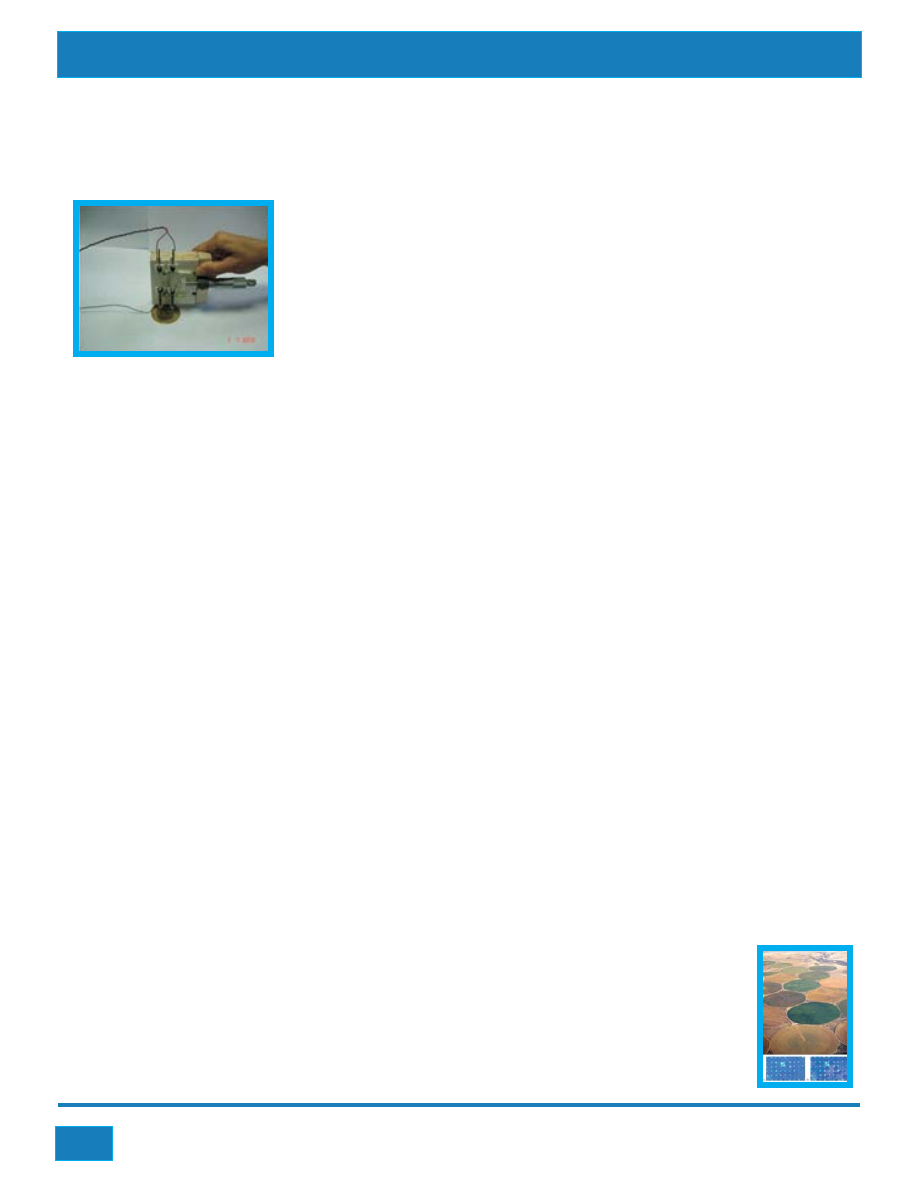
Dr John Bond's method of identifying fingerprints on brass bullet-casings,
even after they have been wiped clean, was based on the minuscule amounts
of corrosion which can be caused by sweat.Now, working with scientists in the
University of Leicester Department of Chemistry, Dr Bond has applied the
technique to industry by developing a simple, handheld device which can
measure corrosion on machine parts. Corrosion leads to wear and tear and
needs to be carefully monitored so that worn parts are replaced at the
appropriate time so this invention should prove a boon to the manufacturing
sector. This is a new, quick, cheap and easy way of measuring the extent of
corrosion on copper and copper based alloys, such as brass. Dr Bond, an Honorary Research Fellow in the
University's Forensic Research Centre and Scientific Support Manager at Northamptonshire Police told
that it works by exploiting the discovery made during the fingerprint research that the corrosion on brass
forms something called a 'Schottky barrier' and is used to see how much the metal has corroded. Such
measurements can already be made but this is quick cheap and easy and can be performed 'in the field' as it
works off a nine-volt battery.Dr Bond said that measuring corrosion of metal such as brass is important to
ensure that machinery does not operate outside its safe limits. This could be anything from checking that a
water pipe will not burst open to ensuring that the metal on an airplane is not corroded. This could lead, for
instance, to the wheels falling off a jet. Having a corrosion measurement means for copper and alloys such
as brass that is quick portable and cheap enables metals to be tested in situation with no prior set up of a
corrosion measuring device. Also, rather than simply saying that the brass is corroding this technique
enables the type of corrosion to be determined. As to which one it gives clues as to how severe the corrosion
is. This can be done already with something like X-ray Photoelectron Spectroscopy (XPS) but that is lab
based and very expensive to use. Our technique works off a 9-volt battery. In that sense, it won't tell you any
more than XPS can, it is just quicker, cheaper and easier. A common use of brass in industry is heat
exchangers as brass is a good conductor of heat. If these are water based, then seeing how the water is
corroding the brass is useful. Also, you simply need to be able to touch the brass with a probe; there is no
other setting up required. It's as easy as taking your temperature with a thermometer. There is much
research on inhibiting the corrosion of brass because of its use in heat exchangers and industrial pipe work,
this technique enables the degree of corrosion to be easily measured.A description of the prototype device
has been published in the journal Review of Scientific Instruments. Dr Bond and his colleagues are now
looking for a company which could exploit the invention and place it on the market.
,
Satellite Data for monitoring Groundwater in Agricultural Regions
Scientists at Stanford have found a way to cheaply and effectively monitor aquifer levels in agricultural
regions using data from satellites that are already in orbit mapping the shape of Earth's
surface with millimeter precision. The amount of water in a groundwater system typically
grows and shrinks seasonally. Rainfall and melted snow seep down into the system in the
cooler months, and farmers pull water out to irrigate their crops in the warmer, drier months.
In agricultural regions, groundwater regulators have to monitor aquifer levels carefully to
avoid drought. They make do with direct measurements from wells drilled into the aquifers,
but wells are generally few and far between compared to the vast size of most groundwater

7
Technology Roundup
systems.
Groundwater regulators are working with very little data and they are trying to manage these huge water
systems based on that. But now, Reeves has shown how to get more data into the hands of regulators, with
satellite-based studies of the ground above an aquifer.
As the amount of water in an aquifer goes up and down, specialized satellites can detect the movements of
the land above the water system and hydrologists can use that information to infer how much water lies
below. Previously, accurate elevation data could only be acquired on barren lands such as deserts. Plants --
especially growing crops, whose heights change almost daily -- create "noise" in data collected over time,
reducing their quality. A team of scientists led by Jessica Reeves has found a way around this growing
problem.
Reeves and Rosemary Knight, a geophysicist in collaboration studied groundwater systems, and Howard
Zebker, a geophysicist and electrical engineer used satellite-based remote sensing techniques to study the
Earth's surface. Knight and Zebker hoped that the combination of their expertise, and the efforts of their
graduate student, would lead to new ways of using satellite data for groundwater management.
Reeves analyzed a decade's worth of surface elevation data collected by satellites over the San Luis Valley
in Colorado. Although the valley is rich with growing crops, Reeves and her advisers hoped that recent
advances in data-processing techniques would allow to gain an understanding of the aquifer that lay
below. As part of analysis, Reeves produced maps of satellite measurements in the valley and saw a regular
pattern of brightly colored high-quality data in a sea of dark, low-quality data. After overlaying the maps
with a Google Earth image of the farmland, the team realized that the points of high-quality data were in
the dry, plant-free gaps between circles of lush crops on the farms.In the San Luis Valley, the majority of
irrigation is done by center-pivot irrigation systems. Like a hand on a clock, a line of sprinklers powered by
a motor moves around, producing the familiar circles seen by airline passengers.
The circles do not overlap, leaving small patches of arid ground that don't receive any water and so don't
have any plants growing on them. Reeves confirmed that these unvegetated data points were trustworthy
by comparing the satellite data to data collected from wells in the area exactly the kind of proof that would
be important to hydrologists studying aquifers.
The satellites use interferometric synthetic aperture radar, known as InSAR. It is a radar technique that
measures the shape of the surface of Earth and can be used to track shape changes over time. Earth
scientists often use InSAR to measure how much the ground has shifted after an earthquake.While
continuously orbiting, a satellite sends an electromagnetic wave down to the surface. The wave then
bounces back up and is detected by the satellite. The properties of the wave tell scientists how far the wave
traveled before it was reflected back. This distance is directly related to the position of the ground.
After the satellite completes a circle around the globe, it returns to the same location to send down another
radar wave and take another measurement. Measurements are taken every 35 days and data collection can
go on for years.Compared to drilling wells for monitoring groundwater aquifers, using InSAR data would
be much cheaper and provide many more data points within a given area. Traditional methods rely on
wells that were not built with scientific data sampling in mind and their results can be inconsistent.
Moreover, the number of wells drilled into any particular aquifer is much too small to be able to cover the
entire groundwater system. Reeves told that it really has potential to change the data collected to manage
our groundwater.
http://www.stanford.edu

8
Technology Roundup
Forthcoming Tech Events
2nd International Conference on Environmental Science and
Technology 2011
1st National Conference on Soft Computing and Information
Technology
ITIF Asia (International Trade & Industrial Machinery Show)
BIT`s 2nd Annual World Congress of Petromicrobiology 2011
www.icest.org
www.pastic.gov.pk
http://ncscit.ir/2011
www.health-asia.com
www.itifasia.com
Symposia on Building Effective Coordination between R&D and Industry
for Enhancing Innovations, Competitiveness and Productivity of
Indigenous Technologies
Health Asia
26-February, 2011
Singapore
3-4 March 2011
Mahshahr, Iran
22 - 24 March 2011
Karachi, Pakistan.
28 - 30 March 2011
Karachi, Pakistan.
25-27 April, 2011
12 February, 2011
Faislabad, Pakistan
8 Engineering Asia International Exhibition and Conference
th
www.engineeringasia.net
28 - 30 March 2011
Karachi Expo Centre, Karachi
9
Technology Roundup
About PASTIC
PASTIC serves as a gateway for
Scientific & Technological
Information for R&D by
catering to the information
n e e d s o f r e s e a r c h e r s ,
entrepreneurs, industrialists,
educationists, policy makers
a n d p l a n n e r s t h r o u g h
anticipatory and responsive
information services.
T e c h n o l o g y I n f o r m a t i o n
Service Section of PASTIC
works exclusively for support
and promotion of technological
information on trade and
industry in the country.
“Technology Roundup” is a
news bulletin that provides
l a t e s t a n d i n n o v a t i v e
technology news, forthcoming
events, etc. It also promotes
products,
services
globally in sectors
such as Agro-Industry,
Energy,
Food Processing, Machinery,
Pharmaceuticals and Textiles.
technologies and
Bio-
Technology, Building Material,
B u s i n e s s , C h e m i c a l s ,
Electronics,
Fisheries,
P a c k a g i n g ,
M i n i n g
Please give us your feedback and address queries to director@pastic.gov.pk
LVD Induction Lamp Technology
Specification:
Company Contact:
Sharif International
Life expectancy: 100,000 Hours
color-LVD
Rendering index: Ra 80
Efficiency: 90 lumen per watt
Operating voltage: 280 volts.
Lt. Col® Tariq Khattak (CEO)
House # 151-A, St # 08, Chaklala Scheme No.3, Rawalpindi.
Phone: 051-5766380
Fax: 051-5598354
E-mail: bilal.malik@sharifinternational.net
www.sharifinternational.net.
Art Structure using Tension Membranes.
www.tensilepakistan.com
www.hatch.com.pk
Specification:
Fire retardant
Noise & Cot reduction
Cost Effective
Energy Conserving
l
l
l
l
Company Contact
:
Hatch Pvt. Ltd.
Tariq Khan (Managing Director)
Unit No. 83, St No. 92, I-8/4. Islamabad.
Phone:+92-51-4444728,+92-51-4861473,+92-51-4101400
Fax.+92-51-4444869
E-mail: info@hatch.com.pk
Tech & Trade Offers