
Patron/Executive Editor
Dr. Manzoor Hussain Soomro
Chairman, PSF/Director General,
PASTIC
Editors
Ms. Nageen Ainuddin
Mr. M. Aqil Khan
Dr. Saima Tanveer
Ms. Saima Majeed
Composer
Ms. Shazia Parveen
T
ECHNOLOGY
R
OUNDUP
Technology Information Section (TIS)
Pakistan Scientific & Technological Information Centre
PASTIC
July-August, 2010
Vol. 2, No. 4
A NEWS BULLETIN FROM
Tech News Headlines
Forthcoming Tech Events
Tech & Trade Offers
Phone: 051-9248103-4, 9248111
Fax: 051-9248113
Email:director@pastic.gov.pk
Web: www.pastic.gov.pk
PASTIC National Centre
Quaid-i-Azam University Campus
P.O. Box 1217, Islamabad
Editorial Board
lAnabolic Steroids
Martindale Abrasion tester
l
l
Conference for Pakistan Journal of Business & Management
lInternational Conference on Business Technology and Engineering
(ICBTE-2010)
lIndustrial Exhibition (Vision 2010)
lWorld Pharma Trials Asia 2010
l14th International Biotechnology Symposium and Exhibition
lInternational Conference on Intelligence and Information
Technology (ICIIT 2010)
n
Renewable Energy: Inexpensive Metal Catalyst can effectively
generate Hydrogen from Water
n
New Software helps track the path of Toxic Spills
n
Infrared Satellite Imaging Technology using Nanotechnology.
n
Feel the Power: Gyms Pedal for Electricity
n
Bio-Crude turns Cheap Waste into Valuable Fuel
n
Oxytocin drives aggression towards Competing out-groups
n
Semiconductor manufacturing technique holds promise for Solar
Energy
n
Sunlight with Cooling Factor

Technology Roundup
2
Tech News
Renewable Energy: Inexpensive Metal catalyst can effectively generate
Hydrogen from Water
www.lbl.gov
Hydrogen would command a key role in future renewable energy
technologies, a team of researchers with the U.S. Department of Energy
(DOE), Lawrence Berkeley National Laboratory (Berkeley Lab) and the
University of California, Berkeley has discovered a new proton reduction
catalyst based on a molybdenum-oxo metal complex that is about 70 times
cheaper than platinum (today's most widely used metal catalyst) for
splitting the water molecule. In addition, this catalyst does not require
organic additives, and can operate in neutral water, even if it is dirty, and can operate in sea water.
These qualities make the catalyst ideal for renewable energy and sustainable chemistry.
The environmentally clean and sustainable method of producing hydrogen is electrolysis of water,
using electricity to split molecules of water into hydrogen and oxygen molecules with the help of a
water-splitting Metal catalyst. These metal catalysts like platinum are commercially available, but are
low valence precious metals whose high costs make their widespread use prohibitive.
The new molybdenum-oxo metal complex is about 70 times cheaper than platinum, can operate in
neutral as well as sea water without the use of additional acids or organic co-solvents with a turnover
frequency of 2.4 moles of hydrogen per mole of catalyst per second. It has high valence. This metal-oxo
complex represents a distinct molecular motif for reduction catalysis that has high activity and stability
in water. These qualities make the catalyst ideal for renewable energy and sustainable chemistry.
Researchers are now focused on modifying the PY5Me ligand portion of the complex and investigating
other metal complexes based on similar ligand platforms to further facilitate electrical charge-driven as
well as light-driven catalytic processes. The emphasis is on chemistry relevant to sustainable energy
cycles..
New Software helps track the path of Toxic Spills
An inter-agency team of scientists lead by an ecological engineer Douglas Ryan have
developed Incident Command (IC) Water Tool, that shows a contaminant moving
through water in real time. This new software tool helps to protect the nation's
drinking water from toxic contaminants. Knowing the movement of contaminants
through waterways and assessing what risk they might pose to public health, the IC
Water Tool could detect: Where is the contaminant going?
IC Water is a computer-based tool that integrates multiple information sources and data at the scene of a
surface water contamination. Using this information, it quickly produces maps, tables and charts that
tell "incident commanders" if drinking water intakes are likely to be in the contaminant's path, and, if so,
when and in what concentrations that contamination will reach the intakes. The IC Water command tool
is currently used by water utilities and state hazardous materials response teams in Oregon and
Washington, and by the National Oceanic Atmospheric Administration (NOAA) and the Environmental
Protection Agency in the Ohio Valley.
Water samples are collected weekly and analyzed, specifically for high levels of bacteria, which can cause
Technology Roundup
3
Technology Roundup
Infrared Satellite Imaging Technology using Nanotechnology
www.rpi.edu
Researchers from Rensselaer Polytechnic Institute TRDY, NY, USA, have developed a new
nanotechnology based micro lens that uses gold to boost the strength of infrared
imaging and could lead to a new generation of ultra-powerful satellite cameras and
night-vision devices. By leveraging the unique properties of nanoscale gold to
squeeze light into tiny holes in the surface of the device, the researchers have
doubled the detectivity of a quantum dot-based infrared detector. It is expected
that with some refinements new technology should be able to enhance detectivity
by up to 20 times.
Infrared detection is a big priority right now, as more effective infrared satellite
imaging technology holds the potential to benefit everything from homeland
security to monitoring climate change and deforestation. The research is the first
in more than a decade to demonstrate success in enhancing the signal of an
infrared detector without also increasing the noise.
The research shows that nanoscopic gold can be used to focus the light entering an
infrared detector, which in turn enhances the absorption of photons and also enhances the capacity of
the embedded quantum dots to convert those photons into electrons. This kind of behavior has never
been seen before.
This detectivity of an infrared photodetector is determined by how much signal it receives, divided by the
noise it receives. The current state-of-the art in photodetectors is based on mercury-cadmium-telluride
(MCT) technology, which has a strong signal but faces several challenges including long exposure times
for low-signal imaging. This new research creates a roadmap for developing quantum dot infrared
photodetectors (QDIP) that can outperform MCTs, and bridge the innovation gap that has stunted the
progress of infrared technology over the past decade.
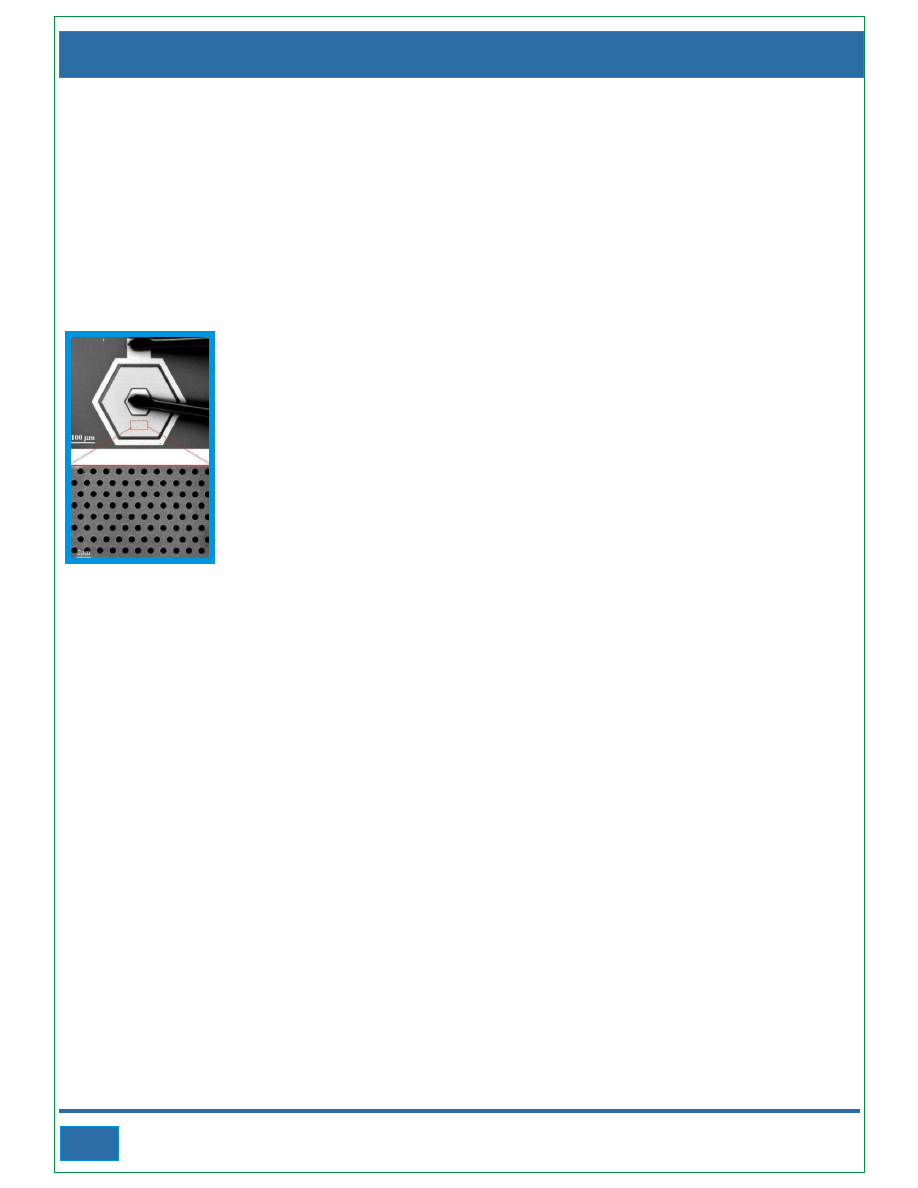
The surface plasmon QDIPs are long, flat structures with countless tiny holes on the surface. The solid
surface of the structure that Lin built is covered with about 50 nanometers -- or 50 billionths of a meter of
gold. Each hole is about 1.6 microns or 1.6 millionths of a meter -- in diameter, and 1 micron deep. The
holes are filled with quantum dots, which are nanoscale crystals with unique optical and semiconductor
properties.
The interesting properties of the QDIP's gold surface help to focus incoming light directly into the
microscale holes and effectively concentrate that light in the pool of quantum dots. This concentration
strengthens the interaction between the trapped light and the quantum dots, and in turn strengthens the
dots' ability to convert those photons into electrons. The end result is that this device creates an electric
field up to 400 percent stronger than the raw energy that enters the QDIP.
The effect is similar to what would result from covering each tiny hole on the QDIP with a lens, but
without the extra weight, and minus the hassle and cost of installing and calibrating millions of
microscopic lenses.
skin irritation, infections in the eyes, ears, and throat, or intestinal illness. The bacterial level is deemed
unacceptable when there are more than 100 bacteria per 100 ml of water.
www.fraunhofer.de
4
Technology Roundup
Feel the Power: Gyms Pedal for Electricity
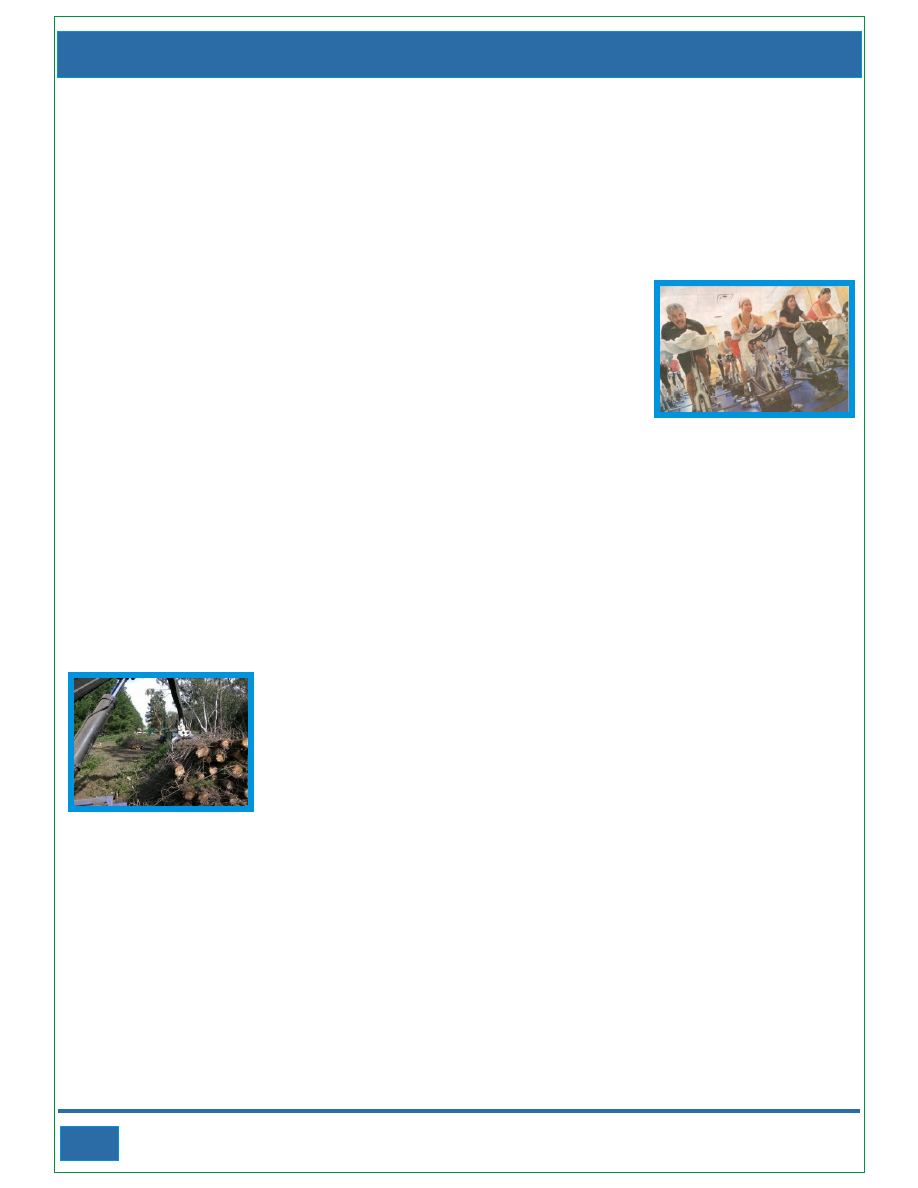
Gym rats can now not only build muscle power, but electric power as they pedal on fitness bikes designed
to light up their own health clubs . The mechanism is simple, using dynamos on the bicycles to transfer 12
volts of electricity produced by the cyclists' pedaling to a generator which creates alternating current of
110 volts. This current helps power the gym building and reduces its bills,
although not the subscriptions for members.
The system is invented by Jay Whelan, CEO of The Green Revolution, in
California, America.
The commercial debut was made in 2009. It takes 20 people to create about
three kilo watts in one-hour session.
In other words, with four sessions a day, the gym creates 300 kilowatts a
month, which is the same as the power needed to light a typical home for half
a year. Over a year, the gymnast can power the equivalent of 72 homes for one month, according to the
company. Green Revolution has several dozen clients in the United States and Canada including
Schools, Universities and Homeless shelters. A small gym might even be able to run its lights entirely
human power.
Green Revolution employs 45 people already and is looking to expand by putting the technology into
other machines, including ellipticals cross-trainers, stepping machines and recumbent bikes.
AFP
Bio-Crude turns Cheap Waste into Valuable Fuel
www.csiro.au
Scientists from CSIRO and Monash University Australia have developed a chemical process that
turns green waste into stable bio-crude oil. This process will clean energy
and reduce greenhouse gas emissions by improving technologies for
converting waste biomass to transport fuels.
The bio-crude oil can be used to produce high value chemicals and biofuels,
including both petrol and diesel replacement fuels.
By making changes to the chemical process, a concentrated bio-crude
which is much more stable than that achieved elsewhere in the world. This
makes it practical and economical to produce bio-crude in local areas for
transport to a central refinery, overcoming the high costs and greenhouse gas emissions otherwise
involved in transporting bulky green wastes over long distances.
The process uses low value waste such as forest thinning, crop residues, waste paper and garden
waste, significant amounts of which are currently dumped in landfill or burned.
The plant wastes being targeted in the process for conversion into biofuels contain chemical known
as lignocellulose, which is increasingly favoured around the world as a raw material for the next
generation of bio-ethanol. Lignocellulose is both renewable and potentially greenhouse gas neutral.
It is predominantly found in trees and is made up of cellulose; lignin, a natural plastic; and
hemicellulose.

5
Technology Roundup
Oxytocin a drives aggression towards Competing out-groups
www.uva.nl
Researchers at the University of Amsterdam provide first-time evidence for a neurobiological cause
of intergroup conflict. They show that oxytocin (commonly known as the "bonding hormone), is a
neuropeptide produced in the brain that functions as hormone and
neurotransmitter, leads humans to self-sacrifice to benefit their own group
and to show aggression against threatening out-groups. This finding qualifies
the wide-spread belief that oxytocin promotes general trust and benevolence.
An important qualification of this research is that oxytocin functions as a
cause of defensive aggression which is oriented towards neutralizing a
threatening out-group. When the competing out-group was not considered a
threat, oxytocin only triggered altruism towards one's own group. This finding provides a
neurobiological explanation for the fact that conflicts between groups escalates when other groups
are seen as threatening. When such threat is low, for example because there are (physical) barriers
between the group territories, conflict escalation is less likely.
The evolution of altruism in intergroup conflict.
The researchers are wondered why oxytocin promotes altruistic behavior. Whereas classic economic
theory has difficulty accounting for altruism, an evolutionary perspective suggests that altruism
functions to strengthen one's own group, from which the individual benefits in the long run. Because
aggression towards competing out-groups helps one's own group to become relatively stronger,
aggression is an indirect form of altruistic, loyal behavior towards one's own group.
Charles Darwin already observed that groups whose members are altruistic towards the own group
have a greater likelihood to prosper, to survive, and spread. The researchers reasoned that if this is
true, neurobiological mechanisms should have evolved that sustain altruism towards the own group,
and aggression towards competing other groups. The discovery that oxytocin promotes altruism
towards the own group, and aggression towards threatening out-groups, supports this evolutionary
perspective.
Semiconductor manufacturing technique holds promise for Solar Energy
Scientists at Illinois University explored lower-cost ways to manufacture thin films of gallium
arsenide that also allowed versatility in the types of devices that will make the future of solar energy
brighter.
Silicon is the most efficient material available for industry standard semiconductor in most
electronic devices, including the photovoltaic cells that solar panels use to convert
sunlight into energy. Other semiconductors like gallium arsenide and related
compound semiconductors offer nearly twice the efficiency as silicon in solar
devices, yet they are rarely used in utility-scale applications because of their high
manufacturing cost.
Typically, gallium arsenide is deposited in a single thin layer on a small wafer. Either the desired
device is made directly on the wafer, or the semiconductor-coated wafer is cut up into chips of the
desired size. The Illinois group decided to deposit multiple layers of the material on a single wafer,

6
Technology Roundup
Sunlight with Cooling Factor
www.fraunhofer.de
In Tunisia and Morocco, scientists are using solar energy to keep perishable foodstuffs such as milk,
wine and fruit fresh.
Solar energy is already being used to power air-conditioning systems in
buildings, but now researchers also want to refrigerate fruit and other
perishable foodstuffs using energy from the sun. Scientists from the
Fraunhofer Institute for Solar Energy Systems ISE in Freiburg have
demonstrated that this is feasible in the Mediterranean region using the
examples of a winery in Tunisia and a dairy in Morocco. In the MEDISCO
project ( Mediterranean food and agro Industry applications of Solar Cooling
technologies) solar plants for refrigerating milk and wine have been installed in cooperation with
universities, energy agencies and European companies. The project is a funded by the European
Commission and run by the Polytechnic University of Milan.
The scientists have installed concentrating collectors which direct the sunlight onto an absorber by
means of a reflector. This makes it possible to convert the solar radiation into hot water with a
temperature of 200 degrees. This extreme water temperature is necessary in order to drive the
absorption refrigeration machine for the high external temperatures that prevail there. Heat is used
to provide refrigeration. The result is the same in both cases: refrigeration in the form of cold water or
a water-glycol mixture. As the absorption refrigeration machine produces temperature, zero degrees,
the experts use the mixture to prevent the water from freezing. The water-glycol solution is collected
in cold accumulators and then pumped through a heat exchanger, which cools the milk. "We use a
slightly different system for wine, with the refrigerant flowing through coiled pipes in the wine tanks.
This method is ideal for countries which have many days of sunshine and in remote areas where there
are no conventional means of refrigeration owing to a lack of water and non-existent or unreliable
energy sources. It is environmentally friendly and reduces the use of expensive electricity for
conventional refrigerators to a minimum. Refrigeration is always available when the sun shines,
which means that it is produced at the times when demand is at its highest.
creating a layered, and “pancake" stack of gallium arsenide thin films. To individually peel off the
layers and transfer them, these stacks have alternate layers of aluminium arsenide with the gallium
arsenide. Bathing the stacks in a solution of acid and an oxidizing agent dissolves the layers of
aluminium arsenide, freeing the individual thin sheets of gallium arsenide. A soft stamp-like device
picks up the layers, one at a time from the top to down for transfer to another substrate like glass,
plastic or silicon, depending on the application. Then the wafer can be reused for another growth.
In this way much more material can be generated more rapidly and more cost effectively.
Freeing the material from the wafer also opens the possibility of flexible, thin-film electronics made
with gallium arsenide or other high-speed semiconductors. Another advantage of the multilayer
technique is the release from area constraints, especially important for solar cells. As the layers are
removed from the stack, they can be laid out side-by-side on another substrate to produce a much
larger surface area especially for photovoltaics that require large area coverage to catch as much
sunlight as possible.
By this method one really multiply the area coverage, and by a similar multiplier could reduce the cost,
while at the same time eliminating the consumption of the wafer might grow enough layers to have 10
times the area of the conventional route. A shift from silicon-based panels to more efficient gallium
arsenide models could make solar power a more cost-effective form of alternative energy.
http://illinois.edu

7
Technology Roundup
Forthcoming Tech Events
Conference for Pakistan Journal of Business & Management
www.hamdard.edu.pk
International Conference on Bussiness Technology and Engineering (ICBTE-2010)
www.iqraisb.edu.pk
Industrial Exhibition (Vision 2010)
www.rcci.org.pk
World Pharma Trials Asia 2010
www.terrapinn.com/2010/pharmatrialscn/
14th International Biotechnology Symposium and Exhibition (IBS2010)
www.ibs2010.org/programme.asp
International Conference on Intelligence and Information Technology (ICIIT
2010)
www.iciit.org
20-25 July, 2010
Karachi, Pakistan.
13 -16 September 2010
China
15 - 19 September 2010
Rimini, Italy.
28-30 October, 2010
Lahore, Pakistan.
23-24 July, 2010
Islamabad, Pakistan.
6-8 August, 2010
Rawalpindi, Pakistan.
8
Technology Roundup
About PASTIC
PASTIC serves as a gateway for
Scientific & Technological
Information for R&D by
catering to the information
n e e d s o f r e s e a r c h e r s ,
entrepreneurs, industrialists,
educationists, policy makers
a n d p l a n n e r s t h r o u g h
anticipatory and responsive
information services.
T e c h n o l o g y I n f o r m a t i o n
Section of PASTIC works
exclusively for support and
promotion of technological
information on trade and
industry in the country.
“ T e c h n o l o g y R o u n d u p ”
provides latest and innovative
technology news, forthcoming
events, etc. It also promotes
products, technologies and
services globally in sectors
such as Agro-Industry, Bio-
Technology, Building Material,
B u s i n e s s , C h e m i c a l s ,
Electronics, Energy, Fisheries,
Food Processing, Machinery,
P a c k a g i n g , M i n i n g
Pharmaceuticals and Textiles.
Please send your feedback and address queries to director@pastic.gov.pk
Anabolic Steroids
Specification: Anabolic steroids, or
anabolic-androgenic steroids, are a class
of steroid hormones related to the
hormone testosterone. They increase
protein synthesis within cells, which
results in the buildup of cellular tissue
(anabolism) , especially in muscles.
Anabolic steroids also have androgenic and virilizing
properties, including the development and maintenance of
masculine characteristics such as the growth of the vocal cords
and body hair.
Company Contact
Alphapharma
Mr. Mushayyad Raza [Marketing]
Address: H-G Colony, Karachi ,Pakistan
Phone: 0092-212637111
Mobile: 0092-3323766322
E-mail: alphamarsh@gmail.com
Tech & Trade Offers
Martindale Abrasion tester
www.marstraders.com
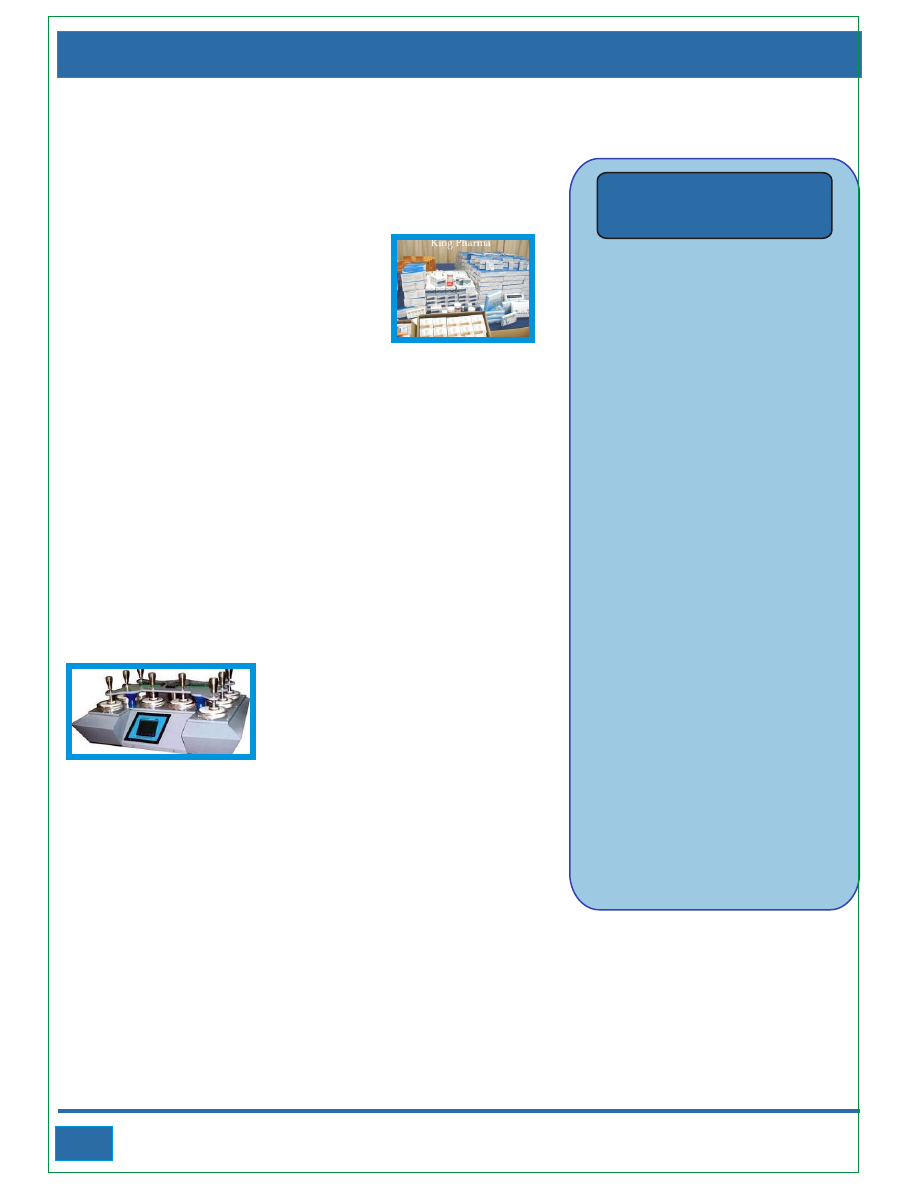
Specification: Used for testing
abrasion resistance of wool or blend
of woven’s wool, knitted and non
woven fabric in specified pressure,
also used for testing balling in light
pressure for most fabrics, especially for wool woven fabric. The
relative moving track between sample and abrasive is figure of
Lissa-jous.
Standards:
ASTM D4966, ASTM D4970, ISO 12947-1, ISO 12945-2
ISO 5470-2 BS 3424-24: 27A, TM112, TM196
Company contact:
Mars Traders
Mr. Ziauddin Qureshi [Director/CEO/General Manager]
Address: A-51, Sector 11-B, North Karachi,Pakistan.
Phone: 0092-212016522
Fax Number:0092-215206702
Mobile: 0092-3018235127