
Patron / Advisor
Editors
Composer
Muhammad Farid Khan Wazir
Chairman PSF
Ms. Nageen Ainuddin
Mr. M. Aqil Khan
Dr. Saima Huma Tanveer
Ms. Saima Majeed
Ms. Shazia Parveen
T
R
ECHNOLOGY
OUNDUP
Technology Information Services Division
Pakistan Scientific & Technological Information Centre
PASTIC
Jan-Feb, 2010
Vol. 2, No.1
A NEWS BULLETIN FROM
Tech News Headlines
Forthcoming Tech Events
Tech & Trade Offers
Phone: 051-9248103-4, 9248117
Fax:
051-9248113
Web: www.pastic.gov.pk
Email:director@pastic.gov.pk
PASTIC National Centre
Quaid-i-Azam University Campus
P.O. Box 1217, Islamabad
Editorial Board
l
l
Teltonika
WirelessCom/ G10
Windmill
Spectrum Enterprises
l
l
l
l
l
l
l
Drink Tech Asia
Agritech Asia
Metal & Steel Asia
Power & Alternative Energy Asia
CWEE China International Wind Energy
Exhibition and Conference
16th International Energy & Environment
Conference
The 9th Annual Biological Production Forum 2010
l
l
l
l
l
l
l
l
l
De-Bugging of Food by a Vacuum Alternative to Pesticides
Computer Scientists attach Images to Passwords to Prevent Fraud
Combination of Lithium and Hydrogen for Future Superconductors
Electrical Engineers develop Pocket-size Fingerprint recognition Device
Smaller and Efficient Nuclear Battery
Single Molecules as Electric Conductors
Thief-Proofing your Laptop with Motion Sensors
Biochemists and Engineers create fast-acting Pathogen Sensor
Robot with a Vision
Technology Roundup
2
Tech News
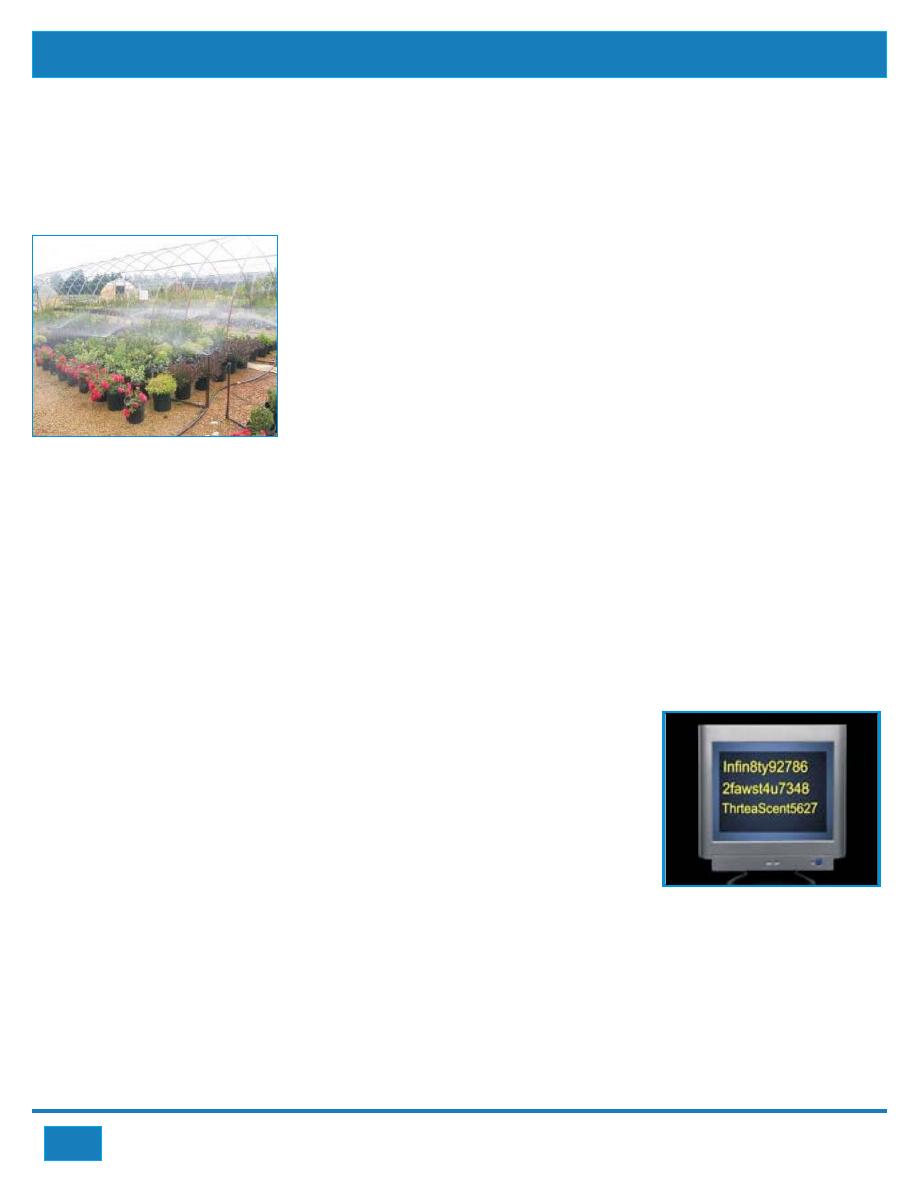
De-Bugging of Food by a Vacuum Alternative to Pesticides
A physical chemist has developed a new technique for ridding harvested produce of
insect pests and microorganisms without using pesticides such as methyl bromide.
Post-harvest fruits and vegetables are typically loaded into a large chamber filled
with methyl bromide gas for about eight hours. Methyl bromide kills most of the
pests (insects and their larvae), but is costly and time-consuming. Five-million
pounds of pesticides a year are used to zap bugs and insects that burrow down on
fruits and veggies. But these colorless, odorless gasses pose a threat to the
environment. It is also scheduled for a worldwide ban, because it is classified as an
ozone-depleting substance. The new technology developed by physical chemist
Manuel Lagunas Solar is creating a new pest control system called MSDD
(Metabolic Stress Disinfection and Disinfestations). This method
doesn't use
chemicals but uses forces and controls the air to achieve the same objective and is
more reliable and cost-effective, and is also non-toxic to humans and safe for the environment. MSDD kills pests using
carbon dioxide, a vacuum pump, and a little alcohol. Insects need oxygen, like all living creatures and MSDD eliminates
their oxygen supply. The produce is put into a chamber, and a vacuum is then applied, reducing the interior air pressure by
about 90 percent,after a few minutes, the chamber is filled with pure carbon dioxide for several more minutes. The
process repeats several times, periodically augmented with ethanol vapor to make sure the bugs are dead. The method has
been successfully tested on table grapes, oranges, grapefruit, stone fruit, kiwi, and bananas.
www.microbeworld.org
Computer Scientists attach Images to Passwords to Prevent Fraud
A computer scientist at Indiana University School of Informatics in Bloomington, is working to find out what the next
computer crime will be ? They have devised a new cryptographic security scheme to protect individual passwords from
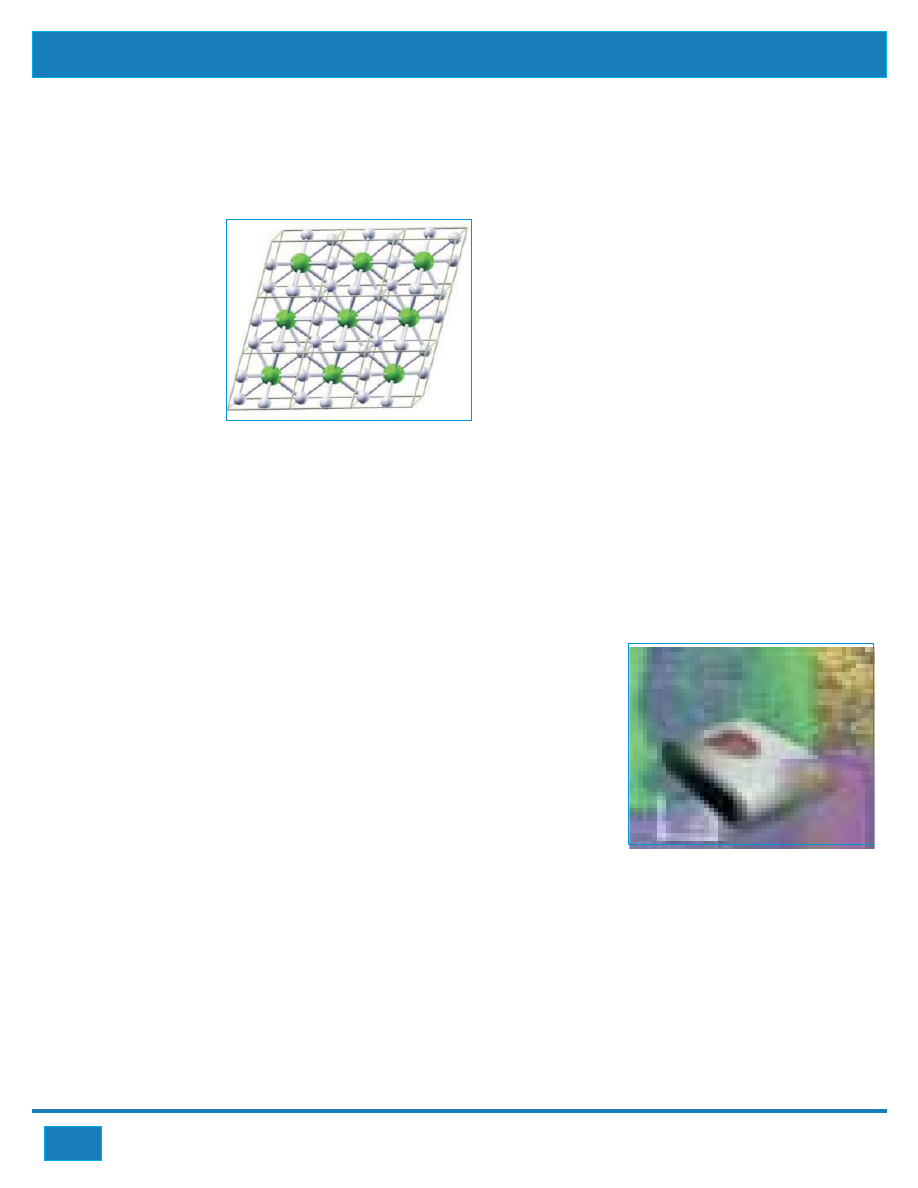
prying eyes. Web sites that visualize images while the user enters a password could help
prevent impostors from stealing personal data or money. The user would see a familiar
image for every letter typed, thus being warned if they see a different one. This could
prevent phishing, the cyber crime practice of masquerading, as a commonly used Web
site to have users type in the passwords that they would use on the real site. The strongest
evidence that you are being phished is that you are getting an e-mail from a bank that
you do not have a banking relationship. The new solution is delayed password
disclosure. It not only uses a password, but also pictures. Each letter or number in your
password would correspond to a picture. If there is even one image that you do not
recognize, that means you are being attacked. Existing security protocols concentrate
on securing the link between two machines, but any hacker can use a computer as a fake access point, stealing information
secretly. Delayed password disclosure counters this by allowing both parties to use a pre-arranged password or PIN for
authentication that is not revealed during communications. Whenever a user initiates a wireless link, the agreed code is
turned into a string of incoherent bits by a mathematical algorithm, while at the other end of the link; another algorithm is
applied to the string and sent back to the user. In this way, the code can be checked mathematically to confirm that the
person at the other end of the link shares the same secret password or PIN.
www.aip.org
3
Combination of Lithium and Hydrogen for Future Superconductors
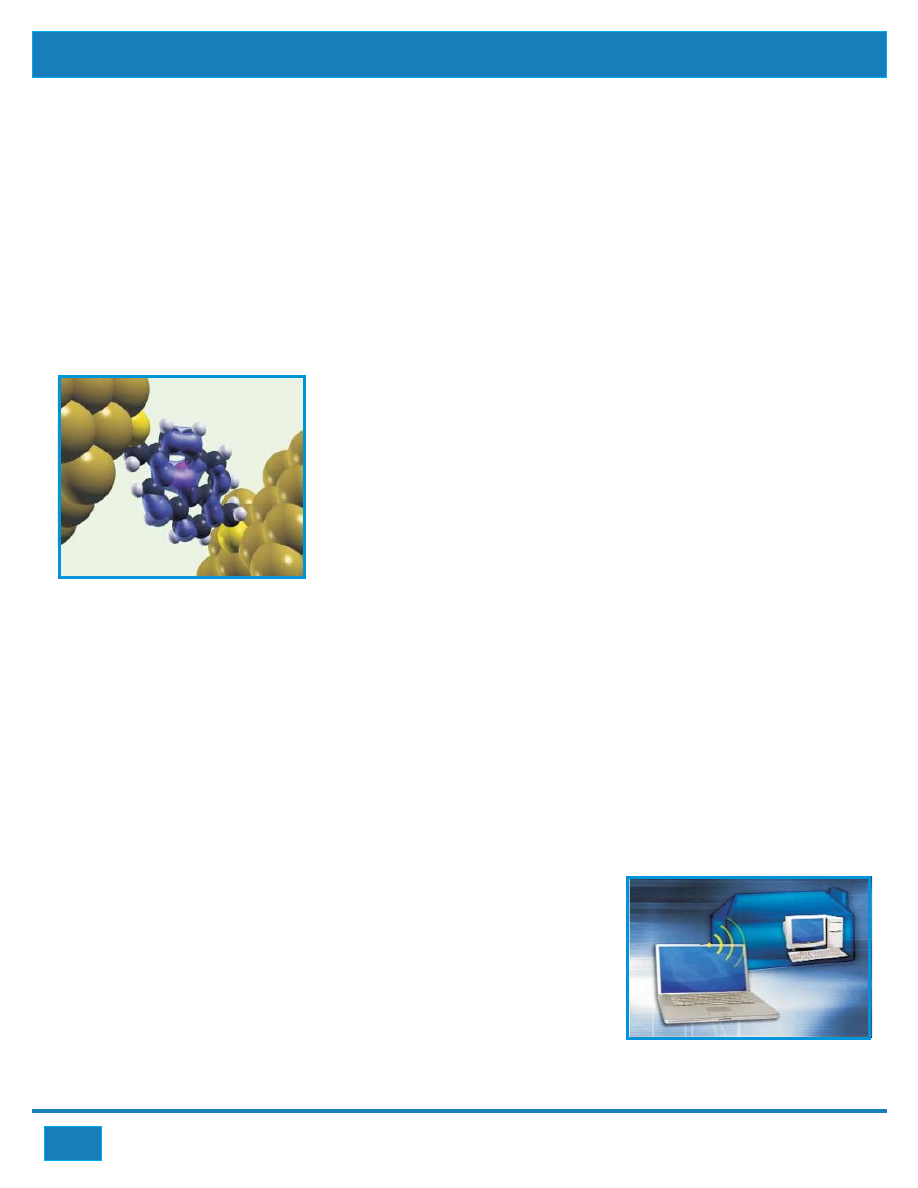
A team of scientists from Cornell University and the State University of New York at Stony Brook announce a theoretical
study that predicts the metallization of hydrogen-rich mixtures at significantly lower pressures. Metallic hydrogen is
predicted to be a high-temperature superconductor (a state of matter where electrons, and thus electricity, can flow
indefinitely and without
resistance). By adding small amounts of lithium to
hydrogen, the study
calculates that the resulting system may be metalized at
around one-fourth the
pressure required to metalize pure hydrogen.Hydrogen
and lithium normally
react with each other to form a stable compound. This
l i t h i u m - h y d r o g e n
compound, or LiH, is not metallic. One of the
combinations predicted
by the team contains one lithium atom for every six
hydrogen atoms or LiH6
the complex calculations predict that in the hypothetical
compound the Li atom is
triggered to release its lone outer electron, which is then
distributed over the three
H2 molecules. Under pressure, the hypothetical reaction
f o r m s
s t a b l e
a n d
metallic hydrogen compound.The calculations also
predict that LiH6 could
be a metal at normal pressures. This stable metallic LiH6
compound is predicted
to form around 1 million atmospheres, which is around 25
percent of the pressure required to metalize hydrogen by it. Another hypothetical compounds studied by the team was
composed of one lithium atom and two hydrogen atoms or LiH2.
The theoretical study opens the exciting possibility that non-traditional combinations of light elements under high
pressure can produce metallic hydrogen under experimentally accessible pressures and lead to the discovery of new
materials and new states of matter.
www.nsf.gov
Electrical Engineers develop Pocket-size Fingerprint recognition Device
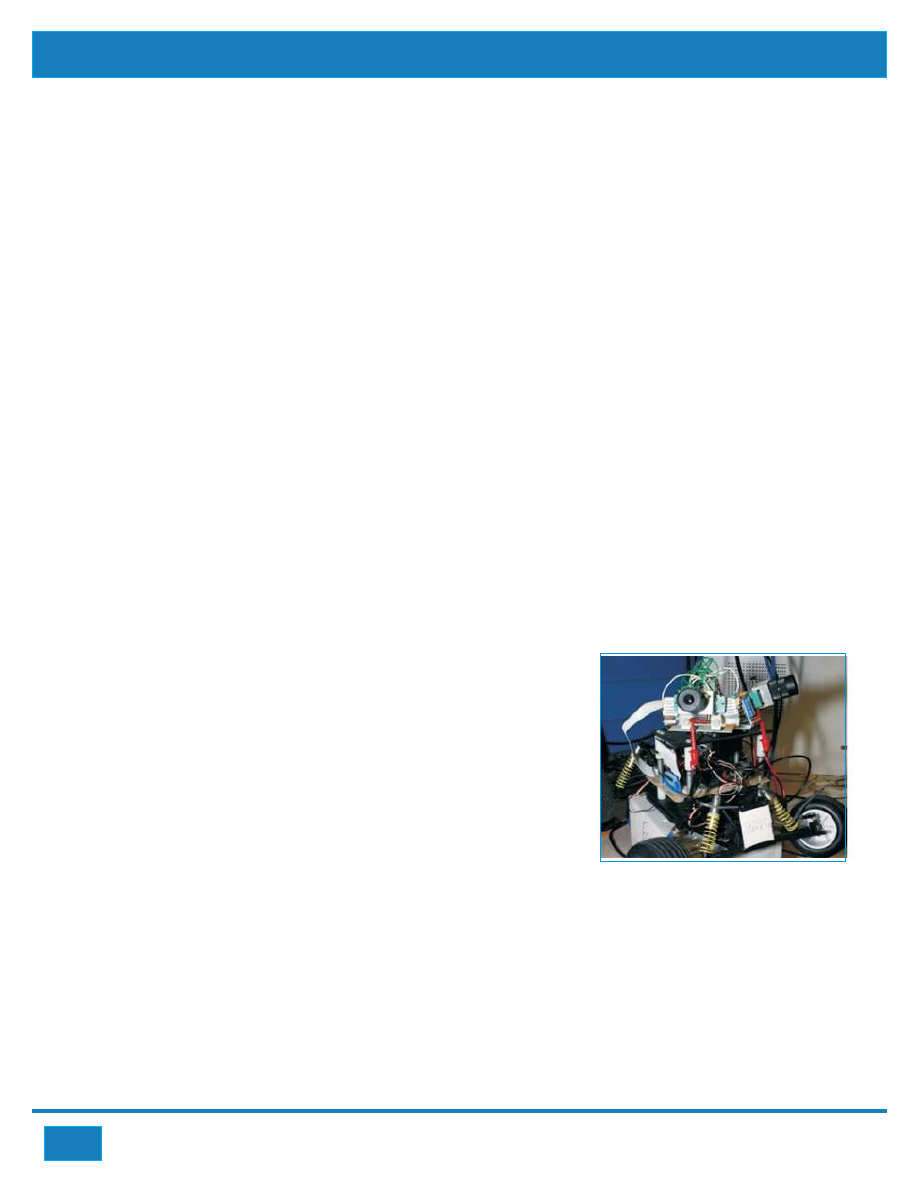
An electrical engineer at Privaris, Inc., in Fairfax, Va. has developed a new security
device that uses a one-of-a-kind access code i.e your fingerprint. The new pocket
device reads fingerprints and validates them by wireless access to a computer. With
this biometrics system, users can avoid using passwords, and get simpler and more
secure access to bank balances, credit cards, and even buildings. It becomes a
personal identification device that you carry with you, and the device only works
for you since the fingerprint, being something that you will not forget. Once you
scan your finger, the device compares the scan to your fingerprint data, or
biometrics already stored in the device. The ability to not only stores the fingerprint
on the device but to do that securely is a unique feature of the device. The new
device can work with existing security systems and also works for access into
buildings. Digits from cadavers and fake fingers molded from plastic, or even play
dough or gelatin, can potentially be misread as authentic by biometric security systems. Electrical and computer
engineers are addressing this issue by trying to "spoof"(the process by which individuals test a biometric security
system by introducing a fake sample ) such systems in hopes of designing more effective safeguards and
countermeasures. The goal is to make the authentication process as accurate and reliable as possible. One such study
found a 90 percent false verification rate; the scanning machines could not distinguish between a live sample and a fake
one. This system was modified to detect the pattern of perspiration from a live finger, which reduced the false
verification rate to less than 10 percent.
www.ieceusa.org
Technology Roundup
Smaller and Efficient Nuclear Battery
Electrical and computer engineers at University of Missouri Columbia are developing a nuclear energy source that is
smaller, lighter and more efficient. These small nuclear batteries, currently the size and thickness of a penny, intended to
power various micro/nanoelectromechanical systems (M/NEMS). Although nuclear power sources have already been
safely powering a variety of devices, such as pace-makers, space satellites and underwater systems. This innovation is not
only in the battery's size, but also in its semiconductor, that uses a liquid semiconductor rather than a solid semiconductor.
In the future, they hope to increase the battery's power, shrink its size and try with various other materials. The battery
could be thinner than the thickness of human hair.
www.missouri.edu
4
Single Molecules as Electric Conductors
Researchers from Graz University of Technology, Humboldt University in
Berlin, M.I.T., Montan University in Leoben and Georgia Institute of
Technology reported an important advance in the understanding of electrical
conduction through single molecules with minimum size and maximum
efficiency. The use of molecules as elements in electronic circuits shows great
potential. The research team has shown that molecules containing an odd number
of electrons are much more conductive at low bias voltages. These fundamental
findings in the highly dynamic research field of nanotechnology open up a
diverse array of possible applications. More efficient microchips and
components with considerably increased storage densities are conceivable. Most
stable molecules have a closed shell configuration with an even number of
electrons. Molecules with an odd number of electrons tend to be harder for chemists to synthesize but they conduct much
better at low bias voltages. Although using an odd rather than an even number of electrons may seem simple, it is a
fundamental realization in the field of nanotechnology because as a result of this, metal elements in molecular electronic
circuits can now be replaced by single molecules. This brings a considerable step closer to the ultimate miniaturization of
electronic components. The motivation for this basic research is the vision of circuits that only consist of a few
molecules. This would open up a wide array of possible applications, the full potential of which will only become
apparent over time. Specific new perspectives are opened up in the field of molecular electronics, sensor technology or
the development of bio-compatible interfaces between inorganic and organic materials. The latter refers to the contact
with biological systems such as human cells, for instance, which can be connected to electronic circuits in a bio-
compatible fashion via the conductive molecules.
www.portaltugraz.at
Thief-Proofing your Laptop with Motion Sensors
Electrical and computer engineers at Carnegie Mellon University have developed
a dime-sized motion sensor that can track lost or stolen laptops and cell phones,
and can also be used to help with personal navigation. It is a nightmare that can
happen in the blink of an eye that your laptop is stolen, and chances are, it is not
coming back. More than 700,000 laptops are stolen each year, but now a new, tiny
motion sensor can tracks your laptop's every move. The sensor is housed in a cube-
shaped casing, and can be embedded in any commercial product. These small
motion sensors can fit inside a laptop computer or even a handheld device, where
they can transmit data back wirelessly. New software uses the data to reconstruct a
laptop's path and its new location, so it can be recovered it in case of theft. Moreover this tiny motion sensor tracks your
Technology Roundup
5
Biochemists and Engineers create fast-acting Pathogen Sensor
Scientists and engineers at Massachusetts Institute of Technology's (MIT) Lincoln Laboratory have invented an
innovative biosensor a device to bring air samples into contact with genetically engineered biosensors in the effort to
detect dangerous biological agents. The technology uses multiple collections of altered cell antibodies, each collection
designed to respond to a specific pathogen by releasing photons of a unique wavelength upon finding it then detectors
measure the photons wavelengths and interpret the pathogens they represent. This device can identify harmful bacteria
or viruses in the air in less than two minutes. It is at least ten times faster than any other automated sensor. Operation is as
simple as loading your DVD player. Disks containing sixteen chambers are loaded into the PANTHER; the device uses
immune cells altered to act as detectors of dangerous biological agents. It takes in air, runs it past the cells, which are
gathered into groups, each designed to react to specific agent. The cells, which are engineered to respond to a specific
pathogen, release photons of light when they detect their target. The machine pulls air through the disk to collect and test
any pathogen that might be in the air. The disk contains the cells that are the key to the canary technology; it releases
those cells into the collected particles and looks for the resulting light, and gives you a sense of what is detected. If a
dangerous pathogen is detected, the sensor goes off alerting anyone who could be in harm's way. The technology can
eventually be used for medical diagnostics to test patient samples. It may even be used in food processing plants to
identify contaminants like E. coli or salmonella. The technology is now licensed commercially.
www.sciencedaily.com
Robot with a Vision
Researcher in the field of Electrical and Computer Engineering (ECE) at
University of Arizona are working to make robots more physical by giving
them sight and an ability to react to what they see. Right now, robots in
general are just pitiful in terms of visual interaction, true, a few of today's
robots can see in some sense, but they are not mobile. These vision systems
are connected to large computers, which precludes their use in small, mobile
robots.
Researchers are developing an airborne visual navigation system by creating
electronic clones of insect vision processing systems in analog integrated
circuits. The circuits create insect-like self-motion estimation, obstacle
avoidance; target tracking and other visual behaviors on two model blimps.
These circuits do not use standard microprocessors, instead, they are based
on what is called "parallel processing" a bunch of slower, simpler analog processors working simultaneously on a
problem. In traditional digital computers, problems are solved in serial fashion, where a single fast digital processor
flashes through a series of steps to solve the problem sequentially because most computers are designed around a
single, powerful processor does not mean that is the way they have to be designed. The human eye, for instance,
processes information at the equivalent of about 100 frames per second (fps) much faster than a movie camera, which
trundles along at 24 fps or a video camera that runs at 30 fps.
The wants to develop a microchip-based vision system that could follow a moving object, or a chip that would
recognize different objects a sidewalk crack it could roll over, for instance, from a ditch that it could not. The key to all
this is packing a huge amount of highly efficient processing in a small space and then the possibilities would be endless
www.arizona.edu
laptop's every move and automatically senses any movement and how fast it is moving. This alert is sent by a wireless
signal to another computer or cell phone you designate. Researchers are also working on adding precise location
information of the laptop to the alerts owner's would receive.
www.aip.org
Technology Roundup

6
Booze to Biofuels: Fuel for the Future
Cars in the future could be running on fuel made from the by-products of brewing and distilling, thanks to a new research
project at the University of Abertay Dundee. The supply of fossil fuels is finite, some estimates suggest that around half
of the world's oil reserves have been used up in the last 200 years and the race is on to find more environmental friendly
alternatives. So the scientists all over the world are trying to find a simple and cost effective way to produce more
biofuels from waste or low value products. Brazil and the USA have both been very successful in creating bioethanol
from sugarcane and maize starch respectively. These countries produce over 70% of global supplies. However the
methods used in these countries are open to criticism since they create an increased demand for land for growing energy
crops. The recent research will be looking at the far more complicated process of turning waste products from industry
into bioethanol as an example of a second-generation biofuel. These products are currently disposed of or processed for
animal feed and turning them into fuel would be an attractive use of the resource. The main advantages of bioethanol
over traditional fuels are that it is CO2 neutral, it produces 65% less greenhouse gas emissions because it burns at a
higher temperature is better for fire safety.
www.abertay.ac.uk
Technology Roundup
Forthcoming Tech Events
Drink Tech Asia, Exhibition
Agritech Asia, Exhibition
Metal & Steel Asia, Exhibition
Power & Alternative Energy Asia, Exhibition
CWEE China International Wind Energy Exhibition and Conference
Drink Tech Asia will showcase the latest innovations in Advanced Equipment and Technologies for Drink Tech
industry.
Karachi Expo Center, Pakistan.
Agritech Asia is a professionally organized exhibition of International standards that will showcase all related
products from around the world. Discover the latest innovations in Advanced Equipment and Technologies,
Agroindustry Startups, Cost Saving Production and many more.
Karachi Expo Center, Pakistan.
The exhibition would serve as a comprehensive showcase of the latest in technology, equipment and machinery as
well as allied services.
Karachi Expo Center, Pakistan.
Power & Alternative Energy Asia will be the biggest specialized exhibition in Pakistan, covering power generation,
transmission and distribution, as well as energy saving technologies and renewable energy development.
Karachi Expo Center, Pakistan.
Shanghai, China
06-08 February, 2010
06-08 February, 2010
27- 29 March, 2010,
27- 29 March, 2010
27-29 April, 2010
www.cwee.com.cn
www.biztradeshows.com
www.biztradeshows.com
www.themagnetguide.com
7
Technology Roundup
16th International Energy & Environment Conference
The 9th Annual Biological Production Forum 2010
12-14 May, 2010
Istanbul, Turkey.
.
21-23 June, 2010
Frankfurt, Germany.
www.icci.com
www.biologicalproduction.com
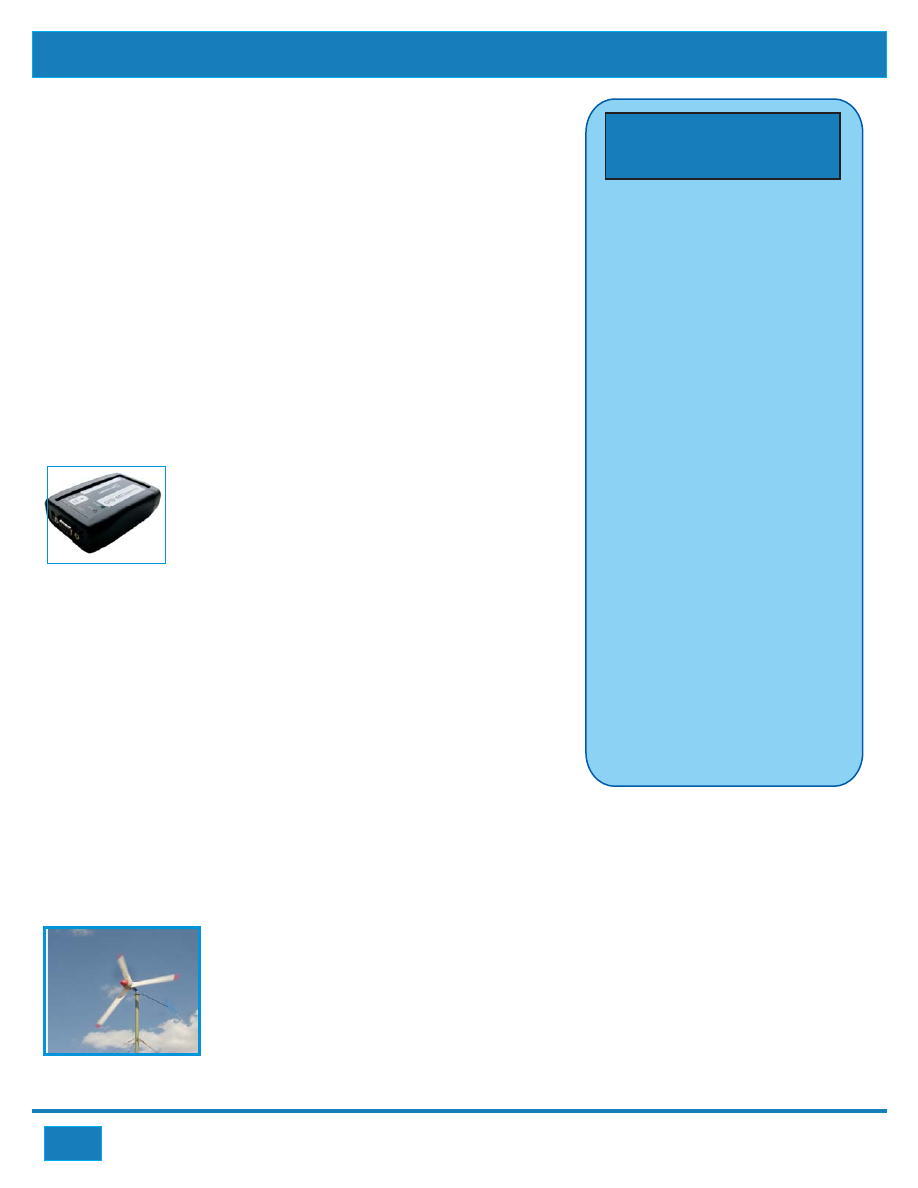
WirelessCom/ G10
Teltonika WirelessCom/ G10 are devices designed
for communication with remote device which have
RS232 ports. RS232 interface is one of the industries
leading standard. This interface can be found in a
large variety of devices like, data loggers, POS
terminals, vending machines, PLCs, control panels,
various meters, switches, routers and the list goes on.
(Manufacturing, Trade, Service of Computer Hardware
& Software)
Mr. Shaukat Ali [Sales]
305, Ahmad Arcade, Block 5 Clifton
Karachi 75400, Pakistan .
Phone: +92 21 32056514
Mobile: +92 3222000765
Fax: +92 21 5831080
Company Contact
TELTONIKA
www.teltonika.pk
Tech & Trade Offers
Windmill
Windmills are ideal for both rural and urban applications including roof top installations. Depending on the shape of
the roof, the wind flow over the roof may be concentrated leading to an increased energy output.Simple to install and
maintain
Manufacturing, Trade of Industrial Supplies
Mr. Abdul Khaliq Bin Zafar [Marketing]
8/21 Arkey Square, New challi, Shahrah-e-Liaquat
Karachi 74000, Pakistan.
Phone: 0092 21 2410610
Mobile: 0092 3452262380
Fax: 0092 21 2410610
Company Contact
Spectrum Enterprises (
)
About PASTIC
PASTIC serves as a gateway for
Scientific & Technological
Information for R&D by catering
to the information needs of
r e s e a r c h e r s , e n t r e p r e n e u r s ,
Industrialist, educationists, policy
makers and planners through
anticipatory and responsive
information services.
Technology Information Services
D i v i s i o n , PA S T I C w o r k s
exclusively for support and
promotion of technological
information on trade and industry
in the country. “Technology
Roundup” is a news bulletin that
provides latest and innovative
technology news, forth coming
events, etc. It also promotes
products,
services globally in sectors such as
Agro-Industry,
Energy,
Food Processing,
Machinery,
Pharmaceuticals and Textiles.
technologies and
Bio-Technology,
Building Material, Business,
Chemicals, Electronics,
Fisheries,
Packaging and Mining
P l e a s e
g i v e
u s
y o u r
f e e d b a c k
a n d
a d d r e s s
q u e r i e s
t o