
T
R
ECHNOLOGY
OUNDUP
Technology Information Services Division
Pakistan Scientific & Technological Information Center
PASTIC
Nov-Dec, 2009
Vol. 1, No.3
Editorial Board
A NEWS BULLETIN FROM
Patron / Advisor
Dr. Manzoor Hussain Somroo, Chairman PSF
Ms. Nageen Ainuddin
Mr. M. Aqil Khan
Dr. Saima Huma Tanveer
Ms. Saima Majeed
Ms. Shazia Parveen
Tech News Headlines
l
l
l
l
l
l
l
l
'Intelligent Car' Warns the Driver in Case of Accident Hazard
New Nanostructure Technology Provides Advances in Eyeglass, Solar Energy Performance
Paper Battery may Power Electronics in Clothing and Packaging Material
Hydrogen Fueled Cars
New Multi-Use Device for Measuring Oxygen Intake
When is the Pineapple Ripe? Metal Oxide Sensors to Detect Safety and Quality Of Foods
New Technology Detects Chemical Weapons in Seconds
Plasmobot': Scientists to Design First Robot Using Mould
International
Fourth Coming Tech Events
National
l
l
l
Aquatech India 2010 (Industry Science & Technology)
The China International Exhibition on Label Printing
Technology 2010
ICECT 2010 (International Conference on Electronic
Computer Technology )
l
l
l
6th Pharma Asia International Exhibition 2009 (Exhibition &
Conference)
IFTECH (International Food & Technology Exhibition)
PAKISTAN
ICBTE-2010 (International Conference on Business Technology
and Engineering )
Tech & Trade Offers
l
l
Dizyan natural gas network
EDX3600B Professional Full-element Analyzer
Design Traders
JMZ Perfect Business Associates
Phone: 051-9248103-4
Fax: 051-9248113
Email:
director@pastic.gov.pk
www.pastic.gov.pk
PASTIC National Center
Quaid-I-Azam University Campus
P.O. Box 1217, Islamabad
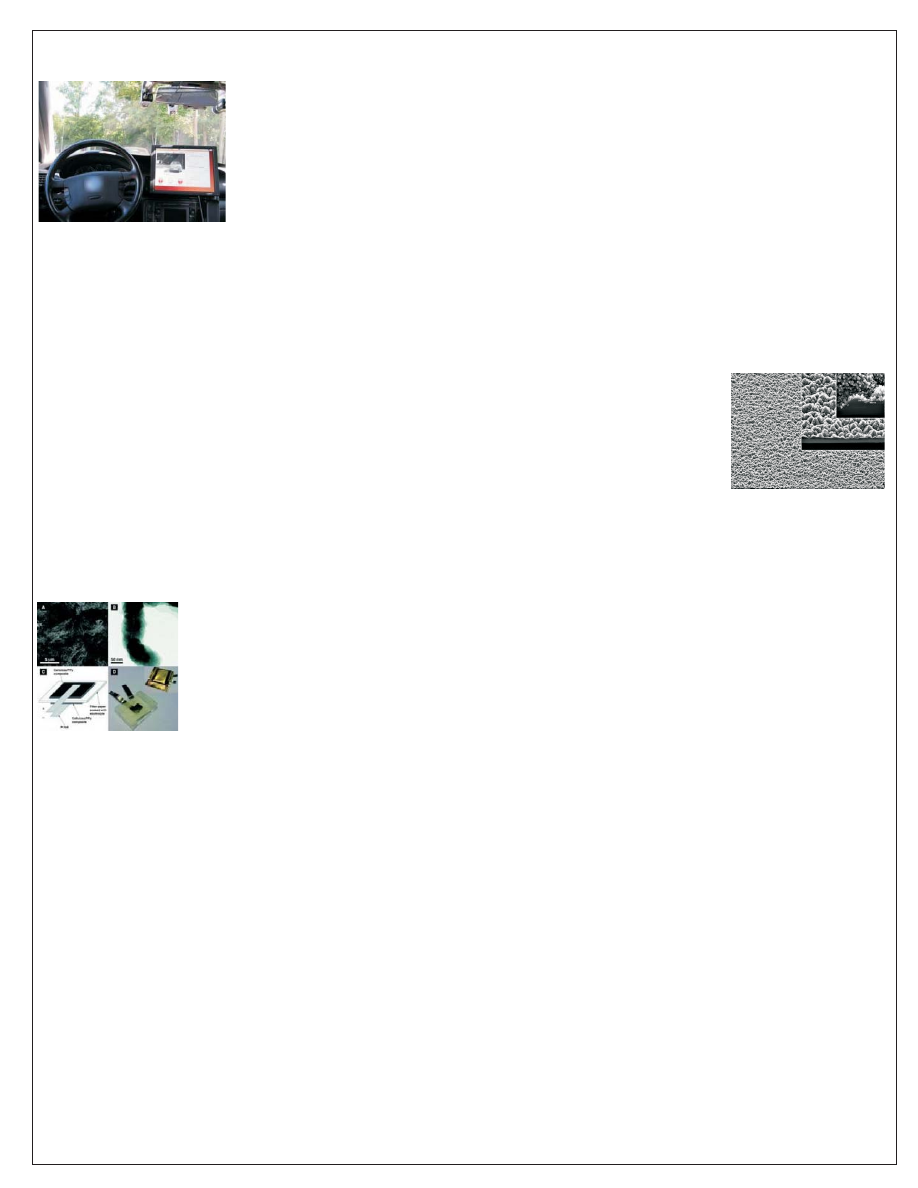
'Intelligent Car' Warns the Driver in Case of Accident Hazard
A research group of the Department of Computer Architecture and Technology at the University of Granada
Spain has developed a new computer system, called DRIVSCO, that allows vehicles to learn from the behavior
of their drivers at the wheel, in such a way that they can detect if a driver presents an “unusual behavior” in a
curve or an obstacle on the road and generates signals of alarm which warn him on time to react. The concept
investigated was how to get that a car learns from the user's driving facing a curve or an approaching
intersection, a pedestrian or another vehicle regardless the type of driving of the driver. The DRIVSCO goes far
beyond a computer vision system for driving assistance. During night driving, if the vehicle detects a deviation
in his way of driving in face of a curve, it interprets that it is due to the lack of visibility of the driver (as the driver
has a limited visibility of the low beams field, whereas the car's night vision system is much more powerful and
has a longer range). Therefore, it generates signals of alarm to warn the driver of his unusual behavior when
approaching a curve or detection of a potentially dangerous object. The research group has developed a system
of artificial vision (analysis of the scenario) in only one chip. Such device receives input pictures and produces a first “interpretation of the
scenario” in terms of depth (3D vision), local movement, image lines, etc, everything in an only electronic chip. This system can be assembled in
different types of vehicles in future. In addition, they have used a “reconfigurable hardware”, so that the system can adapt itself to new field of
application.
New Nanostructure Technology Provides Advances in Eyeglass, Solar Energy Performance
Chemical engineers at Oregon State University,USA have invented a new technology to deposit "nanostructure
films" on various surfaces, which may first use as coatings for eyeglasses that cost less and work better. The key to the
process is use of a chemical bath, controlled by a microreactor, to place thin-film deposits on various substrates such
as glass, plastic, silicon or aluminum. The technology will create a type of nanostructure that resembles millions of
tiny pyramids in a small space, which function to reduce the reflectance of any light that strikes the material. The
films reduce the reflectance of light, and in the case of eyeglasses would capture more light, reduce glare and also
reduce exposure to ultraviolet light. The technique may also provide a way to make almost any type of solar energy
system work more efficiently, and ultimately could be used in cameras or other types of lenses. A patent has been
applied for the new technology, and the first commercial products may be ready within a year.
Www.organstate.edu
Paper Battery may Power Electronics in Clothing and Packaging Material
I
magine a gift wrapped in paper that lights up with words like "Happy Birthday" or "Happy Holidays," thanks to a built
in battery an amazing battery made out of paper. Scientists are trying to develop light, ecofriendly, inexpensive batteries
consisting entirely of nonmetal parts. The most promising conductive polymer being used is polypyrrole (PPy), but
often regarded as too inefficient for commercial batteries. The scientists realized, however, that by coating PPy on a
large surface area substrate and carefully tailoring the thickness of the PPy coating, both the charging capacity and the
charging (discharging) rates can be drastically improved. The secret behind the performance of this battery is the
presence of the homogeneous, uninterrupted, nano-thin coating about 1/50,000th the thickness of a human hair of PPy
on individual cellulose fibers which in turn can be molded into paper sheets of exceptionally high internal porosity. The
special cellulose used was extracted from a certain species of green algae, with 100 times the surface area of cellulose
found in paper. That surface area was key to allowing the new device to hold and discharge electricity very efficiently. The innovative design of the
battery cell was simple since both of the electrodes consist of identical pieces of the composite paper separated by an ordinary filter paper soaked
with sodium chloride serving as the electrolyte. The potential difference is solely due to differences between the oxidized and reduced forms of the
functional PPy layer. The battery recharged faster than conventional rechargeable batteries and appears well-suited for applications involving
flexible electronics, such as clothing and packaging, the scientists say. Alternatively, low-cost very large energy storage devices having electrodes
of several square yards in size could potentially be made in the future.
.Www.acs.org
Hydrogen Fueled Cars
Scientists at the Swiss-Norwegian experimental stations (beamlines) at the ESRF has just discovered a new form of lithium borohydride (LiBH4)
which brought research on hydrogen-fueled cars one step closer to application. Automotive industry regards hydrogen as a perspective energy
carrier. If a good hydrogen storage material is developed, the petrol in cars can be replaced by clean hydrogen energy and five kilograms of
hydrogen would take you as far as twenty liters of petrol. Today there are several compounds of interest, which are known to either store relatively
large amounts of hydrogen or release it easily, but none do both in a way suitable for practical application. Researchers at the ESRF are currently
studying several compounds of light elements with hydrogen and different forms they take at different pressure and temperature. The new form of
lithium borohydride, appears to be unstable. Until today, all the known forms of this material are too stable, which means that they don't let the
hydrogen go. This one is really unexpected and very encouraging. Combined experimental and theoretical efforts suggest that the new from of
LiBH4 can release hydrogen at a lower temperature and becomes even more attractive considering the fact it appears already at 10.000 bar, the
pressure used by pharmaceutical companies to compress pellets. It can be stabilized by chemical substitutions even at ambient pressure. For now,
the team's next step is to apply chemical engineering to the compound to “freeze” the new form at ambient conditions and check whether it shows
more favorable hydrogen storage.
Www.sciencedaily.com
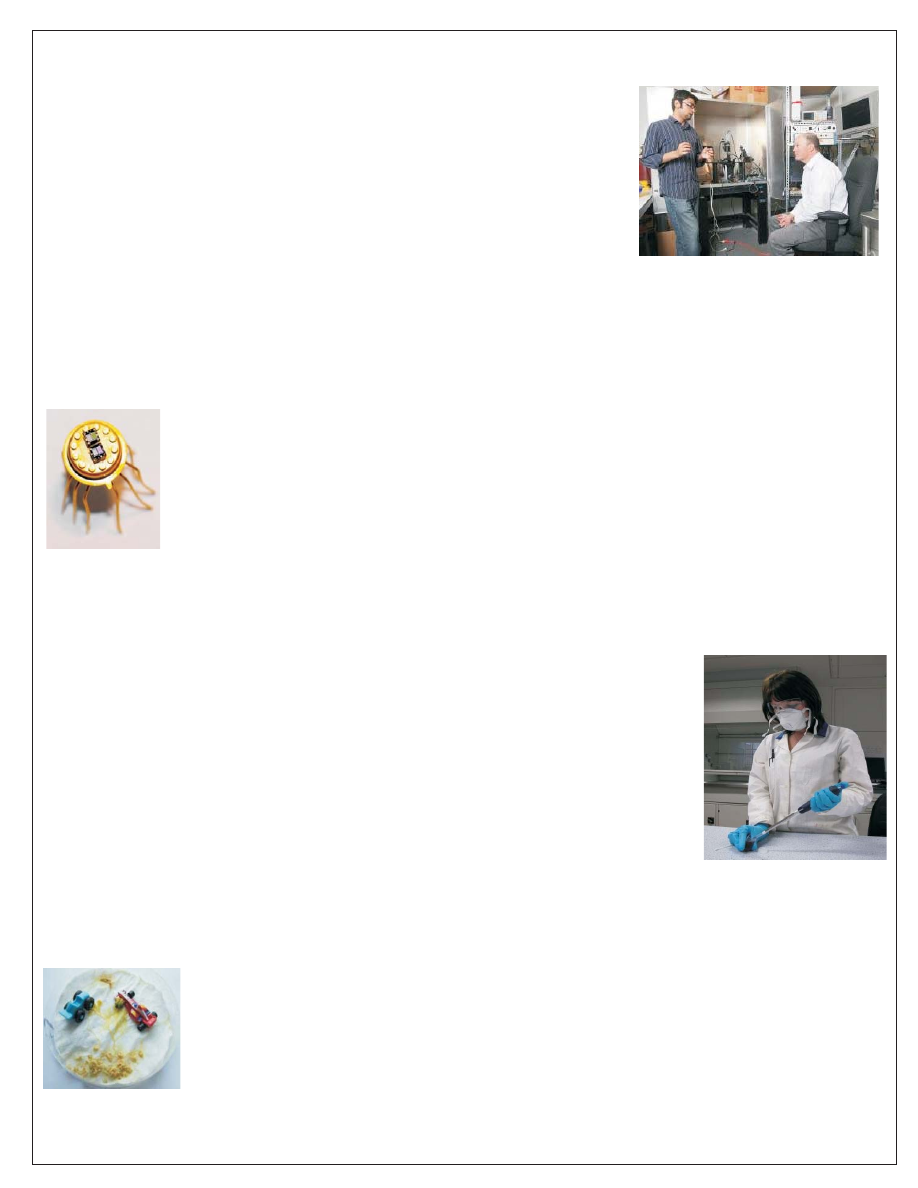
New Multi-Use Device for Measuring Oxygen Intake
Purdue University researcher's team has created a fiber-optic sensor capable of measuring oxygen
intake rates could have broad applications ranging from plant root development to assessing the
effectiveness of chemotherapy drugs. The self-referencing optrode is non-invasive, can deliver real-
time data, holds a calibration for the sensor's lifetime and does not consume oxygen like traditional
sensors that can compete with the sample being measured. The sensor is created by heating an optical
fiber and pulling it apart to create two pointed optrodes about 15 microns in diameter, about one-tenth
the size of a human hair. A membrane containing a fluorescent dye is placed on the tip of an optrode.
Oxygen binds to the fluorescent dye. When a blue light is passed through the optrode, the dye emits
red light back. The complex analysis of that red light reveals the concentration of oxygen present at
the tip of the optrode. The optrode is oscillated between two points, one just above the surface of the
sample and another a short distance away. Based on the difference in the oxygen concentrations,
called flux, the amount of oxygen being taken in by the sample is calculated. It's the intake, or oxygen
transportation, that is important to understand because just knowing the oxygen concentration in or around a sample will not necessarily correlate
to the underlying biological processes going on. The sensor could have applications in biomedical science, agriculture and material science.
Testing included tumor cells, fish eggs, spinal cord material and plant roots. Future work will focus on altering the device to measure things such
as sodium and potassium intake as well. The National Science Foundation funded the research.
Www.purdue.edu
When is the Pineapple Ripe? Metal Oxide Sensors to Detect Safety and Quality Of Foods
Researchers at the Fraunhofer Institutes for Molecular Biology and Applied Ecology IME in Schmallenberg have
developed system that uses volatile components to detect when the pineapple is ripe and when it can be delivered to the
supermarket. The system has been developed by bringing together various technologies based on the use of metal oxide
sensors, similar to those installed in cars, for example, to close ventilation vents when driving through a tunnel.
Researchers at IPM have developed these sensors further and if a gas flows over the sensor, at temperatures of 300 to
400°C, it will burn at the point of contact. The subsequent exchange of electrons changes the electrical conductivity, before
the gas reaches these sensors; it has to go through a separation column with polymers. Certain substances are already
filtered out here. A prototype of the analysis equipment already exists. Initial tests were promising the system measures
the volatile substances just as sensitively as conventional equipment used in food laboratories. In a further step the
researchers want to optimize the system and adapt it to specific problems.
Www.fraunhofer.de
New Technology Detects Chemical Weapons in Seconds
Scientists at Queen's University Belfast are developing new sensors to detect chemical agents and illegal
drugs which will help in the fight against the threat of terrorist attacks. The devices will use special gel pads
to 'swipe' an individual or crime scene to gather a sample which is then analyzed by a scanning instrument
that can detect the presence of chemicals within seconds. This will allow better, faster decisions to be made
in response to terrorist threats. The scanning instrument will use Raman Spectroscopy which involves
shining a laser beam onto the suspected sample and measuring the energy of light that scatters from it to
determine what chemical compound is present. It is so sophisticated it can measure particles of a miniscule
scale making detection faster and more accurate. Normally this type of spectroscopy is not sensitive enough
to detect low concentrations of chemicals, so here the sample is mixed with nanoscale silver particles which
amplify the signals of compounds allowing even the smallest trace to be detected. Preliminary researches
have already been completed and are now at the exciting stage where they put the various strands together
to produce the integrated sensor device. For the future, they hope to be able to capitalize on this research
and expand the range of chemicals and drugs which these sensors are able to detect. It is hoped the new
sensors will also be the basis for developing 'breathalyzer' instruments used by police for detecting alcohol
and roadside drugs.
Www.epsrc.ac.uk
Plasmobot': Scientists to Design First Robot Using Mould
Scientists at the University of the West of England are to design the first ever biological robot using plasmodium, the
vegetative stage of the slime mould Physarum polycephalum, and a commonly occurring mould which lives in forests,
gardens and most damp. This research is at the forefront of unconventional computing. This mould, or plasmodium, is
a naturally occurring substance with its own embedded intelligence. It propagates and searches for sources of nutrients
and when it finds such sources it branches out in a series of veins of protoplasm. The plasmodium is capable of solving
complex computational tasks, such as the shortest path between points and other logical calculations. This new
plasmodium robot, called plasmobot, will sense objects, span them in the shortest and best way possible, and transport
tiny objects along pre-programmed directions. The robots will have parallel inputs and outputs, a network of sensors
and the number crunching power of super computers. The plasmobot will be controlled by spatial gradients of light,
electro-magnetic fields and the characteristics of the substrate on which it is placed. It will be a fully controllable and programmable amorphous
intelligent robot with an embedded massively parallel computer.
www.uwe-ac.uk

FORTHCOMING EVENTS
NATIONAL
6th Pharma Asia International Exhibition 2009 (Exhibition & Conference)
IFTECH (International Food & Technology Exhibition) PAKISTAN
06-08 March, 2010, Karachi, Pakistan
www.health-asia.com
31st May-3rd June, 2010, Karachi, Pakistan
www.foodtechpakistan.com
23- 24 July 2010, Islamabad, Pakistan
www.iqraisb.edu.pk/icbte
ICBTE-2010( International Conference on Business Technology and Engineering )
INTERNATIONAL
Aquatech India
(Industry Science & Technology)
The China International Exhibition on Label Printing Technology 2010
2010
ICECT 2010 (International Conference on Electronic Computer Technology )
3-5 February 2010 New Delhi, India
www.iloveindia.com
9-11 March, 2010, China
www.2456.com
7-10 May, 2010, Kuala Lumpur, Malaysia
www.icect.org
DIZYAN Natural Gas Network
Specification: Canalization pipes are produced from Polyethylene not affected by corrosion and highly
resistant to chemicals and erosion used in natural gas systems at construction site as coils. It is highly resistant
to chemicals
Company Contact
Design Traders
Mr. Shoukat Bari [Marketing]
Address: 9/14, Omer Blessing, Firdous Colony, Nazimabad.
Karachi,74600, Sindh, Pakistan.
Phone: 0092-21-5404646, 8705123-4
E-mail: designtraders@gmail.com
www.designtraders.tk
Tech & Trade Offers
EDX3600B Professional Full-element Analyzer
Specification:
Company Contact
Cracking the problem of quick analysis of complex samples in cement and steel industries Low energy X-rays are used,
delivering good results when exciting light elements UHRD detector, with good energy linearity and energy resolution
Multiple linear regression, reducing inter elemental absorption and enhancement effect.
Dr.Zulfeqar Hussain Khan (CEO)
T-15Second Floor, Hakimsons Building,West Wharf, Karachi 74000, Pakistan
Phone: 0092-21-2315070-80Fax:0092-21-2205080
Mobile: 0092-321-2818712
E-mail:jmzpba@gmail.com
JMZ perfect business associates
Please give us your feedback and address queries to director@pastic.gov.pk