
Patron/Executive Editor
Dr. Muhammad Akram Shaikh
Director General, PASTIC
Managing Editors
Ms. Nageen Ainuddin
Mr. M. Aqil Khan
Editor
Dr. Saima Tanveer
Composer
Kashif Farooqui
T
ECHNOLOGY
R
OUNDUP
Technology Information Section (TIS)
Pakistan Scientific & Technological Information Centre
PASTIC
March-April, 2015
Vol. 7, No. 2
A NEWS BULLETIN FROM
Tech News Headlines
Tech & Trade Offers
Phone: 051-9248103-4, 9248111
Fax: 051-9248113
Email:editor@pastic.gov.pk
Web: www.pastic.gov.pk
PASTIC National Centre
Quaid-i-Azam University Campus
P.O. Box 1217, Islamabad
Editorial Board
l
Prototype Design and Experimentation of Reverse Osmosis (RO)
Based Wastewater Treatment
l
Evaluating The Success of Vegetative Propagation Techniques in
Loquat Cv. Mardan
l
The Biobattery: Turning Sewage Sludge into Electricity and Engine
Oil
l
Energy-Generating Cloth Could Replace Batteries in Wearable
Devices
l
Flexible Sensors Turn Skin into a Touch-Sensitive Interaction Space
for Mobile Devices
l
Energy Use in Buildings: Innovative, Lower Cost Sensors and
Controls Yield Better Energy Efficiency
LVD Induction Lamp
Technology
Forthcoming Tech Events
l
l
l
l
l
l
th
13 International Exhibition for the Energy Industry
th
l 8 Food Technology and Machinery International Show, 2015
l Food Technology Asia, 2015
Solar 2015 Conference & Expo
th
15
International Conference & Exhibition on Engineering Fields
International Innovation and Technology Exhibition
(INOTEX 2015)
th
4
International Conference on Bio-Sensing Technology
CTBT: Science and Technology 2015, Conference

Technology Roundup
2
Indigenous
Technology
Prototype Design and Experimentation of Reverse Osmosis (RO) Based
Wastewater Treatment
Researchers from
e studied of Prototype Design and Experimentation of Reverse Osmosis (RO) Based Wastewater
Treatment
NUST Journal of Engineering Sciences, 2013 6(1) 5-9
Department of Chemical Engineering, University of Engineering and Technology, Peshawar
hav
Huge water resources are available in various parts of the world but are contaminated. Contaminated water sources
have direct and indirect effect on human health. There are numerous diseases like diarrhea, cholera, typhoid fever
are transmitted through the polluted water. Membrane filtration technology offers an advanced alternative for
conventional water treatment technology by producing water free of biological contamination. Especially, Reverse
Osmosis (RO) and Nano filtration (NF) technologies, mainly because of their small pore sizes, have a great
potential to remove biodegradable organic substances from source water and consequently reduce the potential for
bacterial growth in the distribution system. However, pilot scale studies have not been found in the literature to treat
the raw water including physical and biological wastewater characteristics in one step.
Abstract In the past few years, the commercialization of small scale reverse osmosis(RO) plant for low total
dissolved solids(TDS) brackish and contaminated groundwater water desalination offered an alternative solution
to obtain drinking water with TDS lower than 500mg/L. Due to rapid development in membrane technology the
technical and economical usefulness of RO process has been improved. In the current research work, a prototype
Reverse Osmosis (RO) wastewater treatment plant has been developed and its performance was evaluated to
produce the safe and drinkable water at local small community. Salt rejection and permeate water flow rate are the
key performance parameters. These performance parameters are influenced by other variable parameters such as
applied feed pressure, temperature, recovery and feed water salinity. The RO plant performance has been evaluated
through testing different water quality parameters; including physical, chemical and biological analysis of the
treated sample. The plant was operated by varying feed water pressures and feed water salinity which indicated that
the product water has the highest quality and maximum permeate low rate at 25 bar of applied feed water pressure
for feed water salinity up to 4000 mg/L. The water quality results indicate that permeate obtained after treatment
has excellent quality free physical and microbial contaminants.
Muhammad Younas (Department of Chemical Engineering, University of Engineering and Technology,
Peshawar, Pakistan) Wajid Ali (Department of Chemical Engineering, University of Engineering and
Technology, Peshawar, Pakistan) Muhammad Zaheer (Department of Chemical Engineering, University of
Engineering and Technology, Peshawar, Pakistan)
Courtesy:

Technology Roundup
3
Indigenous
Technology
Evaluating The Success of Vegetative Propagation Techniques in Loquat
Cv. Mardan
Researchers from Department of Horticulture, Pir Mehr Ali Shah-Arid Agriculture University,
Rawalpindi have Evaluated The Success of Vegetative Propagation Techniques in Loquat Cv. Mardan
Loquat (Eriobotrya japonica Lindl.) belongs to the family Rosaceae, subfamily Pomoideae is an evergreen
fruit tree. So far, loquat has been grown in over 30 countries in the world. China is the leading country in
loquat cultivation followed by Spain and Japan (Lin et al., 2007). In Pakistan, its production is 13,159 tons.
Loquat fruit matures in early spring season. In Pakistan, its fruit becomes available in the months of March
and April, when none of the other fresh fruit is available in the market, hence fetch good returns. Increasing
trend in loquat area as well as production indicates its great potential in the country.
Loquat cv. Mardan is a promising variety in loquat growing areas of northern Punjab and Khyber Pakhtoon
Khwa. Loquat growers face serious issue of true to type plants availability. An attempt was made to explore
different vegetative propagation techniques to find out most successful method for nursery industry. In the
study propagation through cutting (during spring) and grafting during different suitable seasons (spring and
monsoon) was examined. Cuttings were treated with different growth regulators to promote rooting. PBZ,
IBA and their combinations were applied to the cuttings. Highest success percentage (40%) was achieved
with PBZ. This limited success in rooting of cuttings was complete failure in getting plant survival at the end
of the study. In the second phase of the experiment different grafting techniques i.e. tongue, cleft and side
grafting were evaluated during two different seasons i.e., spring and monsoon. Cleft grafting in the months of
March/ April proved to be most successful method in terms of success (70%), days taken for shoot growth,
no. of leaves, shoots length, no. of branches. While in monsoon season side grafting was significantly better
with a success of 85%. Overall, monsoon side grafting proved to be more successful than any other method.
NADEEM AKHTAR ABBASI* (Department of Horticulture, Pir Mehr Ali Shah-Arid Agriculture
University, Rawalpindi, Pakistan) ISHFAQ AHMAD HAFIZ (Department of Horticulture, Pir Mehr Ali
Shah-Arid Agriculture University, Rawalpindi, Pakistan) ABDUL AHAD QURESHI (Department of
Horticulture, Pir Mehr Ali Shah-Arid Agriculture University, Rawalpindi, Pakistan) IRFAN ALI
(Department of Horticulture, Pir Mehr Ali Shah-Arid Agriculture University, Rawalpindi, Pakistan) SYED
RASHID MAHMOOD (Department of Horticulture, Pir Mehr Ali Shah-Arid Agriculture University,
Rawalpindi, Pakistan)
Courtesy:
Pakistan Journal of Botany , 2014,46 (2) 579-584
4
Technology Roundup
Widely used Food Additives Promotes Colitis, Obesity and Metabolic
Syndrome, shows Study of Emulsifiers
www.fraunhofer.de/en/press
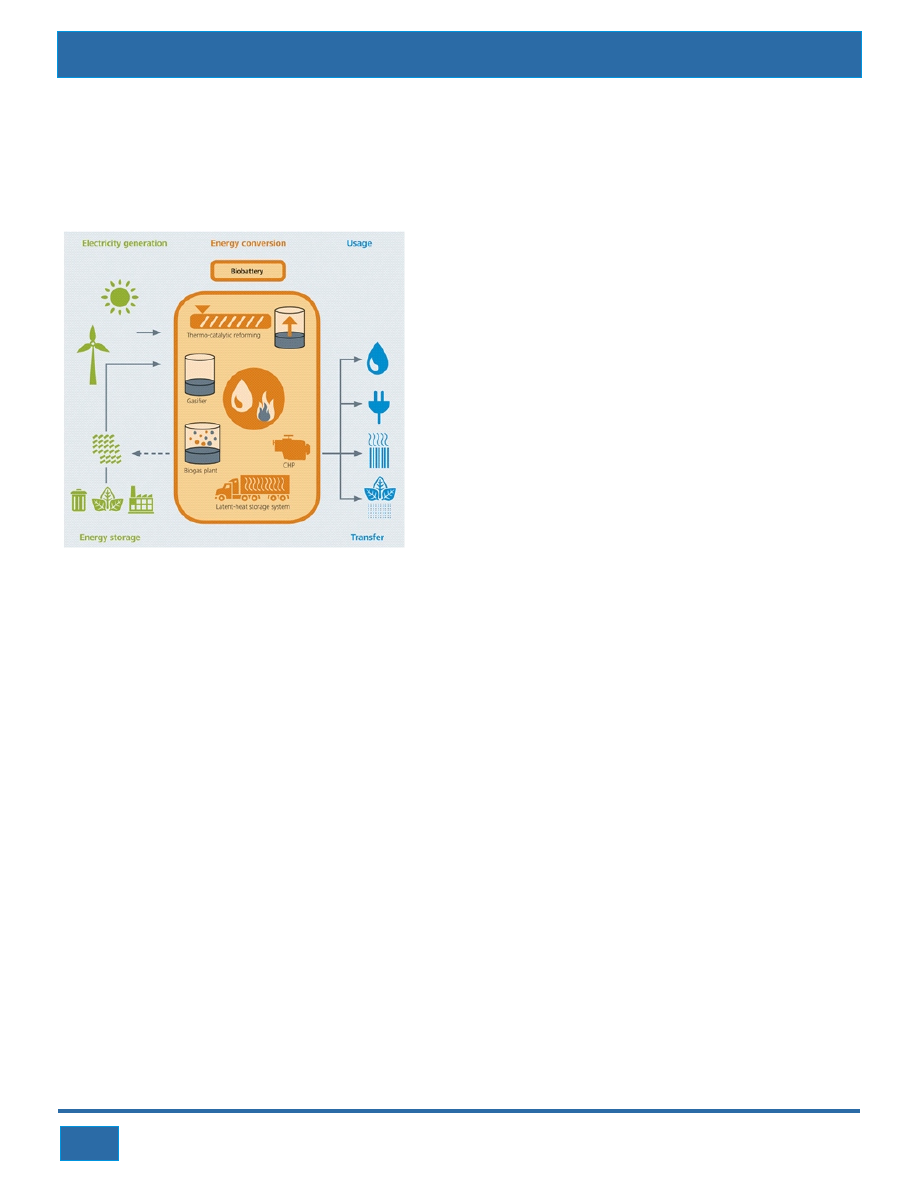
Sewage sludge, green waste, production residue from the food industry, straw or animal excrement with the
biobattery's modular concept a much larger range of biomass can be utilized for energy recovery than
previously. Researchers show that they can convert organic
residues into electricity, heat, purified gas, engine oil and
high quality biochar using this process.
B
iogas plants are an
important element for decentralized energy supply. They
produce electricity from renewable resources and can
compensate for highly fluctuating wind and solar energy.
There are already 8,000 plants in operation in Germany with
an electrical output of 3.75 gigawatts in total, that is the
equivalent to roughly three nuclear power plants. However,
the plants have several disadvantages too: they only process
a limited range of organic substances and are in competition
with the cultivation of food plants.
Scientists from the Fraunhofer Institute for Environmental,
Energy and Safety Technology UMSICHT, Germany have
now succeeded in considerably improving the efficiency of
biogas plants. The biobattery process developed by them not
only supplies electricity and heat but also high quality
products such as gas, oil and vegetable carbon. These can
be utilized as required, for example to produce electricity, as
marine or aviation fuel, as an admixture for fuels or as a fertilizer. If further processed they even provide basic
substances for the chemical industries. The biobattery is modular and consists of a pool of environmentally-
friendly technologies such as biogas plants, thermal storage, carburetors and engines to produce electricity.
The heart of the concept is thermo-catalytic reforming (TCR®). With this the experts convert carbons out of
organic material, for example fermentation residues from biogas plants and bioethanol production, industrial
biomass waste, sewage sludge, straw, scrap wood or animal excrement. The result: oil, gas and biomass
cokes. "The particular advantage of the biobattery is that we can utilize a number of raw materials which would
otherwise have to be disposed of often at great cost.
Researchers are demonstrating that this also works in practice at a pilot plant that utilizes roughly 30 kg of
fermentation residues every hour. The raw materials first pass through a sluice without oxygen into a
continuously rotating screw. There the material is heated up and broken down into biochar and volatile
vapours. The vapours are reheated and then cooled down again. In the process it condenses into a liquid,
which contains bio-oil and water. Researchers separate the high quality oil to reuse it. The resulting gas is
purified and collected. The liquid, gaseous and solid products can be reutilized in various ways. The oil can
either be processed into marine and aviation fuel or used in a combined heat and power plant, as can the gas,
to produce electricity and heat. The separated process water contains numerous short-chain biodegradable
carbon compounds. It can be fed back into the biogas plant to increase the methane yield. The biochar is ideal
as a soil conditioner.
The plant converts more than 75 percent of the energy efficiency into high quality energy sources in a robust,
continuous process. The efficacy can be improved even more if mobile latent heat accumulators are used.
One particular advantage of the biobattery is that the system can be gradually expanded. "This is very
interesting for operators in terms of finance. High investments are not required at the start, as its profitability
analyses proved. Researchers have developed a new way of rapidly screening yeasts that could help produce
more sustainable biofuels. The new technique could also be a boon in the search for new ways of deriving
valuable renewable chemicals from plant-based wastes, reducing our reliance on petr
ochemicals.
3
5
Technology Roundup
Energy-Generating Cloth Could Replace Batteries in Wearable
Devices
www.acs.org
From light-up shoes to smart watches, wearable electronics are gaining traction among consumers, but
these gadgets' versatility is still held back by the stiff, short-lived batteries that are required. These limitations,
however, could soon be overcome. Scientists report the first durable, flexible cloth that harnesses human
motion to generate energy. It can also self-charge batteries or supercapacitors without an external power
source and make new commercial and medical applications possible.
pointed
out that the potential of wearable
electronics extends far beyond the
flashy and convenient. Small,
lightweight devices could play life-
changing roles as robotic skin or in
other biomedical applications. But
to maximize their utility, such
electronics need an ultra-flexible,
long-lasting energy source that is
seamlessly incorporated into the
device's design. For a possible
solution, Kim's team turned to the
e m e r g i n g t e c h n o l o g y o f
"triboelectric nanogenerators," or
TNGs, which harvest energy from
everyday motion.
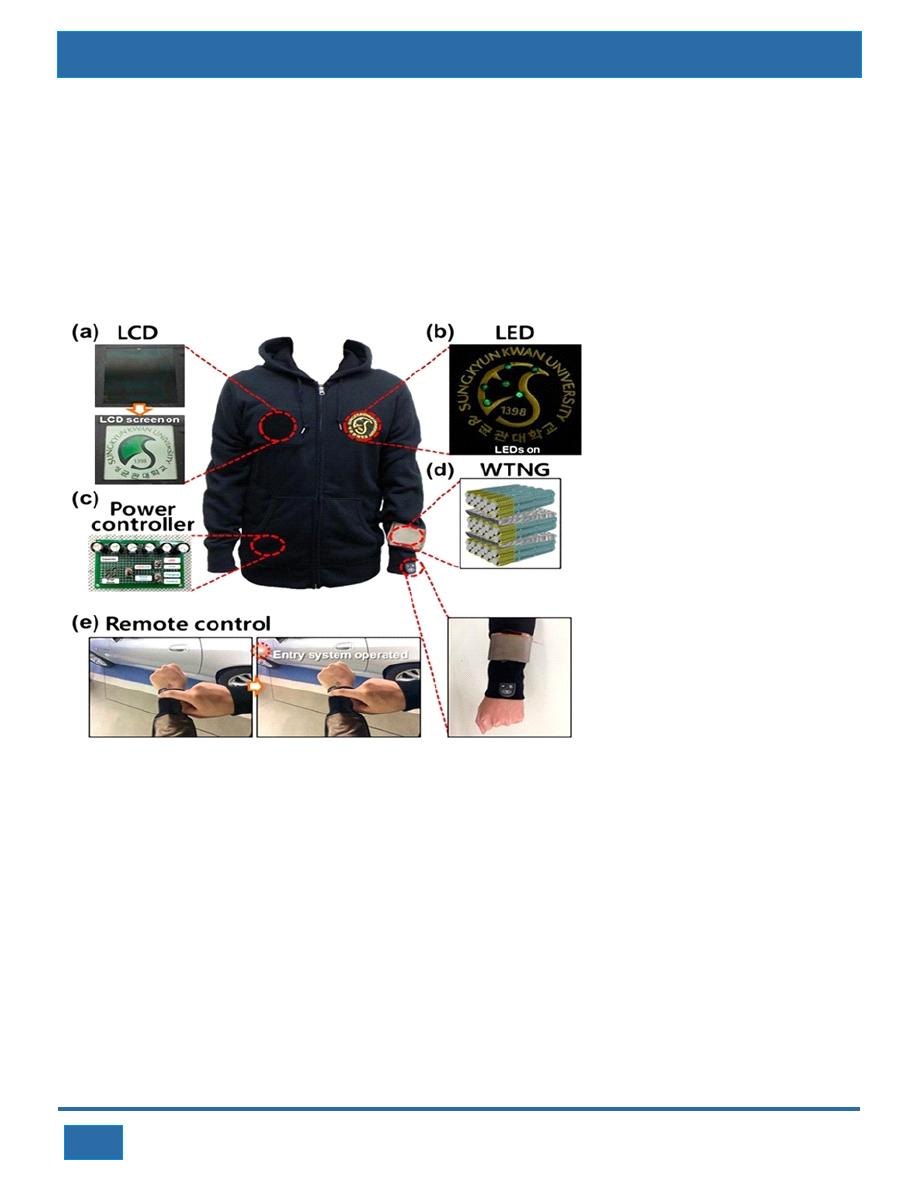
The researchers created a novel
TNG fabric out of a silvery textile
coated with nanorods and a silicon-based organic material. When they stacked four pieces of the cloth
together and pushed down on the material, it captured the energy generated from the pressure. The material
immediately pumped out that energy, which was used to power light-emitting diodes, a liquid crystal display
and a vehicle's keyless entry remote. So the researchers developed a new method of incorporating TNGs
into cloth that allows it to be chemically and physically durable, using a silverized cloth material with nanorods
and a silicon-based organic material embedded in four layers of cloth. They were able to generate a high
output voltage (up to 120V) with an output current of 65 microamperes. In tests, they found that the WTNGs
(wearable TNGs) were able to power light-emitting diodes, a liquid crystal display, and a vehicle's keyless
entry remote, and worked for more than 12,000 cycles.
Scientists at
in Korea and
in Australia
Sungkyunkwan
University
University
of Wollongong
6
Technology Roundup
Flexible Sensors Turn Skin Into a Touch-Sensitive Interaction Space
for Mobile Devices
www.cacm.acm.org/news
If a mobile phone rings during a meeting, its owner often has to dig it out before it can be muted. A more discreet
method would be to decline the incoming call by pressing on one of your fingers. Computer scientists are
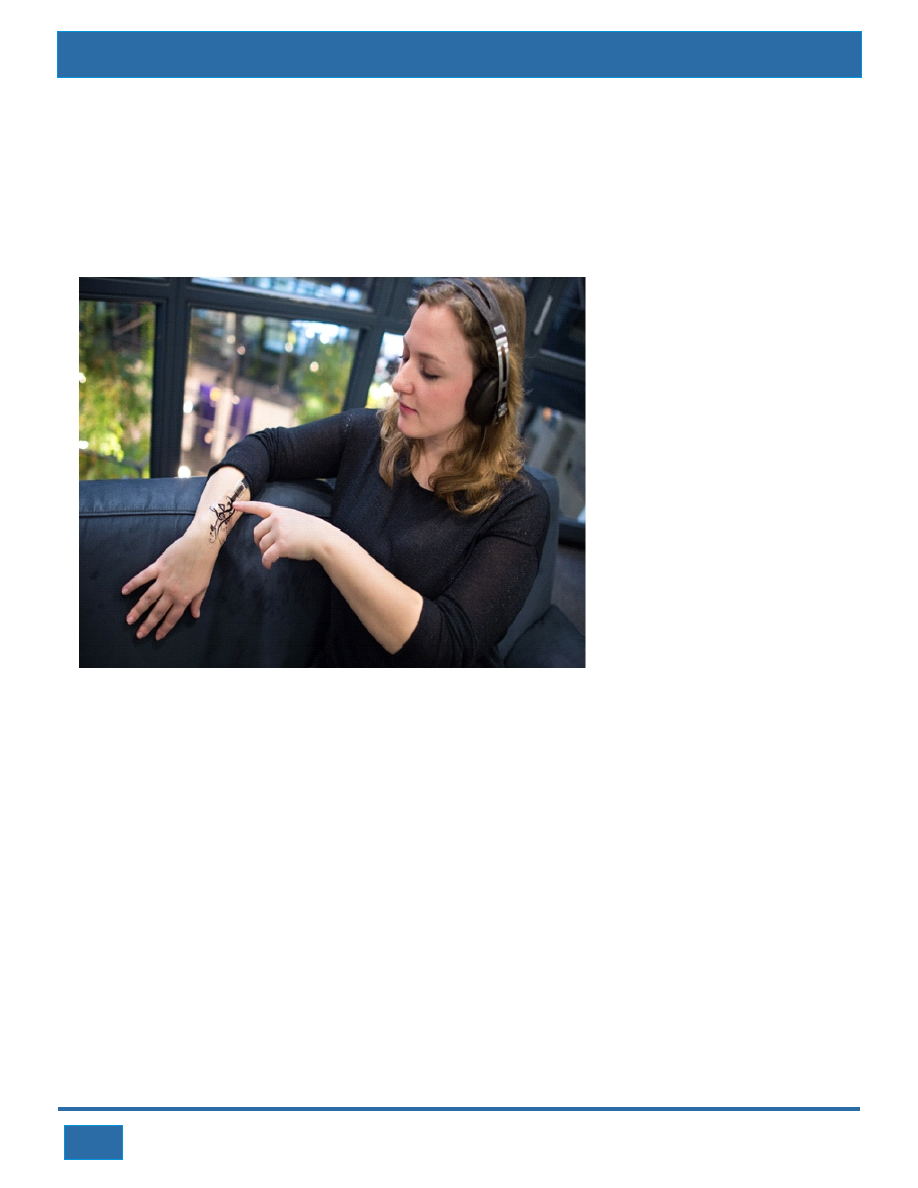
studying the potential use of the human body as a touch sensitive surface for controlling mobile devices. They
have developed flexible silicone
rubber stickers with pressure-
sensitive sensors that fit snugly to
the skin. By operating these touch
input stickers, users can use their
own body to control mobile devices.
Because of the flexible material
u s e d , t h e s e n s o r s c a n b e
manufactured in a variety of shapes,
sizes and personalized designs. A
team of computer scientists from
Saarbrücken in collaboration with
researchers from Carnegie Mellon
University in the USA have developed
touch-sensitive stickers made from
flexible silicone and electrically
conducting sensors that can be worn on
the skin.
The stickers can act as an input
space that receives and executes
commands and thus controls mobile
devices. Depending on the type of
skin sticker used, applying pressure
to the sticker could, for example, answer an incoming call or adjust the volume of a music player. 'The stickers
allow to enlarge the input space accessible to the user as they can be attached practically anywhere on the
body. The 'iSkin' approach enables the human body to become more closely connected to technology.
Users can also design their iSkin patches on a computer beforehand to suit their individual tastes. One sticker,
for instance, is based on musical notation, another is circular in shape like an LP. The silicone used to fabricate
the sensor patches makes them flexible and stretchable. 'This makes them easier to use in an everyday
environment. The music player can simply be rolled up and put in a pocket. They are also skin-friendly, as they
are attached to the skin with a biocompatible, medical-grade adhesive. Users can therefore decide where they
want to position the sensor patch and how long they want to wear it.
In addition to controlling music or phone calls, the iSkin technology could be used for many other applications.
For example, a keyboard sticker could be used to type and send message
s.
Currently the sensor stickers are
connected via cable to a computer system. According to Steimle, in-built microchips may in future allow the
skin-worn sensor patches to communicate wirelessly with other mobile devices.
7
Technology Roundup
7
Energy use in Buildings: Innovative, Lower Cost Sensors and
Controls Yield Better Energy Efficiency
www.ornl.gov/ornl
Buildings are responsible for about 40 percent of the energy consumed in the United States. Studies indicate that
advanced sensors and controls have the potential to reduce the energy consumption of buildings by 20-30
percent. Regulating comfort in small commercial buildings could become more efficient and less expensive
thanks to an innovative low-cost wireless sensor
technology being developed by researchers at
the Department of Energy's Oak Ridge National
Laboratory, USA
.
It is widely accepted that energy-consuming
systems such as heating, ventilating, and air
conditioning (HVAC) units in buildings are under,
or poorly, controlled causing them to waste
energy. Buildings could increase their energy
efficiency if control systems had access to
additional information. Collecting data such as
outside air and room temperature, humidity, light
level, occupancy and pollutants is currently cost
prohibitive, whether the information is gathered
by inexpensive conventional sensors that must
be wired, or by using today's expensive $150-
300 per node wireless sensors.
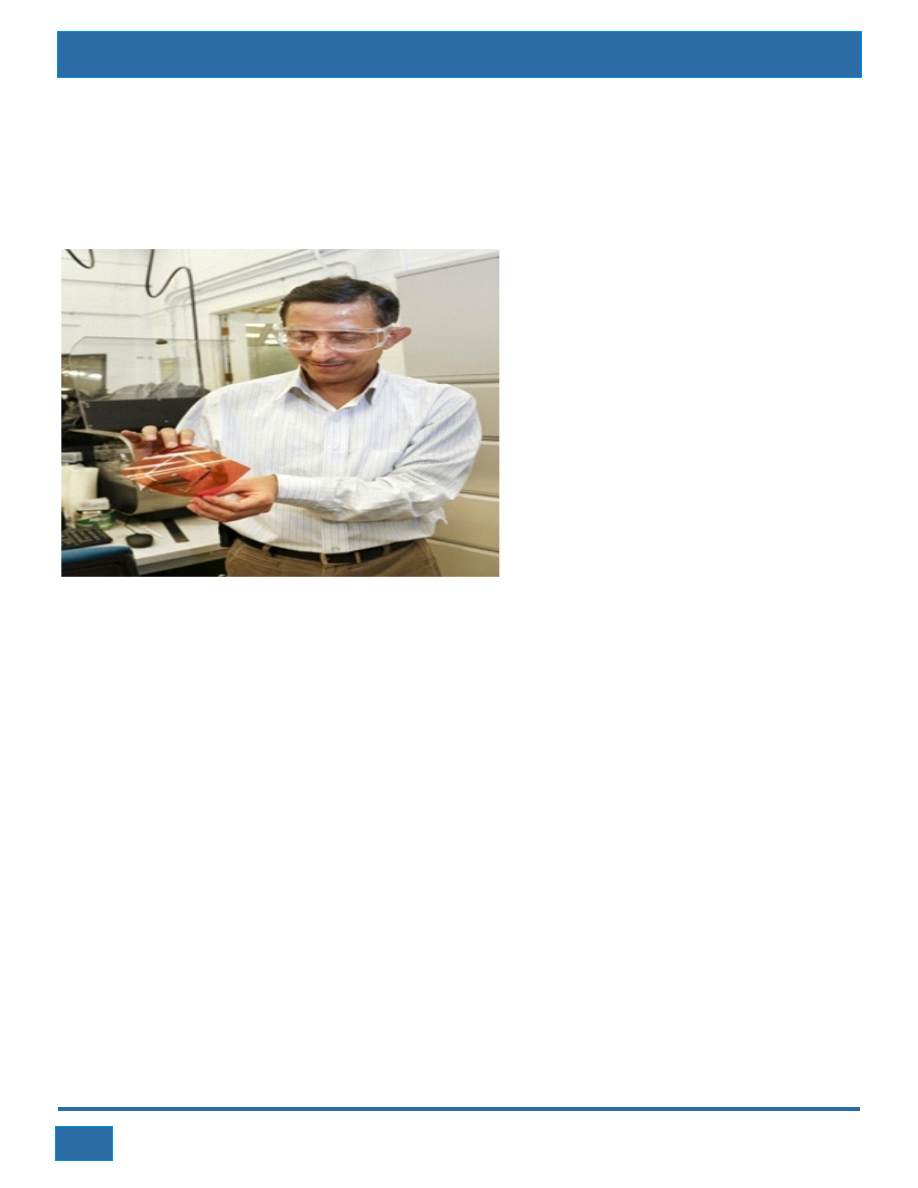
ORNL's new wireless sensor prototype could reduce costs to $1-10 per node by leveraging advanced
manufacturing techniques such as additive roll-to-roll manufacturing. This process enables electronics
components like circuits, sensors, antennae, and photovoltaic cells and batteries to be printed on flexible plastic
substrates (base materials). The nodes can be installed without wires using a peel-and-stick adhesive backing. If
commercially available at the target price point, there would be endless application possibilities where the
installed cost to improve the control of energy-consuming systems would pay for itself through lower utility bills in
only a few years.
The ultra-low power smart sensors collect and send data to a receiver, which can capture data from many
different peel-and-stick nodes and provide the information to the energy-consuming system. The more
information received, the better the building's energy management. Both new construction and retrofitted
buildings can benefit from ORNL's smart sensors. "This technology provides the information that enables
ongoing continuous commissioning, fault detection and diagnosis, and service organization notifications when
needed, ensuring optimal building system operations throughout their service life. ORNL is currently in
negotiating to establish a cooperative research and development agreement with a premier international
electronics manufacturer to make the low-cost wireless sensors commercially available.

Technology Roundup
Technology Roundup
National/International Events
th
13 International Exhibition for the Energy Industry
8th Food Technology and Machinery International Show, 2015
Food Technology Asia, 2015
Solar 2015 Conference & Expo
15th International Conference & Exhibition on Engineering Fields
International Innovation and Technology Exhibition (INOTEX 2015)
4th International Conference on Bio-Sensing Technology
CTBT: Science and Technology 2015, Conference
23-25, April, 2015
Karachi, Pakistan
Www.pogeepakistan.com
12-14, May 2015
Karachi, Pakistan
9-11 June, 2015
Karachi
Melbourne, Australia
www.enfsolar.com
1 - 5 June 2015
Leuven, Belgium
www.euspen.eu
9-12 June 2015
Tehran
10-13, May, 2015
Lisbon, Portugal
www.biosensingconference.com
22-26 June, 2015
Austria
www.ctbto.org
www.foodtechnolgyasia.com
7-8, May, 2015
www.bitcongress.com
www.foodtechnologyasia.com
Forthcoming Tech Events
8
Tech & Trade Offers
About PASTIC
PASTIC serves as a gateway for
Scientific & Technological
Information for R&D by
catering to the information
n e e d s o f r e s e a r c h e r s ,
entrepreneurs, industrialists,
educationists, policy makers
a n d p l a n n e r s t h r o u g h
anticipatory and responsive
information services.
T e c h n o l o g y I n f o r m a t i o n
Service Section of PASTIC
works exclusively for support
and promotion of technological
information on trade and
industry in the country.
“Technology Roundup” is a
news bulletin that provides
l a t e s t a n d i n n o v a t i v e
technology news, forthcoming
events, etc. It also promotes
products, technologies and
services globally in sectors
such as Agro-Industry, Bio-
Technology, Building Material,
B u s i n e s s , C h e m i c a l s ,
Electronics, Energy, Fisheries,
Food Processing, Machinery,
P a c k a g i n g , M i n i n g
Pharmaceuticals and Textiles.
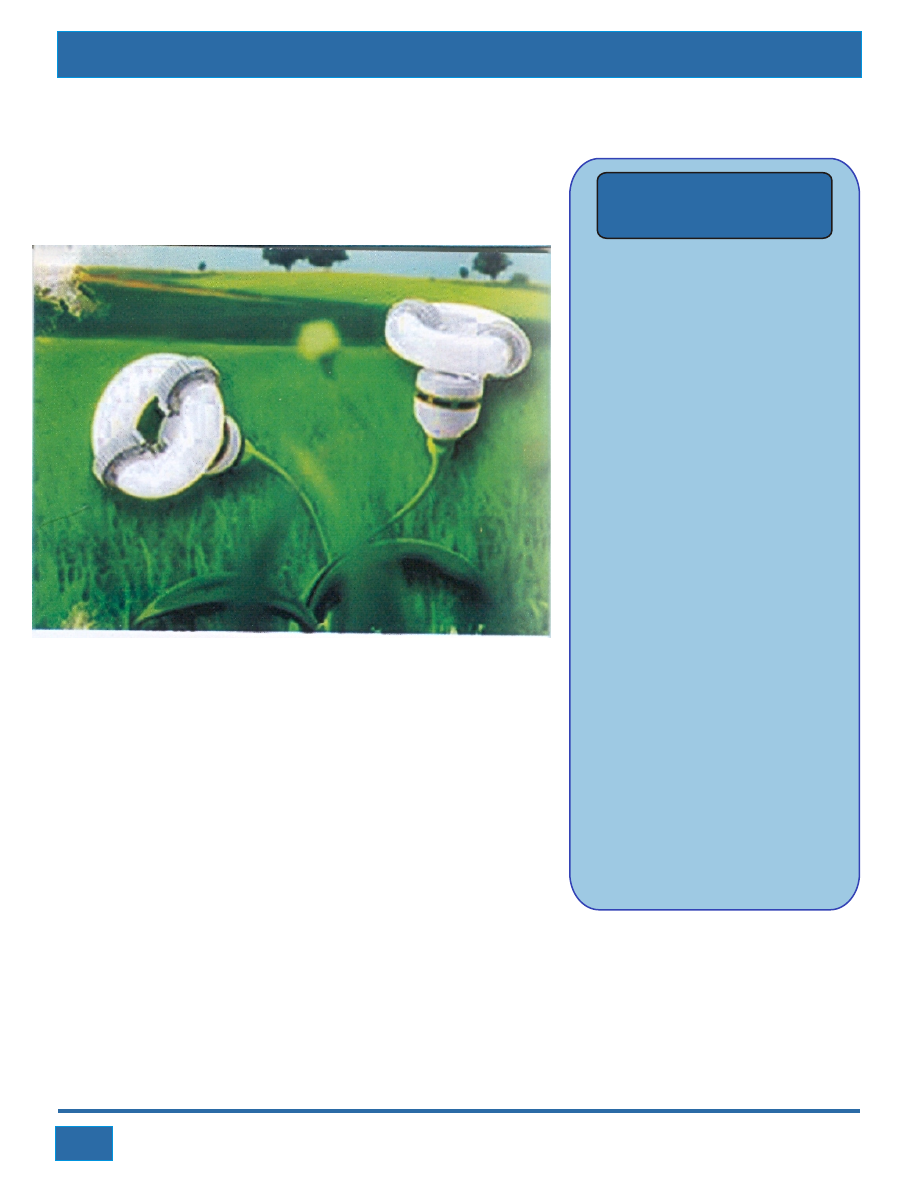
LVD Induction Lamp Technology
Save Energy Save Money
Life expectancy for these lamps is around 10,000 hours with superior lumen
maintaiance to discharge Lamps.
!
Color LVD Induction lamos have a randering index of Ra 80+ with colour
temperature of 4100K.
!
Temerature as low as -35 degree C or as high as 50 degree C.
!
Efficiency LVD Induction lamps are genearlly rated at 90 lumen per watt,
similar to coneventinal metal halide lamps, without the lumen depreciation.
!
Operating Voltage LVD Induction lamp do not drop out the way that a normal
discharge lamp does, even at 100 volts or as high as 280 volts.
!
Flexibility The LVD Induction lamp is available in several configarations and
watts, ranging from 15w,23w,40w,80w,120w,200w versions. There are versions
where the ballast is integral, or in the case of the higher E40 lamp base with remote
ballast for simple installation retrofitting.
Company Contact:-
Sharif International
Sajid Malik, Abad, 151 A, Street No.8 Chaklala,
Scheme-3,Rawalpindi, Pakistan
Tel: 92-51-5766380,5590063, Fax: 92-51-5598354
Bilal.malik@com@sharifinternational.net
www.sharifinternational.net
Technology Roundup
Please give us your feedback and address queries to editor@pastic.gov.pk
9