
Patron/Executive Editor
Dr. Muhammad Akram Shaikh
Director General, PASTIC
Managing Editors
Ms. Nageen Ainuddin
Mr. M. Aqil Khan
Editor
Dr. Saima Tanveer
Composer
Fasih ul Islam
&
M. Kashif Farooqui
T
ECHNOLOGY
R
OUNDUP
Technology Information Section (TIS)
Pakistan Scientific & Technological Information Centre
PASTIC
January-Fabruary, 2014
Vol. 6, No. 1
A NEWS BULLETIN FROM
Tech News Headlines
Tech & Trade Offers
Phone: 051-9248103-4, 9248111
Fax: 051-9248113
Email:editor@pastic.gov.pk
Web: www.pastic.gov.pk
PASTIC National Centre
Quaid-i-Azam University Campus
P.O. Box 1217, Islamabad
Editorial Board
l
Design and Implementation of GUI Based Chemical Industrial
Automation Software
l
l Vanadium Dioxide Research Opens Door to New, Multifunctional
Spintronic Smart Sensors
l Lab-on-a-Chip
l Researchers Develop First Single-Molecule LED
l Engineer Converts Yeast Cells into 'Sweet Crude' Biofuel
l Single Chip Device to Provide Real-time 3-D Images from Inside the
Heart and Blood Vessels
Solar Biogas Digester with Built-In Reverse Absorber Heater
Source International
SPORTS
INDUSTRY
SOLUTION
Forthcoming Tech Events
l
l
l
l
l
l
2nd International Conference On Business Innovation and
Management (ICBIM-2014)
International Conference on Robotics and Emerging Allied
Technologies in Engineering (iCREATE)
10th Pakistan Oil, Gas & Energy Industry Conference
10th International Conference on Web Information Systems and
Technologies (WEBIST 2014)
The International Conference of Bio-security and Bio-safety
Cell Culture Engineering XIV

Technology Roundup
Indigenous
Technology
Design and Implementation of GUI Based Chemical Industrial
Automation Software
The researchers from Department of Computer Science and Engineering, University of
Engineering and Technology, Lahore, Pakistan have developed “Design and Implementation of
GUI Based Chemical Industrial Automation Software
Chemical Industry has a great contribution in the progress and development of a country. Industrial revolution
has updated the fortune of several western countries. The computer-based management is necessary to observe
and control the operations of the chemical plants and to react to adjusting user requirement. The engineer/plant
managers are not only responsible for planning, designing, and controlling the chemical units, their job is also to
keep the plant running smoothly and efficiently, with little or no down time. Generally speaking, the functions of a
manager include installing and configuring devices, diagnosing and troubleshooting chemical processes,
controlling access to services, etc.
This work specifies a set of software tools for the site or chemical laboratory managers/operator to manage and
control the various chemical processes readings and the lab environment status like temperature, air pressure,
sunlight etc. The common problems of such chemical industrial laboratories are the management issues like fault,
manpower, configuration and performance. The proposed system may helpful to minimize the fast intensifying
equipments' cost and complexities by offering improved set of simple GUI software tools to the labs manager or
supporting workers to rapidly resolve or identify the chemical processing lab problems. Since it is a significant
requirement for the chemical lab operator and personnel resources management to control and manage the
chemical industrial plant from a central locality. So, it can also be used in critical industrial units where it is very
difficult to manually control the plant or machinery. The researcher hope that work will be found useful by both
chemical engineers and researchers, and will be used to design strategies for chemical industrial plant
management system based on the presented strategies, or at least as a reference.
This Chemical Industrial Automation Software is developed to provide a user friendly environment that could help
chemical engineers /managers to perform necessary management tasks to control and maintain the chemical
industrial plant from a central point. The system is capable of remotely configuring, managing and monitoring the
different chemical apparatus and serve as a platform for enhancement in order to develop a feature rich yet
affordable management system.
Journal of Pakistan Institute of Chemical Engineers (JPIChE), 2012 40(1): 87-91 refs 09
Courtesy:
Muhammad Junaid Arshad*, Amjad Farooq, Khadim Hussain Asif (Department of Computer Science and
Engineering, University of Engineering and Technology, Lahore, Pakistan).
2
Technology Roundup
Indigenous
Technology
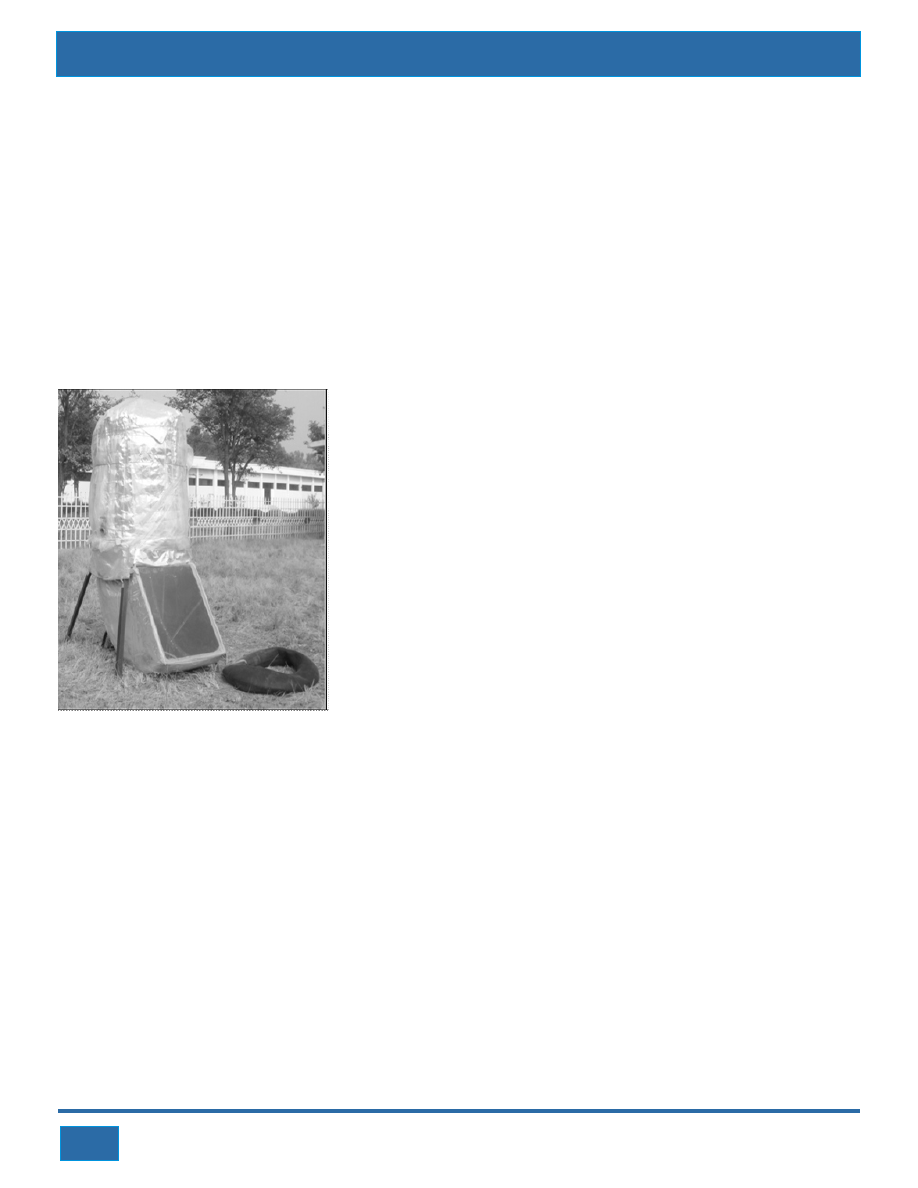
Solar Biogas Digester with Built-In Reverse Absorber Heater
The researcher from Mehran University of Engineering & Technology, Jamshoro, Pakistan have
developed Solar Biogas Digester with Built-In Reverse Absorber Heater
It is known that consuming energy is proportional to the quality or standard of life. There is a close relationship
between energy consumption and the GNP (Gross National Product). It is obvious that for further development of
the country additional sources of energy is required, which are cheap, safe and environmentally compatible with
respect to the action on possible wastes. Utilization of renewable energy is one route to help in solving the above
mentioned problems. In particular, biogas as a source of renewable energy is produced by biotechnology and used
widely on residential scale. At present biogas is used widely in some
countries for lighting, machines, and vehicles, generators, cooking and
heating. Biogas generation is suitable for small to large scale operation
and at present is realized in a number of developed and developing
countries including USA, Hungary, China, India etc. Since 1990s biogas
projects construction in China has developed steadily by the end of 1998,
there were altogether 6.88 million household biogas digesters. In Russia
biogas digesters are used for processing of hard dung into biogas.
In this study the design, fabrication and investigation of a solar biogas
digester with built-in RAH (Reverse Absorber Heater) is presented. The
maximum temperature (500°) inside of the methane tank was taken as a
main parameter at the design of the digester. Using energy balance
equation for the case of a static mass of fluid being heated; the parameters
of thermal insulation of the methane tank were counted. The biogas
digester is consisting of methane tank with built-in solar RAH to utilize
solar energy for the heating of the slurry prepared from the different
organic wastes (dung, sewage, food wastes etc). The methane tank was
filled up to 70% of volume by organic wastes of the GIK Institute sewage,
firstly, and secondly, by sewage and cow dung as well.
The solar irradiance incident to the absorber, slurry's temperature and ambient temperature were measured. It
was found that using sewage only and sewage with cow dung the retention times was 4 weeks and two weeks
respectively and biogas quantity produced was 0.4 and 8.0 m³ respectively. In addition, biogas up gradation
scheme for removal of carbon dioxide, hydrogen sulphide and water vapor from biogas and conversion of biogas
energy conversion into electric power is also worked out.
The biogas digester with built-in solar reverse absorber heater is presented where reverse absorber heater is
installed under the methane tank. The temperature of the slurry-solar irradiance and ambient temperature
relationships experimentally were investigated. The biogas up gradation scheme for removal of carbon dioxide,
hydrogen sulphide and water vapor from biogas and conversion of biogas energy conversion into electric power
are also worked out.
Courtesy:
KHASAN S. KARIMOV*, AND MUHAMMAD ABID (Mehran University Research Journal of Engineering &
Technology, Jamshoro, Pakistan ).
Science, Technology and Development, 2012 32(1): 39-46 refs09
3
4
Technology Roundup
Vanadium Dioxide Research Opens Door to New, Multifunctional Spintronic Smart
Sensors
New research findings from a team led by North Carolina State University open the door to smarter sensors by integrating
vanadium dioxide (V
) onto a silicon chip and using lasers to make the material magnetic. The advancement paves the way
for multifunctional spintronic smart sensors for use in military applications and next-generation spintronic devices.
V
is currently used to make infrared sensors. By integrating V
as a single crystal onto a silicon substrate, the researchers
have made it possible to create infrared smart sensors, in which the sensor and computational function are embedded on a
single chip. This makes the sensor faster and more energy efficient, since it doesn't have to send data to another chip to be
processed. Smart sensors are also lighter than conventional ones, since separate chips aren't necessary.
This research work achieves military applications, sensor technology that needs to be able to sense, manipulate, and respond
to data quickly. In addition, the researchers used high-power nanosecond-pulsed laser beams to modify the Vo² and make it
magnetic. This will allow the creation of spintronic smart sensors that incorporate infrared sensors and magnetic sensors on a
single chip. Spintronics refers to technologies used in solid-state devices that take advantage of the inherent spin in electrons
and their related magnetic momentum. The potential advantages of spintronics include higher memory capacity, faster data
transfer and more computational power on a computer chip.
O
2
O
O
2
2
Www.news.ncsu.edu
Lab-on-a-Chip
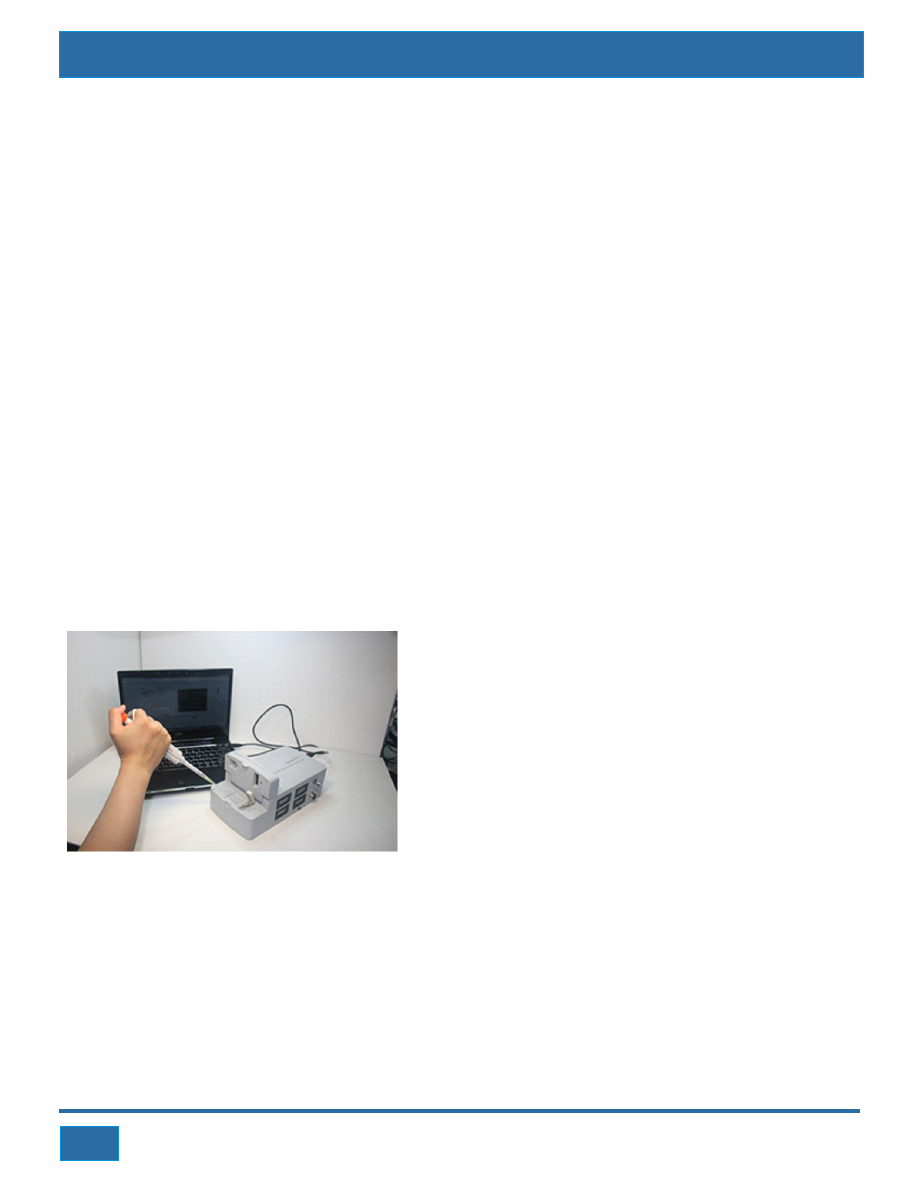
A portable instrument that replaces a full-size laboratory provides accurate multi-element analysis in less than a minute.
Engineers from the A*STAR Institute of Materials Research and
Engineering and their colleagues at the University of Basel,
Switzerland, have designed and developed a compact, portable
analytical instrument that can detect multiple ions and molecules down
to a level of 300 parts per billion (ppb) in less than a minute.
The machine, based on lab-on-a-chip technology, needs only drop-
sized liquid samples. The analysis is very quick, precise and sensitive,
and can be performed remotely as no direct contact with the solution is
necessary. As such, the device has widespread potential applications in
the water, food and beverage, agriculture, environmental,
pharmaceutical and medical industries. The instrument is now ready
for commercialization, as it is one of only a handful of actual lab-on-a-
chip instruments reported so far.
The easy-to-operate machine, which weighs only 1.2 kg, combines microchip electrophoresis (MCE) with a sensing
technology known as a dual capacitively-coupled contactless conductivity detector (dC4D). The system first uses
electrophoresis to separate ions and then detects the ions using dC4D. All analyses are performed in microfluidic channels
consisting of capillaries inside polycarbonate plastic chips that are narrower than a human hair.
The beauty of the dC4D technology is its simplicity. It relies on remote conductivity measurements via a pair of electrodes.
One electrode sends radio-frequency signals through a channel to the second electrode, and the signal received is read by a
computer. Because the ions have charge, their resistance drops as they pass through the microfluidic channel, resulting in
sudden peaks. Specially designed software then analyzes the data to provide both qualitative and quantitative information.
5
Technology Roundup
The instrument has two access compartments. The front compartment houses a plastic chip and a replaceable cartridge
detector for the testing; both are designed to eliminate noise. The back compartment houses the electronics and software, the
data acquisition card and a battery that powers the instrument for up to 10 hours.
The researchers tested the instrument's capability to measure inorganic ions in water, rabbit blood and human urine, as well
as organic and inorganic acids in fruit juice. They assessed its accuracy against standard methods. The researchers have
approached about licensing the technology by several companies active in clinical analyses and in the ornamental fish farm
industry. They are hoping to further develop their system to achieve detection levels lower than 1 ppb by pre-concentrating
the samples; they are also planning to introduce nanofluidics into the dC4D system.
www.research.a-star.edu.sg
Researchers Develop First Single-Molecule LED
The ultimate challenge in the race to miniaturize light emitting diodes (LED) has now
been met. A team led by the Institut de Physique et de Chimie des Matériaux de
Strasbourg (IPCMS, CNRS/Université de Strasbourg), in collaboration with UPMC
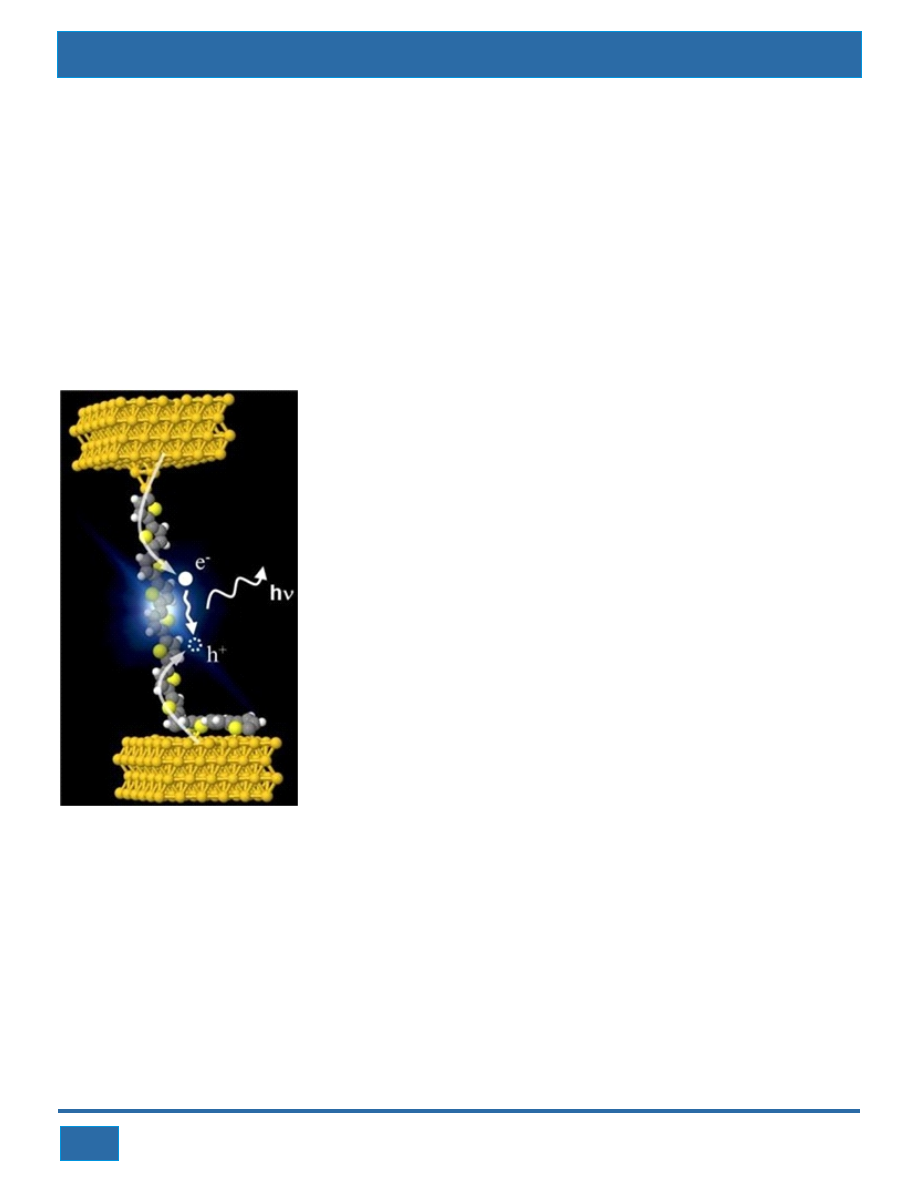
and CEA, has developed the first ever single-molecule LED. The device is formed
from a single polythiophene wire placed between the tip of a scanning tunneling
microscope and a gold surface. It emits light only when the current passes in a certain
direction. This experimental tour de force sheds light on the interactions between
electrons and photons at the smallest scales. Moreover, it represents yet another step
towards creating components for a molecular computer in the future.
Light emitting diodes are components that emit light when an electric current passes
through them and only let light through in one direction. LEDs play an important role
in everyday life, as light indicators. They also have a promising future in the field of
lighting, where they are progressively taking over the market. A major advantage of
LEDs is that it is possible to make them very small, so point light sources can be
obtained. With this in mind, the researchers have produced the first ever single-
molecule LED.
To achieve this, scientists used a single polythiophene wire. This substance is a good
electricity conductor. It is made of hydrogen, carbon and sulfur, and is used to make
larger LEDs that are already in the market. The polythiophene wire was attached at one end to the tip of a scanning tunneling
microscope, and at the other end to a gold surface. The scientists recorded the light emitted when a current passed through this
nanowire. Scientists observed that the thiophene wire acts as a light emitting diode: light was only emitted when electrons
went from the tip of the microscope towards the gold surface. When the polarity was reversed, light emission was negligible.
The researchers showed that this light was emitted when a negative charge (an electron) combined with a positive charge (a
hole) in the nanowire and transmitted most of its energy to a photon. For every 100,000 electrons injected into the thiophene
wire, a photon was emitted. Its wavelength was in the red range.
The researchers also envision its other potential applications in the foodstuffs industry. In the future, color indicator systems
integrated into foils or bottle closures are intended to make the quality status of the packaged foods visible. Because the sell-

3
6
Technology Roundup
by date does not represent a guarantee of any kind. Food stuffs may often spoil prematurely unnoticed by the consumer due
to a packaging error, or in the warehousing, or due to disruptions in the refrigeration chain. Oil-based and fat-containing
products are specifically prone to this, as are meats, fish and ready meals.
From a fundamental viewpoint, this device gives researchers a new tool to probe phenomena that are produced when an
electrical conductor emits light and it does so at a scale where quantum physics takes precedence over classical physics.
Scientists will also be able to optimize substances to produce more powerful light emissions. Finally, this work is a first step
towards making molecule-sized components that combine electronic and optical properties. Similar components could form
the basis of a molecular computer.
www.sciencedaily.com
Engineers Converts Yeast Cells into 'Sweet Crude' Biofuel
Researchers at The University of Texas at Austin's
Cockrell School of Engineering have developed a new
source of renewable energy, a biofuel, from genetically
engineered yeast cells and ordinary table sugar. This
yeast produces oils and fats, known as lipids,that can be
used in place of petroleum-derived products.
The researchers created the new cell-based platform
given that the yeast cells grow on sugars and the biofuel
produced by this process is called a renewable version of
sweet crude. The researchers' platform produces the
highest concentration of oils and fats reported through
fermentation, the process of culturing cells to convert sugar into products such as alcohol, gases or acids. The research team
was able to rewire yeast cells to enable up to 90 percent of the cell mass to become lipids, which can then be used to produce
biodiesel.
In many industrial biochemical processes lipid produced in such a high concentration that could theoretically be used to
power a car. Since fatty materials are building blocks for many household products, this process could be used to produce a
variety of items made with petroleum or oils i.e. from nylon to nutrition supplements to fuels. Biofuels and chemicals
produced from living organisms represent a promising portion of the renewable energy market. The researchers took a
starting yeast strain of Yarrowia lipolytica, and convert it into a factory for oil directly from sugar. This work opens up a new
platform for a renewable energy and chemical source. The biofuel they formulated is similar in composition to biodiesel
made from soybean oil. The advantages of using the yeast cells to produce commercial-grade biodiesel are that yeast cells
can be grown anywhere, do not compete with land resources and are easier to genetically alter than other sources of biofuel.
By genetically rewiring Yarrowia lipolytica, the researchers have created a near-commercial biocatalyst that produces high

7
Technology Roundup
levels of bio-oils during carbohydrate fermentation. This is a remarkable demonstration of the power of metabolic
engineering. So far, high-level production of biofuels and renewable oils has been an elusive goal, but the researchers believe
that industry-scale production is possible with their platform.
The team increased lipid levels by nearly 60-fold from the starting point. At 90 percent lipid levels, the platform produces
the highest levels of lipid content created so far using a genetically engineered yeast cell. To compare, other yeast-based
platforms yield lipid content in the 50 to 80 percent range. However, these alternative platforms do not always produce lipids
directly from sugar as the UT Austin technology does. The research team is continuing to find ways to further enhance the
lipid production levels and develop new products using this engineered yeast.
www.esciencenews.com
Single Chip Device to Provide Real-time 3-D Images from Inside the Heart and
Blood Vessels
Researchers from George W. Woodruff School of Mechanical Engineering at
the Georgia Institute of Technology have developed the technology for a
catheter-based device that would provide forward-looking, real-time, three-
dimensional imaging from inside the heart, coronary arteries and peripheral
blood vessels. With its volumetric imaging, the new device could better guide
surgeons working in the heart, and potentially allow more of patients' clogged
arteries to be cleared without major surgery.
The device integrates ultrasound transducers with processing electronics on a
single 1.4 millimeter silicon chip. On-chip processing of signals allows data from more than a hundred elements on the device
to be transmitted using just 13 tiny cables, permitting it to easily travel through circuitous blood vessels. The forward-looking
images produced by the device would provide significantly more information than existing cross-sectional ultrasound.
Researchers have developed and tested a prototype able to provide image data at 60 frames per second, and plan next to
conduct animal studies that could lead to commercialization of the device. The device will allow doctors to see the whole
volume that is in front of them within a blood vessel. This will give cardiologists the equivalent of a flashlight so they can see
blockages ahead of them in occluded arteries. It has the potential for reducing the amount of surgery that must be done to clear
these vessels.
The single chip device combines capacitive micromachined ultrasonic transducer (CMUT) arrays with front-end CMOS
electronics technology to provide three-dimensional intravascular ultrasound (IVUS) and intracardiac echography (ICE)
images. The dual-ring array includes 56 ultrasound transmit elements and 48 receive elements. When assembled, the donut-
shaped array is just 1.5 millimeters in diameter, with a 430-micron center hole to accommodate a guide wire. Power-saving
circuitry in the array shuts down sensors when they are not needed, allowing the device to operate with just 20 milliwatts of
power, reducing the amount of heat generated inside the body. The ultrasound transducers operate at a frequency of 20
megahertz (MHz). Imaging devices operating within blood vessels can provide higher resolution images than devices used

from outside the body because they can operate at higher frequencies. But operating inside blood vessels requires devices
that are small and flexible enough to travel through the circulatory system. They must also be able to operate in blood
Www.news.gatech.edu
Technology Roundup
8
Forthcoming Tech Events
National
International Conference on Robotics and Emerging Allied Technologies in
Engineering (iCREATE)
Www.allconferencealerts.com
2nd International Conference on Business Innovation and Management
ICBIM-2014
Www.allconferencealerts.com
10th Pakistan Oil, Gas & Energy Industry Conference
Www.oilcouncil.com
International
10th International Conference on Web Information Systems and Technologies
(WEBIST 2014)
www.wonference.com
The International Conference of Bio-security and Bio-safety
Www.nature.com
Cell Culture Engineering XIV
www.conferencealerts.com
22 - 24 April, 2014
Islamabad, Pakistan.
26 - 27 April, 2014
Islamabad, Pakistan.
29th May, 2014
Karachi, Pakistan.
03 -05, April 2014
Barcelona, Spain
5th - 7th May, 2014
Giza, Egypt
04th - 09th May, 2014
Quebec , Canada

Technology Roundup
Tech & Trade Offers
About PASTIC
PASTIC serves as a gateway for
Scientific & Technological
Information for R&D by
catering to the information
n e e d s o f r e s e a r c h e r s ,
entrepreneurs, industrialists,
educationists, policy makers
a n d p l a n n e r s t h r o u g h
anticipatory and responsive
information services.
T e c h n o l o g y I n f o r m a t i o n
Service Section of PASTIC
works exclusively for support
and promotion of technological
information on trade and
industry in the country.
“Technology Roundup” is a
news bulletin that provides
l a t e s t a n d i n n o v a t i v e
technology news, forthcoming
events, etc. It also promotes
products, technologies and
services globally in sectors
such as Agro-Industry, Bio-
Technology, Building Material,
B u s i n e s s , C h e m i c a l s ,
Electronics, Energy, Fisheries,
Food Processing, Machinery,
P a c k a g i n g , M i n i n g
Pharmaceuticals and Textiles.
Please give us your feedback and address queries to editor@pastic.gov.pk
9
SOURCE INTERNATIONAL
Sports Industry Solution
Dealer:
VIPER Extreme
Dye Sublimation Printers
l
High speed, high volume sublimation inkjet
printers
l
Print on the thinnest transfer papers and on closed
polyester fabrics
l
Reliable high speed production thanks to
mechanical robustness, 8 print heads and Mutoh’s
exclusive i2 Intelligent Interweaving print
technology
l
Production speed up to 37 m²h with crisp, clean
images ready for after-treatment
l
Top speed up to 77 m²h, with continuous ink
supply option for longer runs
l
Deep & vivid colours from Mutoh water-based
sublimation inks
Company Contact: Source International
Mehmood Siddiqui (Manager)
Tel:092-0300-2197723, 021-5312100, Fax: 092-021-5312099
E-mail: source@khi.wol.net.pk
Address: 1st Floor, 10-C, 24th Commercial Street, Phase 2, Extn. D.H.A.,
Karachi.